
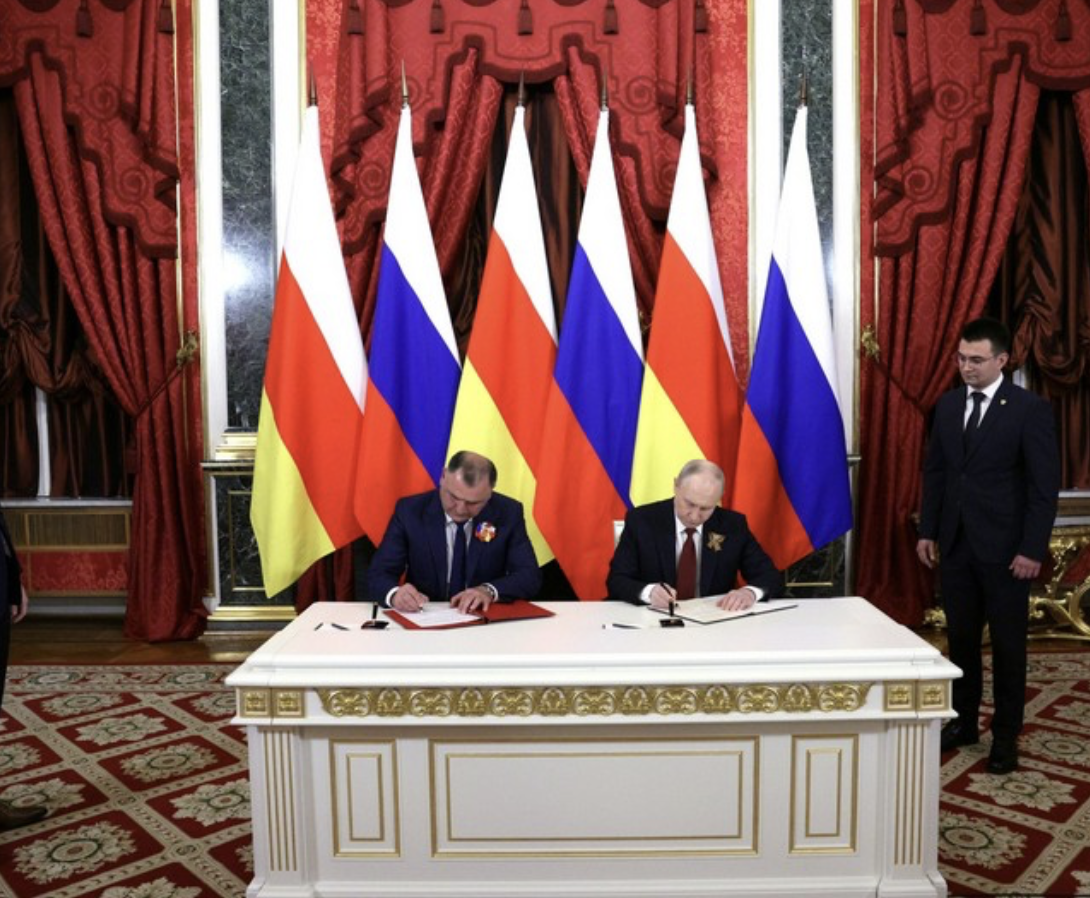
On 9 May, marking the 81st anniversary of victory in the “Great Patriotic War” (a term used in Russia and several former Soviet countries to refer to the 1941–1945 war between Nazi Germany and its allies and the Soviet Union), Alan Gagloev, the de facto President of Georgia’s Russian-occupied Tskhinvali region, the so-called Republic of South Ossetia, and Russian President Vladimir Putin, signed an agreement “On Deepening Allied Cooperation.”
The signing of the agreement, which was described in Tskhinvali as a “historic event,” raised concerns regarding the possible annexation of the Tskhinvali region by Russia.
Signing and Ratification of the 9 May Agreement
On 9 May 2026, during a visit to Moscow, the de facto President of the occupied Tskhinvali region, Alan Gagloev, met with Russian President Vladimir Putin. Following the meeting, Gagloev and Putin signed the agreement “On Deepening Allied Cooperation.” According to Tskhinvali’s assessment, the agreement is strategic in nature and defines key directions for interaction between the parties in the fields of security, economy, and social development. The document also envisages the gradual formation of a unified economic space, harmonisation of legal systems, infrastructure development, and the expansion of interaction in the social, labour, and humanitarian spheres.
On 10 May, Putin submitted the agreement to the State Duma for ratification, and appointed Russian Deputy Foreign Minister Aleksandr Alimov as his official representative in the ratification process. The State Duma ratified the agreement on 13 May, while the Federation Council did so on 20 May. On 25 May, Putin signed the law on ratification of the agreement. For his part, Gagloev submitted the agreement to the de facto parliament on 14 May, which ratified it on 21 May. On the same day, Gagloev signed the “constitutional law” on ratification of the agreement.
Following the 2008 Russia–Georgia war and Russia’s recognition of the independence of the so-called Republic of South Ossetia (Tskhinvali region), more than 100 bilateral agreements were signed between Russia and the occupied region. Among them, two particularly important agreements should be highlighted, as they established the legal and political framework for the development of bilateral relations.
Shortly after the Russia–Georgia war, on 17 September 2008, Moscow and Tskhinvali signed the “Agreement on Friendship, Cooperation and Mutual Assistance between the Republic of South Ossetia and the Russian Federation.” The agreement consists of 31 articles and defines the framework of cooperation. It was the first framework agreement upon which the subsequent bilateral treaty base was built.
No less important was the “Agreement on Alliance and Integration,” signed on 18 March 2015, which consists of 15 articles, and covers specific areas of cooperation and integration. It is noteworthy that the title of the analogous agreement signed with occupied Abkhazia in 2014 does not contain the word “integration,” and focuses only on alliance and strategic cooperation. The 9 May agreement is based precisely on the two agreements from 2008 and 2015.
Details of the 9 May Agreement
The 9 May agreement consists of 16 articles.
The first article is general in nature and envisages the “expansion of cooperation” between Russia and the occupied Tskhinvali region “for the purpose of ensuring regional peace and stability; implementing coordinated policies in the fields of defence, security and foreign policy (including improving border control on the Russia–South Ossetia state border [meaning the section of the Russia–Georgia state border not controlled by official Tbilisi]); improving socio-economic conditions; developing infrastructure and human potential; harmonising legal norms; and creating favourable conditions for the free movement of capital, goods, services, and labour between the contracting parties.”
Since the 2008 Russia–Georgia war, the Tskhinvali region has been entirely dependent on Russia. The region’s security is ensured by Russia’s 4th military base, while the occupation line is “guarded” by the Border Directorate of the Russian Federal Security Service, which is involved in the process of “borderisation” and the detention/abduction of Georgian citizens from areas adjacent to the occupation line. Unlike occupied Abkhazia, the Tskhinvali region has practically none of its own “armed forces,” as, since 2008, their number has been reduced to a minimum.
The Tskhinvali region’s “foreign policy” activity also depends on Russian diplomatic, financial, and logistical support. Through Russian efforts, the independence of the so-called “Republic of South Ossetia” has been recognised by five UN member states, including Russia. However, apart from Russia, Tskhinvali has no representative offices in any of these countries. The foreign visits of representatives of the de facto authorities depend on Russian diplomatic and logistical support.
Economic and trade relations in the Tskhinvali region are underdeveloped, and the region’s economic activity and infrastructure projects depend on Russian financial support. The region’s “budget” is practically entirely financed by Russia, while salaries and pensions are dependent on Russian subsidies.
According to the second article, Russian citizens “may occupy state and municipal positions” in the occupied Tskhinvali region, and vice versa. However, this has not been an obstacle in practice even before now. The de facto prime ministers of the Tskhinvali region have already included Russian citizens: Yuri Morozov served as de facto prime minister from 2005 to 2008, including during the August 2008 war, while Vadim Brovtsev held the position from 2009 to 2012, and also served as acting de facto president from 11 December 2011 to 19 April 2012. In addition, it is common practice to appoint Russian citizens with military backgrounds as heads of the de facto defence and security agencies. Since 2004, the de facto defence ministers have mostly been Russian military officers. Since 2 June 2025, the de facto defence minister has been Russian officer Lieutenant General Yuri Yarovitsky, and since 21 July 2025, Yuri Kadii, linked to the Russian Federal Security Service, has headed the so-called State Security Committee. This article may also open the way for Russia to “send” a candidate from Russia for the illegitimate presidential elections planned in the Tskhinvali region in 2027.
According to the third article, the parties shall ensure equal rights for citizens to acquire, possess, use, and dispose of property. This article will allow Russian citizens to purchase property in the Tskhinvali region, although to date there has been relatively little demand for this, unlike in Abkhazia, where Russian citizens and businesses show strong interest in purchasing real estate.
The fourth article concerns the protection of entrepreneurs’ rights, while the fifth concerns the mutual recognition of documents issued by state and local self-government bodies.
According to the sixth article, unification must take place in the areas of labour, social protection, and pension legislation. Pensioners residing in the Tskhinvali region have long been receiving Russian pensions. Since 2025, the representative office of the Russian “Promsvyazbank” in Tskhinvali has been responsible for distributing Russian pensions. At the same time, Russian citizens temporarily or permanently residing in the Tskhinvali region are also eligible to receive Russian mandatory medical insurance.
The seventh article concerns the protection of human rights and freedoms.
According to the eighth article, in order to improve the population’s standard of living, a unified economic space should be ensured, within which unification should take place in legislation regulating economic activity, as well as in civil and tax legislation. The approximation of key social and macroeconomic indicators should also be ensured. The socio-economic situation of the population of the Tskhinvali region is entirely dependent on Russia, since, under conditions of minimal local economic relations, income generated from economic activities is insignificant. As a result, the local “state budget” is entirely dependent on Russian subsidies, infrastructure projects are implemented within the framework of investment programs financed by the Russian budget, and Russia also provides pensions and salary supplements. For example, between 2008 and 2022, Russia allocated 100.4 billion Russian roubles in financial assistance to the Tskhinvali region. However, Russian financial assistance is considerably greater, since these figures do not include funds allocated to eliminate the energy deficit, or pension expenditures for Russian citizens residing in the region.
According to the ninth article, the parties should facilitate the transition to a unified framework for external borrowing and foreign investment, and create a favourable environment for investors.
According to the tenth article, energy systems (including gas transportation), transportation, communications, and telecommunications systems should be unified. In reality, the occupied Tskhinvali region is already fully dependent on Russia in these areas. Since 2009, the region has been supplied with Russian gas through the Dzuarikau–Tskhinvali gas pipeline. Russia is also the sole source of electricity, fuel, telephone communication, and internet access. The only functioning road connecting the region with the outside world is the Transcaucasian Highway (Transkam), which links the Tskhinvali region with Russia. There are frequent cases when electricity supply, telephone communications, or internet connections in the region are completely disrupted due to climatic or technical incidents occurring on Russian territory.
According to the eleventh article, coordinated social policy should be implemented, and access to medical services for the population should be increased. This constitutes a particularly serious challenge for the region, since the local medical infrastructure cannot meet the needs of the population. As a result, in serious medical cases, patients prefer treatment in territory controlled by Georgia. Russia, in this regard, seeks either to develop medical infrastructure locally or to provide treatment for patients in Russia, which in many cases is currently associated with time, expenses, and additional bureaucracy.
According to the twelfth article, coordinated educational and vocational training programs should be implemented. Russia has for years supplied schools in the occupied region with Russian-language textbooks, and quotas have been allocated for local youth in Russian higher education institutions.
According to the thirteenth article, cultural ties should be expanded and joint cultural, mass, and sporting events should be organised.
The fourteenth article states that the agreement is not directed against third countries.
The fifteenth and sixteenth articles are technical in nature and concern amendments to the agreement and ratification procedures.
It is noteworthy that while the 2015 Agreement on Alliance and Integration was prepared in two languages, Russian and Ossetian, the 9 May 2026 agreement was prepared only in Russian.
Russia’s Foreign Policy Concept and the Emphasis on Integration
In the context of the 9 May agreement, Russia’s 2023 Foreign Policy Concept, adopted after the start of Russia’s full-scale military aggression against Ukraine, is particularly noteworthy. Unlike the 2013 and 2016 concepts, the 2023 conceptintroduces changes in the section concerning the occupied regions. In the new concept, Russia gives priority importance (Chapter V, Regional Directions of the Foreign Policy of the Russian Federation, Near Abroad, Article 49, Paragraph 8) to the “comprehensive support of the Republics of Abkhazia and South Ossetia in realising the voluntary choice made by the peoples of these countries in favour of deepening integration with Russia, based on international law.” The word “integration” appeared for the first time in the 2023 concept, which constitutes the principal difference from the 2013 and 2016 concepts. According to those earlier concepts, Russia’s priority was “supporting the Republics of Abkhazia and South Ossetia in establishing themselves as modern democratic states, strengthening their international positions, and ensuring reliable security and socio-economic recovery.”
The mention of the word “integration” in the concept generated certain fears in Abkhazia, where excessive integration into Russia’s legal-political space is viewed as a threat to the construction of an independent state. In contrast, in the Tskhinvali region, there is full consensus regarding the deepening of integration processes with Russia.
How the 9 May Agreement Was Assessed in Tskhinvali
In the Tskhinvali region, both the signing of the 9 May agreement and its subsequent ratification received unequivocally positive assessments. The prevailing sentiment was that this was a historic event and another step forward towards unification with Russia.
According to de facto President Alan Gagloev, the agreement confirms that “our close allied relations are moving to a new stage of development.” He described the document as “another step towards the rapprochement of our countries and peoples.” Prior to ratification, he also addressed the de facto parliament and emphasised the prospect of uniting the Ossetian people within a single state.
Following ratification by the de facto parliament, both current and former de facto presidents who personally attended the session expressed unanimity. The only exception was the first de facto president, Ludvig Chibirov, who was unable to attend due to poor health.
According to Gagloev, “we built our future together with the great ‘derzhava,’ the Russian Federation. It should be noted that in South Ossetia, the Russian Federation is perceived as our great homeland. This is the key, most important, and principal issue.”
According to Eduard Kokoity (de facto president from 2001–2011), “we are destined to remain together with Russia, destined to unite our small people. If someone does not understand this, that is their problem. Because of ambitions, we should never bring these disagreements to the political level.” According to Kokoity, “South Ossetia remains an independent state, and all key decisions are made only by the people living in the republic.”
According to Leonid Tibilov (de facto president from 2012–2017), “despite certain contradictions that exist both in society and political circles, today we saw unity in parliamentary circles.” He noted, “the most important thing is that we must have a unified foreign policy with Russia. Judging by the content of the document, in the future we will speak about a unified economic space, as well as a unified contour of security and defence for our country.”
According to Anatoly Bibilov (de facto president from 2017–2022), “despite existing political differences, parliamentarians managed to find common ground in the interests of the state.” Bibilov is in conflict with Gagloev, and, since 2022, has remained in territories occupied by Russia in Ukraine. However, his arrival in Tskhinvali for this occasion indicates that the de facto leaders of the occupied region are united regarding relations with Russia.
According to the pro-Gagloev party Nykhas, “the new agreement represents an important stage in the further development of allied relations between the two countries. The agreement creates a foundation for joint work in the social sphere, economy, healthcare, education, infrastructure, and security.” According to Zita Besaeva, leader of the party faction and deputy speaker of the de facto parliament, the agreement is “a roadmap initiating the process of bringing living standards in South Ossetia into line with Russian standards.”
According to the main opposition party in the occupied region, United Ossetia, “the formation of unified and understandable rules of interaction creates further opportunities for attracting investment and long-term economic development.” According to the party leader Atsamaz Bibilov, “the agreement creates a foundation for the systemic development of the economy and the establishment of clearer rules for interaction with Russia.”
According to Taymuraz Tatdaev, deputy speaker of the de facto parliament and leader of the Communist Party faction, “particular importance is attached to the article concerning the consideration of labour seniority of South Ossetian residents in the process of establishing pension rights.” According to the Communist Party’s assessment, “the agreement corresponds to the national interests of the people of South Ossetia.”
According to Sergei Kharebov, leader of the People’s Party faction and deputy speaker of the de facto parliament, “the agreement has fundamental significance for the stable functioning and development of South Ossetia.”
A widespread opinion in the Tskhinvali region is that the new agreement creates prospects either for joining the Russia–Belarus Union State or for entering the Russian Federation, similar to the way Russia annexed regions of Ukraine. However, joining the Union State would require Belarus to recognise the so-called Republic of South Ossetia, which has not happened to date.
The Failed 2022 Referendum
The issue of joining Russia last became especially relevant during the illegitimate presidential elections of 2022, when the referendum announced by de facto President Anatoly Bibilov was cancelled following Alan Gagloev’s victory.
Gagloev adopted a cautious approach to the issue. On the one hand, he claimed that Bibilov’s announcement of the referendum was a false political act intended to deceive voters, and on the other, he emphasised that unification with Russia was the historical choice of the Ossetian people, although, in his words, full integration required appropriate readiness.
At the public level, the Kremlin did not support the holding of a referendum. Opinions were voiced that the referendum was rushed, and required “additional wording.” Kremlin spokesperson Dmitry Peskov stated that further work on the referendum’s wording was necessary because it created “a certain legal paradox.” He referred to the term “unification,” which, according to Peskov, implied the creation of a new state, something impossible in practice. According to him, Russia was taking no steps in this direction (the incorporation of the occupied region into the Russian Federation), nor was anything similar planned.
According to Russian Foreign Ministry spokesperson Maria Zakharova, “we assess the cancellation decree as a healthy step, corresponding to the spirit of the union between our countries.” However, she also added that “in Russia, the desire of the people of South Ossetia to build their future together with Russia is viewed with great respect.”
Tbilisi’s Assessment
As of June 3, the Georgian authorities had not issued an official statement regarding the agreement signed between Moscow and Tskhinvali on 9 May. Only on 15 May did Georgian Foreign Minister Maka Bochorishvili, while speaking at the 135th session of the Committee of Ministers of the Council of Europe in Moldova, state:
“Occupation, effective control, and Russia’s responsibility for grave human rights violations have been confirmed by international courts, including through judgements of the European Court of Human Rights. Nevertheless, Russia continues to disregard its international obligations and is taking steps toward the annexation of Georgia’s regions. Evidence of this is the so-called Treaty on Deepening Alliance and Interaction signed on 9 May 2026 in Moscow and Tskhinvali between Russia and the occupation regime.”
Main Conclusions
- The 9 May agreement is not the first document to discuss the deepening of relations between the occupied Tskhinvali region and Russia. A more comprehensive agreement on alliance and integration had already been signed in 2015. The 9 May agreement follows the spirit of the 2015 agreement, while specifying some issues in greater detail. The Tskhinvali region is effectively dependent on Russia in all spheres, and its “independence” is formal in nature. If the provisions of the new agreement are implemented, the “legislation” of the occupied region will be unified with Russian legislation, which will bring the Tskhinvali region even closer to Russia and, should Moscow make a political decision, prepare the process necessary for annexation.
- A higher level of integration with Russia and eventual accession to the Russian Federation represent the demand of both the population residing in the occupied Tskhinvali region and the de facto political elite. Unlike occupied Abkhazia, they are prepared voluntarily to abandon formal independence. The deepening of integration into Russia’s legal-political and economic space and eventual unification with Russia provoke no resistance among them, and the 9 May agreement is viewed as a historic step toward the unification of the Ossetian people (Ossetians residing in the so-called Republic of South Ossetia and the Republic of North Ossetia–Alania).
- Georgia’s Russian-occupied regions (Abkhazia and the Tskhinvali region) are instruments in Moscow’s hands for exerting pressure on Georgia, and are directed against Georgia’s territorial integrity, sovereignty, and Western orientation. For Russia, whose international influence has weakened in recent years, the signing of the 9 May agreement may serve as a message to Tbilisi that, should Georgia return to a pro-Western course, Russia may proceed with the annexation of the Tskhinvali region.
- Tbilisi’s weak reaction to the 9 May agreement can be explained by the policy of the “Georgian Dream” government, which avoids criticising Moscow and justifies such an approach through a policy of “strategic patience,” which, according to their view, should eventually alter the situation in favour of Tbilisi regarding conflict resolution. Such a policy by Georgian Dream creates the illusion that avoiding provoking Russia may improve prospects for resolving the conflicts in Abkhazia and the Tskhinvali region. However, in recent years, there have been no signs of concessions from Russia in this regard. On the contrary, Moscow’s influence in the occupied regions continues to increase, creating the impression that Russia is, at the very least, preparing for the annexation of the Tskhinvali region. If Russia experiences further failures in Ukraine, Moscow may indeed require the annexation of the Tskhinvali region to demonstrate “success” on the foreign front.