
Introduction
The fuel supply crisis in the Russian Federation, caused by Ukrainian airstrikes targeting a significant number of oil refineries, has spread into the Russian-occupied Georgian region of Abkhazia. The crisis intensified in late July and August 2026, coinciding with the peak summer tourist season in Abkhazia, as local residents and Russian tourists increasingly reported kilometre-long queues at petrol stations.
Occupied Abkhazia has experienced significant fuel shortages in the past, including prior to the Russo-Ukrainian war, largely due to logistical shortcomings. However, the latest crisis appears to be particularly severe.
The Georgian Prime-Minister mid-August confirmed that “a Georgian business supplied petrol to the occupied region,” although the final destination of the supplied fuel was not confirmed by either party. These developments put a spotlight on the fuel supply mechanisms and system in the occupied region.
The article overviews the occupied region’s fuel supply system, operating companies, oil depots, and the beneficiary owners.
Chronology of the Summer 2026 Fuel Shortage
Ukraine’s airstrikes on Russian oil refineries caused a fuel shortage in Russia, which was also reflected in the situation in occupied Abkhazia. On August 4, 2026, de facto Prime Minister Vladimir Delba met with de facto Energy Minister Batal Mushba to discuss the issue. Logistical problems that arose on the territory of Russia were named as the reason for the fuel shortage in Abkhazia.
Russia is Abkhazia’s sole supplier of fuel, and problems arising in Russia are immediately reflected in the fuel market in Abkhazia. After a certain delay, during the period of July 15 – August 10, Abkhazia received 2,300 tonnes of fuel from Russia. De facto authorities stated that the restriction imposed on fuel distribution was a temporary and forced measure aimed at maintaining reserves and satisfying consumers.
On August 10, de facto President Badra Gunba held another meeting on the issue. According to Gunba, disruptions in fuel supplies were being caused by “circumstances” beyond Sokhumi’s control, and the de facto authorities were “doing everything in their power to normalise the situation as quickly as possible.” Gunba instructed that existing reserves be prioritised for security and law enforcement agencies, as well as medical, social, and municipal services.
On August 12, information spread on Abkhaz Telegram channels that fuel had entered Abkhazia from the territory controlled by the central government of Georgia. Georgian PM Irakli Kobakhidze confirmed on August 12 that a “private business” had supplied fuel to occupied Abkhazia from territory controlled by Tbilisi. “We did not take fuel into Abkhazia, a private business took it in,” he stated, going on to note that such measures are allowed by Georgian legislation, including the “Law on Occupied Territories,” which regulates business activities with the occupied regions.
Following Kobakhidze’s statement, the de facto authorities also confirmed the information. On August 12, the de facto authorities told the news agency Apsnypress: “Fuel supply continues from the Russian Federation within the volumes provided for by the agreement. However, due to the current circumstances caused by external factors, [that quantity of] vehicle fuel is insufficient for the Republic of Abkhazia. In connection with this, a decision was made regarding the possibility of having fuel supplied from alternative sources.”
The phrase “alternative source” spread among Abkhazian and Russian Telegram users and was exclusively used to describe fuel of Georgian origin. The Abkhaz de facto officials usually refrain from naming Georgia as a country of origin, instead labelling it an “alternative source.”
At a briefing held on August 18, PM Kobakhidze released updated figures. According to him, as of August 18, 680 tonnes of fuel had been transported into occupied Abkhazia: “At this stage, only 680 tonnes have been transported in, so, naturally, it cannot fully cover the existing demand for fuel. However, over the coming days, the transportation of additional fuel into Abkhazia is planned, and, through this, the fuel supplies will be replenished, fully eliminating the humanitarian problem,” he stated.
The fuel shortage caused enormous queues at gas stations across the entire occupied territory, with some lines stretching over 1.5 kilometres. While the lines began to diminish in the latter half of August, this was likely due to the departure of the majority of Russian seasonal tourists rather than a full recovery of the fuel supply, which remained unconfirmed. At the end of August, no further information was released regarding additional fuel deliveries from the Georgian-controlled side.
Fuel Demand and the Number of Vehicles in Abkhazia
According to the latest data, there are approximately 82 thousand vehicles registered in Abkhazia. The number has grown nearly three-fold in the last 12 years, from 33,258 units in 2014 to 82,000 in 2026. However, this figure does not represent the actual number of cars, particularly during the summer tourism season, which begins in June and lasts until the end of September. Aside from the influx of predominantly Russian visitors, there are around 10 thousand cars with Russian registration plates regularly present in Abkhazia, since the majority of Abkhazians hold Russian passports, and live and work in Russia.
According to the available data, average annual fuel consumption in the occupied region sits at around 100 thousand metric tonnes. This number has grown significantly in recent years. In 2022, Abkhazia imported 70,360 tonnes from Russia; in 2023 – 83,961 tonnes; in 2025, the volume exceeded 93 thousand tonnes; and in 2026, fuel consumption exceeded 110 thousand tonnes.
Russia and Abkhazia have agreed quotas on importing petroleum products into the occupied territory without paying value added tax. The deal allows VAT-free import of 70 thousand tonnes of petrol with an octane number below 95; 25 thousand tonnes of petrol with an octane number of 95 and above, but below 98; 30 thousand tonnes of diesel; seven thousand tonnes of raw petroleum; and two thousand tonnes of propane.
Primary Companies in the Abkhazian Fuel Market
There are four major companies operating in the fuel industry of occupied Abkhazia: Russia’s Rosneft, and the Russian-owned Podorozhnik, Azid, and Alkhan. These companies, along with their gas stations, operate oil depots connected to the region’s railway infrastructure. There are several other minor companies importing, reselling, or distributing petroleum products, however, most of them do so under no significant Russian or local investment or brand name. It is noteworthy that the entire Gali municipality in the occupied Abkhazia, which remains predominantly ethnic Georgian to this day, has only a single gas station. The Abkhazian de facto government also operates a de facto state-owned company: the State Fuel Company of Abkhazia.
Podorozhnik – Apsny Oil (Rus: Апсны-Ойл)
Apsny-Oil is a multiprofile company founded in occupied Abkhazia in 2014. It owns a chain of fuel stations under the brand “Podorozhnik.” Abkhazia’s ex-Minister of Economy, Kristina Ozgan, headed this entity in 2014-2017. The company began constructing its own fuel stations in 2020, and opened the first three in 2021. Podorozhnik appears to be the second largest chain of fuel stations in Abkhazia, the largest one being Rosneft. Additionally, the company operates the Bzipi Fuel Depot. However, despite Podorozhnik stations being operated by an Abkhazian-founded company, its owners and founders trace back to Russia.
Apsny Oil was founded by a Russian company, Apsny-Group, which appears to be an investment entity uniting seven different companies operating in occupied Abkhazia. Apsny-Group’s current shareholders are Russian businessman Aleksandr Gorbachev and LT Investment LTD. Apsny-Group began expanding its Abkhazian businesses during the 2008 Russo-Georgian War. According to the information provided by the company itself, “while the [Russian] tanks were driving into Georgia on ‘August 7th,’ someone [the company] was developing vineyards on over 400 hectares in Abkhazia.”
The main beneficial owner of Apsny-Group appears to be Eduard Khudainatov, a Russian mogul and an ex-chief of Russia’s largest state-owned fuel company, Rosneft. Prior to Rosneft, Khudainatov headed Russia’s largest gas-company, Gazprom. He has been sanctioned by the EU, UK, and Switzerland, with some designations pointing to his direct close connection with Russian President Vladimir Putin.
In 2019, an Abkhazian de facto MP accused ex-de facto President of Abkhazia, Aleksandr Ankvab, of illegally lobbying Apsny Oil. According to him, in 2014, oil licenses issued by Ankvab and de facto Prime Minister Leonid Lakerbaia were unprofitable and part of a corruption scheme involving both leaders.
In 2022, Oleg Lakoba, an ethnic Abkhaz Russian businessman, was appointed as director of Apsny Oil. Prior to Lakoba’s appointment, in 2021, a local media outlet published a video dedicated to the issue. It featured two representatives of the company in charge of the construction. One of them was Oleg Lakoba, who is sometimes mentioned as a “diplomat” in Russian media. This was one of the first appearances of this individual with ties to the Abkhaz fuel business.
Oleg Lakoba
Lakoba, in parallel with his commitments at Apsny Oil, is head of the “International Cultural-Business Center of the Republic of Abkhazia.” The centre was stablished in 2012 by a decree issued by then-de-facto President of Abkhazia, Aleksandr Ankvab. It was tasked to promote cultural and economic trade ties in Russia. Shortly after conception, the de-facto prime minister appointed a supervisory board for the centre, which included five different so-called ministries, represented by the de-facto ministers themselves. The centre was also given a special governmental status equipped to promote the occupied region’s interests with interagency powers.
According to Lakoba himself, the centre has built a formidable network which goes beyond the Russian Federation, and has included working visits to Russian-occupied Crimea, and to Belarus, Venezuela, Israel, Germany, and the United States. Since this organisation is part of the de-facto government of occupied Abkhazia, the visits to Israel, Germany, and the United States were likely informal and based on personal connections.
The organisation is particularly active in Russia, where it holds regular meetings and facilitates deals bringing more Russian economic interests into occupied Abkhazia. It has signed a cooperation agreement with the Russian-Abkhazian Business Council, which is subordinate to a Russian federal entity. The Russian government founded numerous similar organisations to promote Russia’s business interests and economic ties, particularly in regions and countries that fall within its sphere of influence and beyond (e.g. the Russian-Georgian Business Council).
Lakoba is the husband of Olga Belova, a prominent Russian propaganda journalist who has been awarded the Medal of the Order ‘For Merit to the Fatherland,’ II Class, “for a significant contribution to the development of domestic broadcasting” in Russia. Belova rose to prominence as an anchor and host of TV programmes at the Russian state-owned NTV channel, and currently works as a presenter at Russian military-propaganda state-owned TV Zvezda, among other entities, hosting TV programmes “Main with Olga Belova” and “Hello, Comrades!.” She is also a member of the Presidium of Russian state organisation “Mothers of Russia.”
According to Ukraine’s Main Intelligence Directorate, or GUR, “[Belova] is one of the main figures in the Kremlin’s propaganda, openly supporting Putin’s policies, the occupation of Crimea, and Russia’s invasion of Ukraine. In her broadcasts, she actively spreads propaganda narratives, justifies Russian aggression, and discredits Ukraine. In particular, the main topics of her speeches are the theses of ‘denazification,’ ‘demilitarization,’ accusations that the Armed Forces of Ukraine ‘shoots civilians,’ and an undermining of the legitimacy of the Ukrainian government. In addition, Belova promotes the narrative of ‘external governance of Ukraine’ by the United States and NATO, emphasising that the West ‘controls all Kyiv’s decisions.’ This message is used to discredit international assistance to Ukraine and to justify further military action by Russia.”
In 2023, following Russia’s full scale invasion of Ukraine, the EU sanctioned Olga Belova. According to the EU’s Statement of Reasons: “Olga Belova is a propagandist working at TV Zvezda, an outlet of the Russian Armed Forces. She is a host of TV Zvezda’s flagship programmes, which regularly spread disinformation regarding Russia’s war of aggression against Ukraine, undermine Ukraine’s territorial integrity and sovereignty, and provide crucial media support for Kremlin policy. In particular, she has spread disinformation concerning Ukrainians being Nazis who are also preparing biological and chemical weapons for use against Russians. She is also a member of the governing board of the ‘Mothers of Russia’ organisation, which supports the war of aggression against Ukraine. Therefore, Olga Belova is responsible for supporting and implementing actions and policies which undermine and threaten the territorial integrity, sovereignty and independence of Ukraine.”
Rosneft (Rus: “Роснефть”)
The Russian state-owned fuel company Rosneft entered the local market in occupied Abkhazia on May 26, 2009. By 2024, Rosneft was meeting over half of the local demand for petroleum products. In 2015, the oil company began supplying aviation fuel to Sokhumi Airport. Supplies are delivered with the assistance of the Samara Oil Refinery.
The company operates in the local market through two entities: RN-Abkhazia and RN-Shelf of Abkhazia. 51% of RN-Abkhazia belongs to Rosneft, while 49% is owned by the de facto republic’s state-owned enterprise Abkhaztop. De facto minister Kristina Ozgan served as the General Director of RN-Abkhazia from 2017 to 2020, right after serving as chief of another fuel company, Apsny Oil, in 2014-2017. In 2021, Abkhaztop was reformed into the State Fuel Company of Abkhazia.
The State Fuel Company of Abkhazia
The State Fuel Company of Abkhazia (formerly Abkhaztop) is a government entity responsible for managing, distributing, and storing petroleum products in the occupied territory. The de facto state-owned company has a track-record of mismanagement, corruption accusations, and conflicts of interest. Notably, it owns and operates the Gudauta Oil Depot, for which Abkhaztop appeared in a legal dispute in the 2010s.
In October 2015, the Bank of Abkhazia provided a 40 million-rouble credit to Sukhum-Bank to supply capital to the Gudauta Oil Depot, a subsidiary of state fuel enterprise Abkhaztop. Following a repeated breach of payment schedules, Sukhum-Bank obtained a binding arbitration court settlement in December 2019, which initiated an auction for the seized real estate assets of the Gudauta depot. Abkhaztop management and the de facto Ministry of Economy fought back, arguing that selling off fuel facilities to pay a bank debt was an illegal giveaway of state property. The dispute turned into a public clash to keep de facto state energy assets out of private hands.
The crisis involving Abkhaztop and commercial interests resulted in a reorganisation of the de facto state-owned company. Abkhaztop’s legal counsellor, who led the reorganisation process, justified the move and argued that the state-owned company was too large, employed too many people, and was thus unsustainable. Following the legal dispute, the de facto government replaced the company’s management. According to the lawyer, the new management was left with a severe financial legacy, including unpaid debts of more than 200 million roubles. He added that “for some reason” the depot was giving away fuel without collecting payment. Ultimately, however, those involved did not address the conflicts of interest and corruption allegedly prevalent in the case, instead attributing the company’s failure to ineffective management.
AZID
AZID is one of the older companies in the occupied region, operating in several fields, primarily in fuel import and distribution. According to its website, Azid operates seven gas stations and a primary oil depot in Eshera, northwest of Sokhumi. The firm was among the local distributors that received fuel from a Georgian supplier during the August 2026 shortage. In a public statement, Azid noted that it continues to procure AI-92 and AI-95 gasoline from “alternative sources” to ease the deficit, a standard euphemism used by Abkhaz companies and local media to refer to commercial cooperation with the Georgian side, without naming it directly.
The director of AZID appears to be Adamir Gabunia. Prior to Azid, Gabunia headed Abkhazian de facto state company Abkhazian Maritime Shipping Company (Rus: Абхазское морское пароходство). Earlier, shortly after the Russian telecommunications company Megafon acquired the Abkhazian communications monopolist Aquafon in 2008, Gabunia was appointed as one of its managers.
ALKHAN
Alkhan LTD is listed among the fuel importers of occupied Abkhazia. The company expanded into the fuel business in 2017, having launched in 2005 as a service and goods provider in the construction and related industries. Alkhan claims to have direct supply lines from China. The fuel branch of the company operates six confirmed gas stations in occupied Abkhazia. The two branches of the company share an address in Sokhumi, where the entity has constructed an oil depot. The current owner of Alkhan LTD is Astamur Khadjimba, who inherited the company from his father, Amiran.
Oil Depots in Occupied Abkhazia
Bzipi Oil Depot
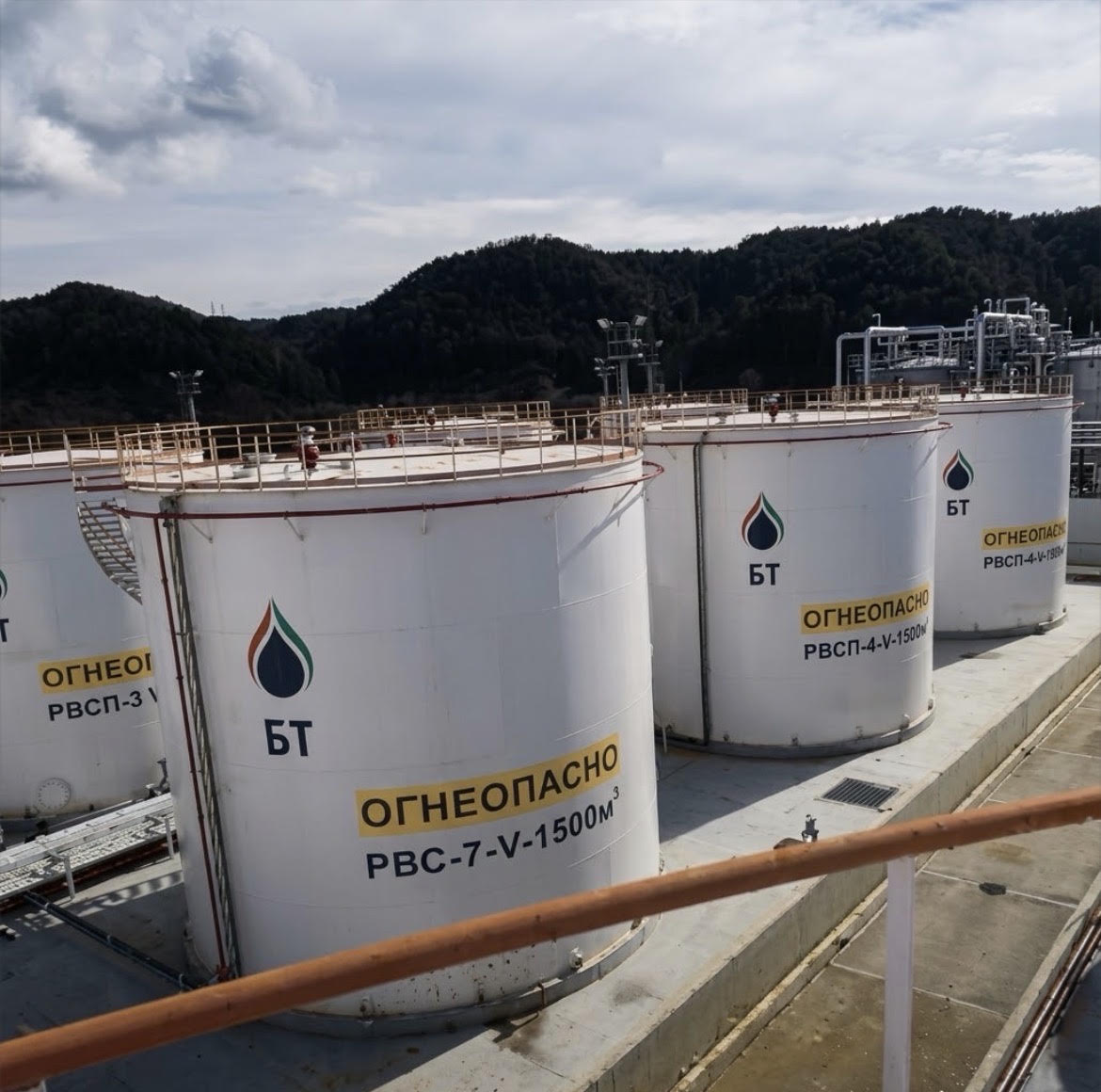
Construction of the Bzipi Oil Depot commenced in 2020. Although the preparation had been long underway, the local population issued complaints about the ecology and environmental damage deriving from the infrastructure development process. In 2020, a local news outlet published a video covering the issue. The video included interviews with the then-alleged stakeholders: Beslan Blabb, Director of Bzipi Terminal LTD, and Oleg Lakoba, the recently appointed director of Apsny Oil, a company whose beneficial ownership traces back to Russian oligarch Eduard Khudainatov. Bzipi Oil Depot belongs to Apsny Oil and stretches over a territory of 4.5 hectares.
In that interview, they noted that the construction oversight and delivery of licensed works was carried out in full compliance with the international regulations and standards for such terminals. The company ensuring compliance and holding the relevant license, according to them, was a Turkish entity called PGM Inspection. This was also confirmed by a Turkish worker, who inadvertently admitted that a Turkish company, whose state of registration considers Abkhazia to be Georgia’s sovereign territory temporarily occupied by Russia, conducts business activities there.
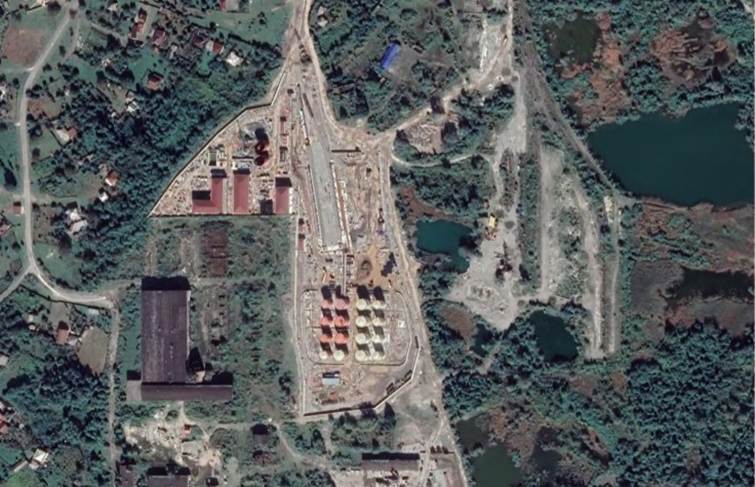
2022 Satellite view of Bzipi Oil Depot. Source: Google Earth
Coordinates: 43.220446928262945, 40.366031602447514
Gudauta Oil Depot
The Gudauta Oil Depot is an Abkhazian de facto state-owned facility.
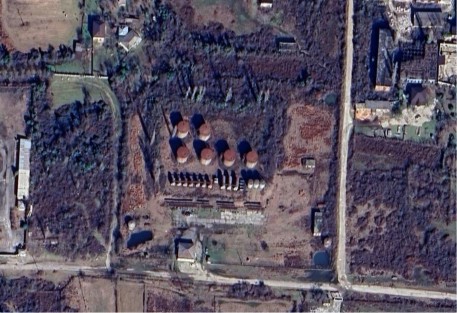
Gudauta Oil Depot. Source: Google Earth
Coordinates: 43.1049804836416, 40.60463522683311
Alkhan Oil Depot in Sokhumi
Alkhan Oil Depot belongs to and is operated by the local oil company Alkhan.
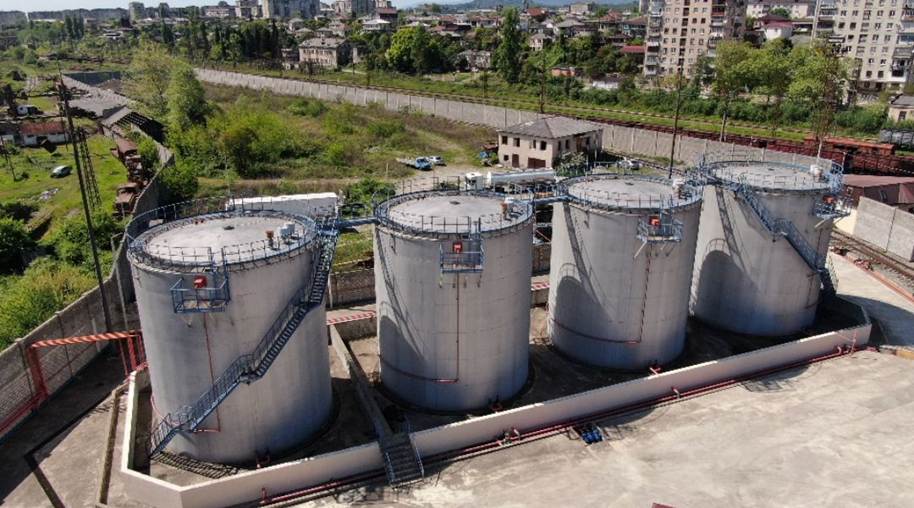
Source: alkhan-fuel-abh.ru
Coordinates: 43.00511986724623, 40.99094150275391
Sokhumi and Ochamchire Oil Depots
The official website of Azid lists two oil depots operated by them: Sokhumi and Ochamchire. They also provide a Yandex Maps plugin on their website, where they have marked locations and addresses of their gas stations and oil depots. It is an interesting observation that as an address and location of their Ochamchire Oil Depot, they have marked the recently constructed Ochamchire Naval Port and the oil storage infrastructure there. Azid is the company that imported fuel from a Georgian company during the 2026 summer fuel crisis in occupied Abkhazia.
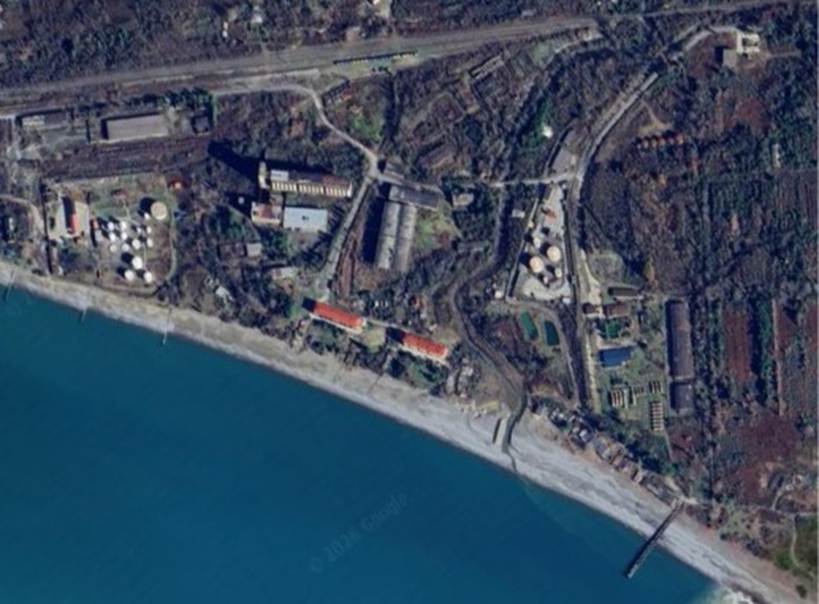
Sokhumi Oil Depot in Eshera. Source: Google Earth
Coordinates: 43.02196871908829, 40.932374888252895
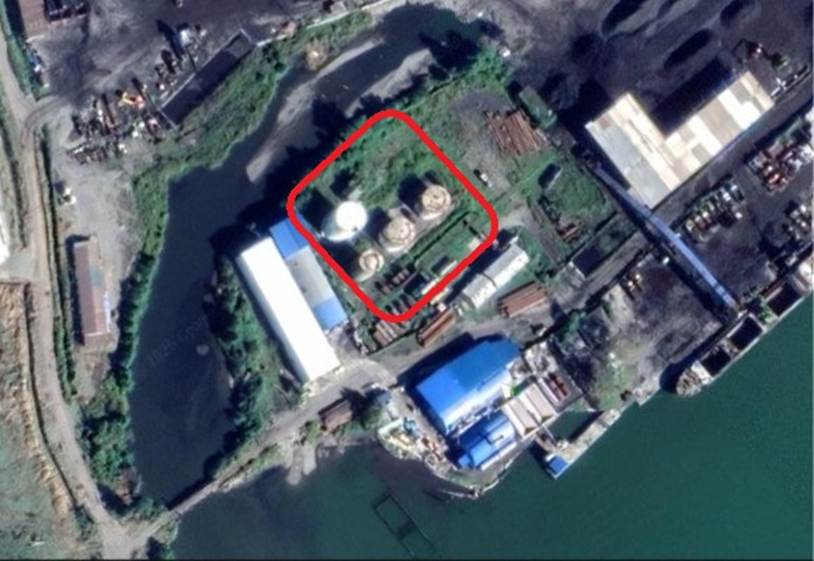
Oil Depot within the Ochamchire Port. Source: Google Earth
Coordinates: 42.74549591311324, 41.42416609295824
Oil Depots and Gas Stations in Occupied Abkhazia
Abkhazia Petroleum Storage Depot Chart
This chart shows the approximate total volume of the identifiable cylindrical storage units by their approximate diameter and height. Vertical storage units are utilised for storing petroleum products, including petrol (gasoline), diesel, and raw petroleum (bitum), however, it cannot be said which tank stores which type of product exactly. Horizontal tanks are most likely utilised for storing propane and other gaseous products, though the chart does not include these. The volumes are provided in cubic meters, since every petroleum product has different density. For instance, 1 litre of petrol weighs approximately 0.74 kilograms, etc.
| Operator | Location | Number of Tanks (Volume in Thousand m³) | Approx. Total Volume in Thousand m³ |
| Alkhan | Sokhumi | 4 x 0.95 | >3.8 m³ |
| Azid | Eshera | 2 x 0.95 2 x 3 – 3.5 | >7.9 |
| Gudauta Depot (de facto state-owned | Gudauta | 6 x 1 3 x 0.1 | >6.3 |
| Eshera Depot (likely operated by AZID) | Eshera | 1 x 3 1 x 2 3 x 0.33 1 x 0.25 3 x 0.95 4 x 0.7 | >11.5 |
| Bzipi (Apsny Oil) | Gagra | 16 tanks (+2 separate) | 20 |
| Azid | Ochamchire Port | 1 x 1.5 3 x <1 | <4.5 |
| N/A, Likely Decommissioned | Ochamchire Municipality | 9 Small, 12 Medium, 3 Large Storage Tanks | N/A |
| Total: >54 Thousand m³ |