
Russian military units have been deployed on the territory of modern Kazakhstan since the Russian Empire. Military sites and facilities saw particular growth during the Soviet Union. The Soviet forces operated military training grounds, test facilities and a cosmodrome there, conducting the majority of its nuclear tests on Kazakhstan’s territory.
Today, Russia does not have the military bases in Kazakhstan in a conventional sense, but operates multiple military sites, ranging from integrated air defence facilities to the Baikonur cosmodrome. These military sites were commissioned during the time of the Soviet Union and, since its collapse, have been operating under the framework of bilateral agreements between the two countries.
Vast areas in Kazakhstan have been utilized for missile, anti-missile, nuclear, and even biological warfare tests for decades. Kazakhstan bore enormous environmental and social costs without meaningful compensation. Entire territories were isolated from public access, local populations were exposed to potential radiation and biological hazards, and economic opportunities tied to fertile land, oil reserves, and water resources were sacrificed for Soviet and Russian military needs.
Kazakh authorities stated in 2024 that Russia leased three sites for military use in the country, however, the actual number of military and dual purpose test sites is higher. This article briefly overviews the locations in Kazakhstan currently in use by Russia for military and dual purposes.
Key Strategic Agreements
Russia and Kazakhstan signed their first bilateral agreement even before the formal dissolution of the Soviet Union. On November 21, 1990, Boris Yeltsin and Nursultan Nazarbayev, then the heads of the Russian SFSR and Kazakh SSR respectively, concluded an agreement that drew a broad framework of current mutual understanding and future cooperation between the two countries. They agreed that the Soviet-period state borders would remain unchanged, and both formally acknowledged each other’s sovereignty by committing not to pose any threat to the latter.
The first bilateral framework agreement between the two after formal dissolution of the Soviet Union was the treaty on Friendship, Cooperation, and Mutual Assistance of May 25, 1992. This document acknowledged the special status of the aforementioned 1990 agreement, while defining broader areas for cooperation. Though this agreement is a common instrument used by the Russian Federation for establishing relations with other post-Soviet states, the treaty with Kazakhstan went further by stating in Article 5 that “in case of an act of aggression against one or both countries, the signatory parties will provide necessary assistance, including military.” The clause was adopted despite both countries having already signed the founding Collective Security Treaty on May 15, 1992. Kazakhstan later became a founding member of the Collective Security Treaty Organization (CSTO), established in 2002.
Russia and Kazakhstan signed another framework agreement on “Good Neighbourliness and Cooperation in the XXI Century” in 2013, although this agreement was in fact an amended version of the original May 25, 1992 treaty. This time, they did not mention the mutual military assistance in case of attack on one of the signatory parties, however, they marked broader fields of cooperation, including creating a unified economic domain and tightly cooperating in the Customs Union. They also introduced further development and cooperation in space and the Baikonur cosmodrome. The agreement put primary emphasis on the security field and intergovernmental partnership in this domain.
Key Military Agreements
Russia and Kazakhstan signed the first treaty on Military Cooperation in 1994, however, they adopted an updated version of the agreement in 2020, which entered into force in May 2022. The 2020 treaty on Military Cooperation identified priority directions for cooperation, ranging from combat preparations to sports and cultural activities between the countries’ ministries of defence. Apart from general cooperation in defence, the parties agreed to exchange military intelligence, conduct joint exercises and training for their servicemen, and more.
Another relevant document in this domain is the agreement on Military-Technical Cooperation between Russia and Kazakhstan, signed on December 24, 2013, and entering into force in 2015. This is a typical agreement concluded by the Russian Federation with partner states and Georgia’s Russian-occupied “South Ossetia” and Abkhazia regions, with the intent to fill local military equipment and arms demands predominantly with Russian production.
On May 27, 2025, the Russian Federation and Kazakhstan adopted a new Programme on Strategic Partnership in the Military Sphere for 2026-2030. Russian defence minister Andrey Belousov highlighted the importance of further developing Russian-Kazakhstan military cooperation considering the “deteriorated security environment” in the region, as well as the importance of their strategic partnership “in light of the 80th anniversary of victory in the Great Patriotic War” (Soviet iteration of the World War II).
Russia and Kazakhstan have been operating a unified air defence system since 2013. Russian then-defence minister Sergey Shoygu and his Kazakh counterpart signed the respective bilateral agreement during Shoygu’s first official visit to Kazakhstan. The air defence system integration aimed to provide the joint defence of borders, early warning of airspace violations, and troop coordination. Overall leadership of forces and assets within the combined grouping was to be exercised by a commander appointed under procedures determined by the defence ministries of both parties.
Russian Military and Dual-Purpose Sites in Kazakhstan
Kapustin Yar and Emba
During their peak, the Soviet military test sites covered a vast area in Kazakhstan, amounting to over 7% (up to 11% according to some estimates) of the country’s total territory. After the collapse of the Soviet Union, Russia moved a significant portion of its systems and facilities from Kazakhstan to Russia. However, Russia has been paying a lease to its neighbouring country for the use of test ranges located there.
The 1995 agreement between the two on the “Terms of Utilization and Rent of the Emba Range” defined the framework for Russian forces’ activities in this particular area, and regulates organisation, planning, coordination, and other aspects of Russia’s military activities. The Emba Range has remained crucial for the operations of another military facility located in the Astrakhan Oblast of the Russian Federation: Kapustin Yar.
The Emba test range is located over 800 kilometres (500 miles) east of Kapustin Yar. Russia has been testing its ICBMs and other missiles at these locations since the mid-1990s. With the launch facilities located in Russia, these missiles fly nearly one-third of Kazakhstan’s territory before hitting the designated areas near the Emba Range.
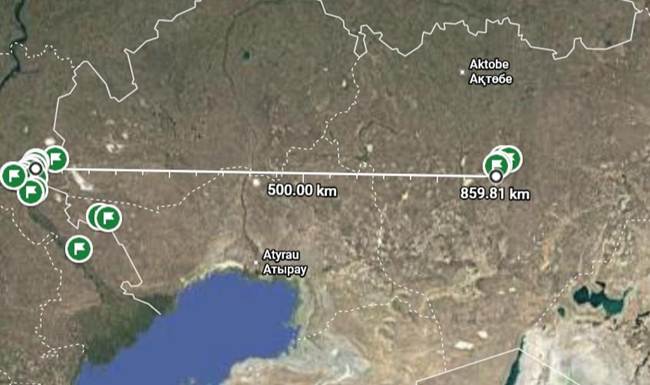
Kapustin Yar in Russia’s Astrakhan Oblast (left) and the Emba Range in Kazakhstan (right).
Kapustin Yar remains one of Russia’s most important military facilities. According to various sources, Russia makes use of this particular facility for the deployment of the “Oreshnik” IRBM system, which it has already used against Ukraine multiple times since 2022. Considering the operational history of Kapustin Yar and other test areas located within Kazakhstan, it can be assumed that at least part of “Oreshnik” development has taken place on Kazakh territory.
The Sary-Shagan Range
Another impact site for the Russian test missiles launched from Kapustin Yar is located near Lake Balkhash. The Sary-Shagan test site, originally established in 1956, covers a considerable area, and has recently been used for testing missiles such as the Topol-ME. Sary-Shagan was included in the Russo-Kazakh agreements as one of the primary components of the Unified Air Defence System.
Another reason why the Sary-Shagan range is so important to the Russian Armed Forces is its location. The site is over 2000 kilometres away from the launch sites in Kapustin Yar, which allows the Russian military to replicate ICBM and IRBM threat intercepts.
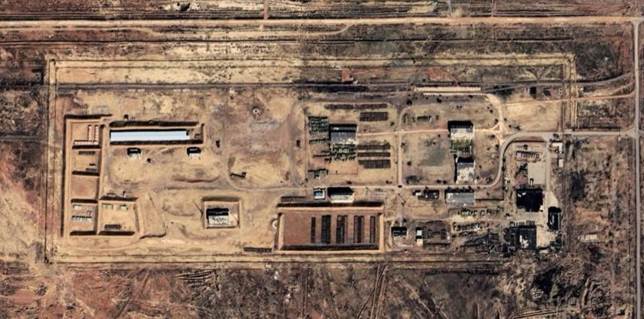
Sary-Shagan Equipment and Missile Storage Facility. Source Google Earth
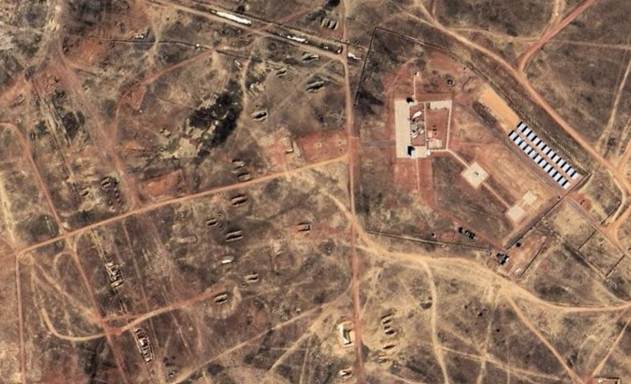
Another site on the Sary-Shagan Range. Source: Google Earth
The Taysoygan and Semipalatinsk Sites
The idea of using Kazakhstan’s vast steppes for testing artillery rockets, ICBMs, IRBMs, and nuclear bombs was conceived by the USSR. According to different estimates, Soviet forces conducted at least 470 underground, ground, and high-altitude nuclear tests, primarily at the Semipalatinsk test facility, but also in Emba, Lyra, Azgyr, and other areas. On August 29, 1991, President of the then-Kazakh SSR Nursultan Nazarbayev signed a decree “On the closure of Semipalatinsk Nuclear Test Site.” However, Russia continued using the area for non-nuclear tests.
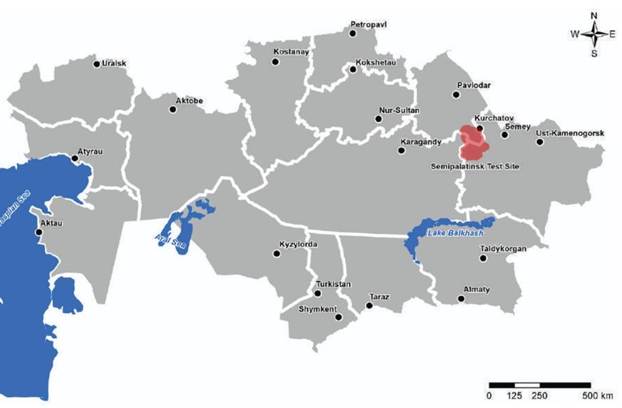
Semipalatinsk test site location (red) within the Kazakhstan territory. Source: nnc.kz
The Taysoygan test range in Kazakhstan is a major military site originally built by the Soviet Union and later passed down to Russia. Historically subordinated to the Soviet 929th Flight-Test Center, the area was used for decades to test advanced aerospace hardware, missiles, and tactical nuclear weapons. The intensive military use has left a large part of the landscape covered by impact craters. The locals have found unexploded ordnance multiple times.
In recent years, after major oil reserves and valuable groundwater were discovered in the area, the purpose of the land has shifted from military testing to a predominantly economic one. The Kazakh government negotiated to reclaim nearly 750,000 hectares of the territory for domestic use and resource drilling. However, Russia still leases and controls a smaller portion of the original range.
In 2006, Kazakhstan’s Ministry of Environmental Protection conducted a large-scale demographic study and concluded that the testing site had not caused any significant harm to the health of nearby residents. However, multiple reports show locals having complained about a sharp increase in cancer (including leukemia in children), cardiovascular disorders, mental illnesses, and respiratory diseases, along with a growing number of suicides. They have tied these developments to radiation exposure.
Various studies carried out on the Semipalatinsk nuclear test site area point towards over 1.5 million locals having been affected by the nuclear tests. A Japanese-Kazakh study even found cancer rates in the affected regions in Eastern Kazakhstan to be 25–30 % above the national average. Soviet secrecy prevented systematic disclosure of actual data.
The Baikonur Cosmodrome
The most prominent Russian-operated dual-purpose facility in Kazakhstan is the Baikonur Cosmodrome. The Soviet Union developed its space program and launched all of its space rockets from this site. Russia inherited the Soviet space program and has been operating the launch pads and facility for the International Space Station and satellite purposes. After the United States retired the shuttle program, the Soyuz rocket was the only spacecraft delivering American astronauts to the ISS for years until SpaceX’s Falcon 9 was commissioned.
What is less well-known is that Baikonur was one of the Soviet Union’s major missile and ordnance test sites, until Russia and Kazakhstan agreed to transform it into a “civilian” facility. Russia has been launching its military and surveillance satellites from this cosmodrome since the 1990s. The USSR tested some of its more important ICBMs, including those capable of carrying nuclear warheads, at Baikonur. Most of these missiles were later inherited by Russia.
There are numerous bilateral agreements between the Russian Federation and Kazakhstan concerning Baikonur. One of the initial treaties between the two was “on the Terms of Use of the Baikonur Cosmodrome” signed in 1992. Baikonur city was known as Leninsk until 1995, and all of the agreements related to the cosmodrome use its previous name rather than Baikonur.
This agreement defined the cosmodrome and city’s legal status, as well as the costs of upkeep and other commitments. Russia would cover 94% of the costs of operation, white the Kazakh side would commit 6%. Apart from this, the Russian Federation was to pay 15% of the profits from the operations towards the development of the city and civilian infrastructure.
Further agreements expanded Russia’s legal status on the city’s territory. The 1995 agreement put Baikonur partially under Russian administrative control and jurisdiction. Russia would manage the city’s budget, conduct policing through its Ministry of Internal Affairs, and the Russian flag would be raised alongside the Kazakh one at the administrative building of the city. The 2004 agreement extended the terms of lease of the cosmodrome and the entire area until 2050.
Aralsk-7
Another confidential Soviet test site located partially in Kazakhstan, sharing territory with Uzbekistan on the Vozrozhdeniye Island (Island of Rebirth), was “Aralsk-7.” From 1948 until the dissolution of the Soviet Union in 1992, the island hosted one of the USSR’s biological weapons programs. The military complex served as a testing ground for anthrax, plague, and smallpox, with experiments conducted on monkeys, dogs, and other animals.
The nearby settlement housed scientists, military personnel, and their families. The program was partially exposed after a 1971 smallpox contamination incident triggered an outbreak in a neighboring area. The area was abandoned after the collapse of the Soviet Union; however, it was the United States and Uzbekistan, not Russia, who carried out decontamination works in the early 2000s.
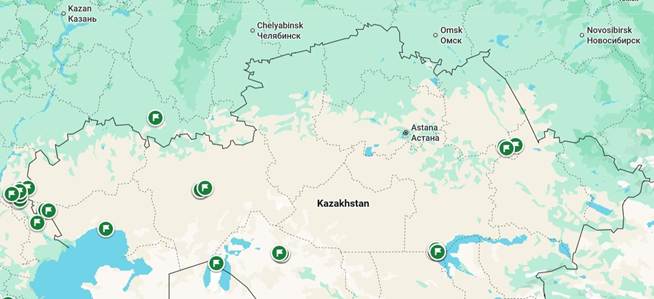
Locations of several Russian military and dual-purpose facilities in Kazakhstan.