
Introduction
Numerous articles have been published on the Russian military presence in Moldova’s breakaway Transnistria region, which some depict as a Russian-armed “stronghold.” Various claims have been made on the number of Russian servicemen, creating misconceptions. Russian military experts call Transnistria a “deterrence factor” against NATO’s expansion to the east. This article analyses the publicly available data and provides a deductive picture of the current state of the Russian Operational Group of Russian Forces (OGRF) and the Russian Peacekeeping Force in Moldova’s Transnistria.
An “Ethnic” Conflict and Russian Intervention
The de facto Ministry of Defence of the so-called Pridnestrovian Moldavian Republic (PMR), or Transnistria, regularly issues statements celebrating the anniversary of the creation of the OGRF – the Russian operational grouping that was established on the foundation of the disbanded 14th Army of the Russian Federation. According to the “ministry,” the OGRF’s primary task is participation in the “peacekeeping operation” in the region, and protection of ammunition storages close to Cobasna village.
The OGRF is ordered to react immediately to any situational changes in the region. The de facto institution also notes that, thanks to the active position and involvement of the Russian Federation, “the genocide” was brought to an end in Transnistria, and the presence of the Russian forces creates firm conditions for the negotiation process and political dialogue.
The so-called ministry has often underlined the importance of Russia’s role in the Transnistrian conflict resolution. Publications usually highlight terms such as “genocide” when referring to the people of Transnistria, speak of how Russia intervened to protect the sovereign decision of the people, or suggest that Moldova attempted to exterminate the Russian language and the people resisted. Notably, they rarely mention the factual circumstances of how the Russian military formations became involved in the conflict.
Russia has since tried to frame the developments as an ethnic conflict. Russia has used the same “suppression of ethnic minorities” excuse to intervene not only in Moldova, but throughout the post-Soviet space, particularly in Georgia’s Abkhazia and Tskhinvali (so-called “South Ossetia”) regions.
One of the formal reasons for Russia’s 14th Guards Army interfering and fighting against Moldovan forces was the “Language Law” adopted in 1989 in Moldova. The law established Moldovan as the state language and asked the citizens to reach language proficiency by 1994. At the time, the ethnic composition of Moldova was 65% Moldovans, 14% Ukrainians, and 13% Russians. The Transnistria region had 40% Moldovans, 28% Ukrainians, and 26% Russians. The language law was never enforced in the country; however, it became a focal point for the Russian military intervention.
Russia formalised its true intentions in 2006, when the PMR held an illegitimate referendum that asked two questions of the population of the breakaway region:
- Do you support the course for the independence of the Moldovan Republic of Transnistria and the subsequent voluntary accession of Transnistria to the Russian Federation?
- Do you think it is possible for the Moldovan Republic of Transnistria to renounce its independence and then join the Republic of Moldova?
According to the results, 98% of the PMR’s residents voted in favour of accession to the Russian Federation, while over 96% voted against reunification with Moldova. The so-called referendum was declared illegitimate by the United States, European Parliament, and the United Nations. On the contrary, Russia praised the high-quality independence, exceptional turnout, and transparency that showed the people’s pro-Russian aspirations.
Russia’s intentions were further clarified in April 2022, when Russian Major General Rustam Minnekayev stated the following: “Control over the south of Ukraine is another way to Transnistria, where there is also evidence that the Russian-speaking population is being oppressed.” The Russian officials thus admitted that one of the motivations for capturing Ukraine’s Odessa Oblast was to establish a land bridge to Transnistria.
Russian Armed Forces in the PMR
Russia’s 14th Guards Army in Transnistria
The involvement of Russia’s 14th Guards Army in the Transnistria armed conflict has been confirmed by the Russian Federation and praised by Russian military researchers and academics alike. Its role was decisive in clashes that culminated in 1992. Following the collapse of the Soviet Union, the union’s 14th army found itself in legal uncertainty, as the majority of its units were stranded on the territories of the recently established independent states of Moldova and Ukraine, far away from Russian jurisdiction.
Initial mainstream politics in Moldova popularised the idea of unification with Romania, which Russia opposed. On November 14, 1991, the Moldovan president declared all Soviet arms, equipment and facilities the property of Moldova. For a brief period of time, the military formations were subordinated to the Commonwealth of Independent States. In 1992, the first president of the Russian Federation, Boris Yeltsin, signed a decree on the transferal of military units of the former USSR deployed on the territory of Moldova to the Russian Federation. Moldova has been demanding the removal of Russian troops from its territories ever since.
During the Transnistrian conflict, several units of the 14th army “transferred” themselves, along with ammunition and equipment, to the PMR jurisdiction; a move by which Russia attempted to cover its direct involvement in the initial hostilities. According to several Russian bloggers, the separatist forces were receiving arms and equipment from even the 14th army units deployed in neighbouring Ukraine.
The Russians used three main arguments to justify keeping their military presence in Moldova after the collapse of the Soviet Union.
First, they claimed that the unit personnel unilaterally refused to leave the so-called PMR territory, as locals amounted to approximately 80% of the staff of the army. Second, they blamed the Moldovan authorities for declaring the presence of the ex-soviet soldiers on its territory as illegal, with Moldova refusing to pay them social, status-related privileges and other benefits. And, lastly, Russians claimed Moldovans had provoked and mistreated the military personnel of the 14th army and their family members. All of these claims would later turn out not to be exclusive to the Transnistria conflict, where Russia chose itself to become involved.
In June 1992, after realising the so-called PMR military was failing and the Moldovan forces were advancing, the Russian President ordered the Russian 14th army to support the separatist forces with its full strength. By the end of the active phase of the hostilities, Moldovan forces had retreated into government-controlled territory. The Russian military units then legitimised their presence in Moldova’s breakaway region under the status of the OGRF and the “Peacekeeping Force.” However, as Russian military bloggers would later call it, the PMR became a Russian outpost or “stronghold in the middle of Europe.”
The Russian armed forces have not left Moldova’s Transnistria region since. These units, operating under three separate designated formats, have been utilised by Russia as leverage that surpassed pressure on Moldova. Some Russian experts have named the PMR as “Russia’s deterrence tool against NATO’s expansion in the east.”
Throughout the 2000s, Russia has attempted multiple approaches to solve the Transnistrian conflict in its favour, from the “Kozak Memorandum,” which foresaw the federalisation of Moldova with Transnistria, Gagauzia having special status within the Moldavian Federation, to a Russian Federal commission headed by Evgeniy Primakov, who was tasked by Vladimir Putin to settle the matter. Primakov’s commission pushed for the creation of a common state of Moldova and Transnistria under a treaty co-guaranteed by Moscow and Kyiv. Under the treaty, Transnistria would have the right to secede from the “common state.” All of these attempts failed.
OGRF and the “Peacekeeping Force” – Current Estimates
Since 1995, the Russian military in Transnistria has been operating under two separate groupings: the Operational Group of Russian Forces and the Russian Peacekeeping Force. Until 1996, the peacekeeping force was made up of military units from Russia. Thereafter, Russia began filling up its peacekeeping force numbers from the local population who held Russian passports. According to Russian sources, the peacekeeping force consisted of two battalions: one of them was posted in the security zone, while the other was on constant deployment on the ceasefire line. These two battalions are part of the OGRF and rotate on active deployment once a year.
The OGRF, established in 1995, was entirely made up of units of the former 14th army. By 2005, the forces comprised two separate motorised rifle battalions, guards and engineering battalions, and several other units. In addition, there was an operational helicopter squadron operating in the PMR that was part of the OGRF, but which was later transferred and has since been operating under the Russian Airforce. Motorised rifle battalions would also participate in the peacekeeping force. The number of servicemen within the OGRF never exceeded 1500 soldiers. By the early 2000s, approximately 70% of the soldiers were Russian citizens residing in Transnistria.
According to a 2016 article published by the Russian Foreign Ministry, while the initial 1992 agreement “on the principles of peaceful resolution of the armed conflict in the Transnistria region of the Republic of Moldova” foresaw six Russian battalions, a helicopter squadron, and communication and logistics infrastructure, the actual number of boots on the ground has been significantly reduced.
Even if Russia’s recent claims are true, and the OGRF currently comprises 1500 servicemen in four battalions and other smaller units, the numbers do not add up according to Russian military standards. Specifically, a fully staffed motorised rifle battalion in the Russian army has at least 500 servicemen, while security and logistics battalions usually employ between 300 and 400 servicemen. These numbers, along with other units mentioned by Russian official and expert sources, should amount to at least 2000 active servicemen, which means that throughout the OGRFs deployment in Transnistria, the Russian military units have been understaffed.
Some of Russia’s most prominent bloggers have been posting exaggerated data and claiming the OGRF employed over 2500 servicemen. However, their numbers do not add up. They claim the OGRF’s two motorised rifle battalions, the 82nd and the 113rd, operate in coordination with the 540th separate control battalion, yet these three battalions cannot technically staff over 2500 servicemen, even by Russian military standards. This once again underscores the unreliability of Russian public sources.
The Cobasna Ammunition Depot
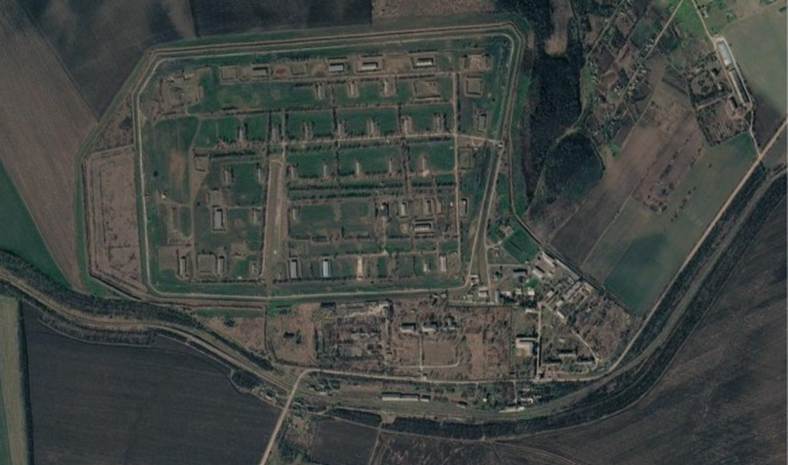
The Cobasna depot, south of Cobasna village. Coordinates: 47°45’38.15″N 29°12’17.88″E. Source: Google Earth
The infamous depot located in Transnistria’s Cobasna village was built in the 1940s by Soviet forces. The depot stored a significant stockpile of explosive materials, ammunition, and artillery shells belonging to the Western Military District of the Soviet Union. The stockpile expanded during the late 1990s when the USSR was made to move its arms from the GDR, Czechoslovakia, and other states within its sphere of influence.
Cobasna village is located only two kilometres from the Ukrainian border and within 20 kilometres of the Transnistria-Moldova line. The information on the amount of ammunition stored there is scarce and is obscured by the Russian Federation. According to OSCE, out of 42,000 tonnes of ammunition, almost half has been gradually extracted from the depot. Specifically, 1,153 tonnes in 2001, 2,405 tonnes in 2002, and 16,573 tonnes in 2003. The [U1] OSCE itself committed a financial contribution of up to $3 million to this process.
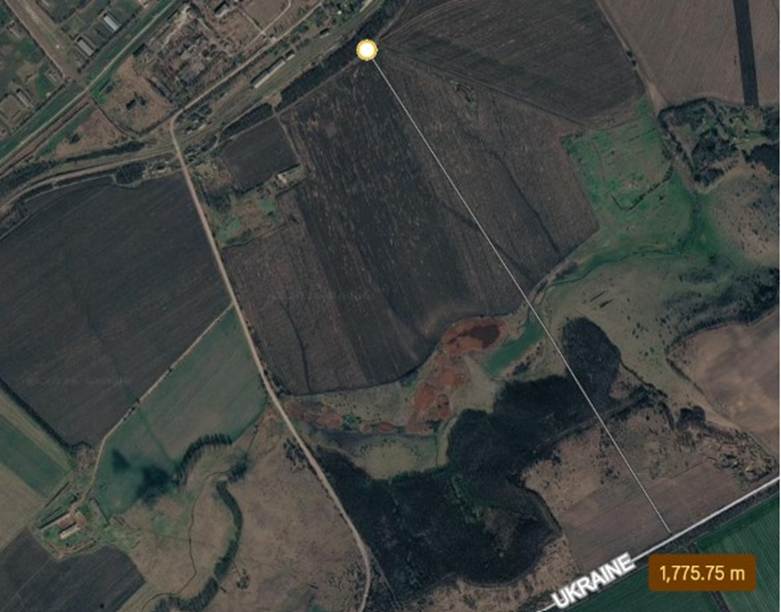
The depot is located less than 2km away from the Moldova-Ukraine border. Source: Google Earth
According to various sources, approximately 20 thousand tonnes of ammunition and explosive materials are still present in the depot. However, the majority of relevant studies suggest that, considering the processes leading to the reduction of the stockpiles and the natural aging of the materials, a significant portion of it has long been outdated. A amount of supplies has also been allegedly found in different parts of the world through sales. By the end of 2003, the Transnistrian de facto authorities, with the intention of using it as a deterrent, demanded the ordinances and ammunition to be kept in warehouses.
Russia has been particularly cautious in selecting the servicemen which guard the Cobasna depot. According to Russian pro-government military bloggers, the staff undergoes regular checks and technical audits, and is under near-constant scrutiny. Only a special contingent is allowed on the territory itself. Apart from the military, there is a group of civilian personnel maintaining the depot, predominantly staffed by local Transnistrian-Russian citizens, who must undergo certification to gain security clearance “overseen by the counter-intelligence bodies” of the Russian Armed Forces. The same sources claim there are 70 armed military servicemen guarding the facility and 250 civilian personnel executing technical and maintenance tasks.
Operational Combat Vehicles and Equipment
In 2022, the Russian military claimed it had encountered Ukrainian UAVs in proximity to the Cobasna ammunition depot and shot them down close to the village. This was followed by multiple similar and unsolidified claims throughout the year. The process culminated in 2023 when Russia, following the obvious failure to execute the initial invasion-plan for Ukraine, began making statements on Ukraine’s “plans to invade Transnistria” or to “drag Moldova into its war against the PMR.”
Around the same time the Russians claimed they had intercepted those Ukrainian UAVs, Russian state media published articles that provided obvious exaggeration of the armoured equipment pool and size of military personnel combat-ready and available for operations in the PMR.
For instance, Sputnik stated that the frozen conflict in Transnistria was deterring NATO’s expansions to the east, and that the “Kyiv regime was ready to attack Tiraspol on the first order from Washington.” The West, according to Sputnik, was promising Kyiv Europe’s largest ammunition depot in Cobasna. “However, the main barriers for them are the 3000 Russian peacekeepers, over 7000 soldiers of the PMR, and over 400,000 Russian citizens residing in Transnistria ready to resist.”
The Russians also claimed the OGRF had “over 100 battle tanks, 200 BTR and BMP armoured fighting vehicles, thousands of light combat vehicles, BM-21 GRAD MRLS systems and a helicopter squadron. The Ukrainian border brigades, Moldovan armed forces of just 6000 men, and the NATO units from Romania, Poland and the US will fail to neutralise this mighty grouping (of the Russian military).”
These events were largely considered as Russian “false flag” operations aimed at confusing the Ukrainian military and removing its combat units from the eastern frontline. The operation apparently failed to achieve the ultimate goal, however, and put Russia’s actual combat capacity in the PMR under further scrutiny.
Following Russia’s full-scale invasion of Ukraine in February 2022, Moldova and Ukraine barred the transit of Russian military flights and arms into the PMR. While this move further impeded Russian capabilities of rotation and the upkeep of its military equipment in Transnistria, the majority of it has not undergone any significant modernisation, possibly for decades. It should be noted that the rotation of the Russian forces has been significantly disrupted since the Russian annexation of Crimea in 2014.
In 2005, Russian MoD newspaper “Red Star” claimed that the entirety of the heavy armoured equipment that the 14th army and its successor in the PMR, the OGRF, possessed had long been extracted back to the Russian Federation. The author of the relevant article said that none of the OGRF units had any heavy tank, artillery pieces, or infantry fighting vehicles left; there were only BTR-70s, BRDM-2, rifles, and grenade launchers remaining in the area.
Considering the region had not experienced any significant escalation from 2005 up until 2022, and weapon transit had been effectively barred in and out of the PMR, it is highly unlikely the Russian units could become any more capable than they were.
There are numerous recent reports on the Russian heavy equipment deployed and in service in the OGRF. For instance, prior to the full-scale war, the Military Balance 2022 claimed there were up to 100 armoured vehicles in the service of the OGRF and Peacekeeping Force. Further, it was claimed that the PMR de facto authorities had up to 40 T-64 and T-72 tanks, some 40 various armoured fighting vehicles, and 40 self-propelled guns.
The Kyiv Post provided more modest, albeit relatively realistic estimates, according to which predominantly outdated Russian military equipment in the PMR comprised approximately 20 T-34 tanks, 80 BTR armoured personnel carriers, and up to 20 BM-21 Grad MRLS systems.
The OGRF’s Outpost and Airfield
The entire Russian military facility, including a combat vehicle pool and military airfield, is within 10 kilometres of the Ukrainian border. The northern side of the base is open, with no civilian infrastructure covering it that could be theoretically used by the Russian forces as a deterrent. The majority of the buildings, as seen on the most recent satellite imagery, are poorly maintained, and a significant portion of them in various areas are destroyed.
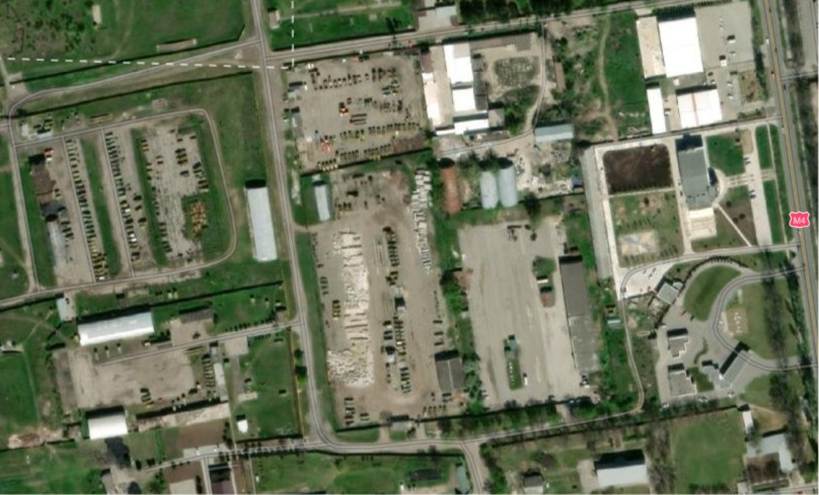
Russian military facility basing the OGRF forces and a combat vehicle pool northwest of Tiraspol. Source: Esra
Satellite images from different years show no significant change in the quantity of equipment parked at the facility, the majority of which are trucks and unidentified non-armoured vehicles.
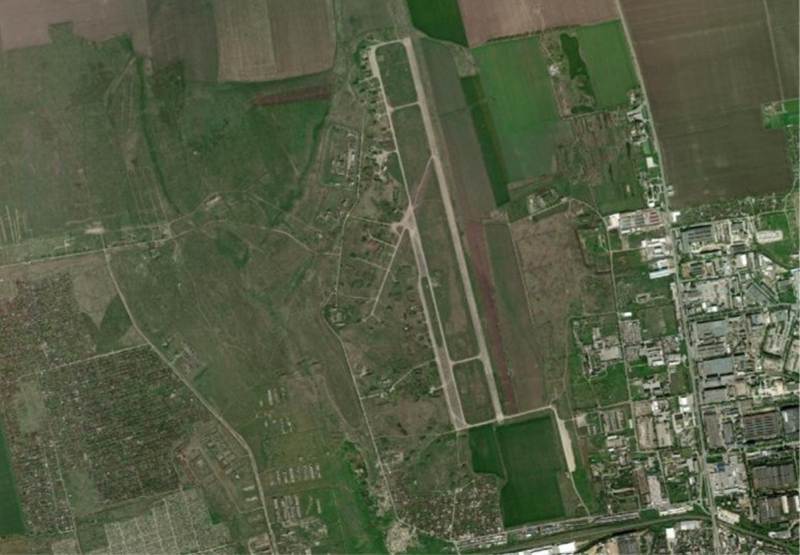
The 2025 images from Esra show no combat aircraft or helicopters parked at the Tiraspol airfield. While no sources have ever identified the presence of Russian military jet-aircraft at this airfield, the territory has multiple camouflaged hangars that could potentially store operational ground combat vehicles. The area also includes a training range with trenches and fortifications.
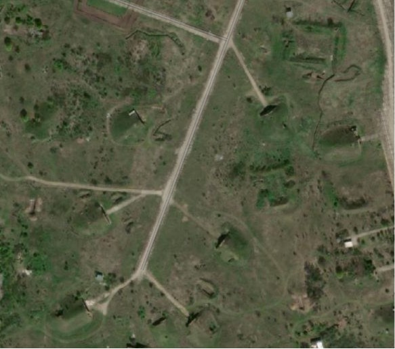
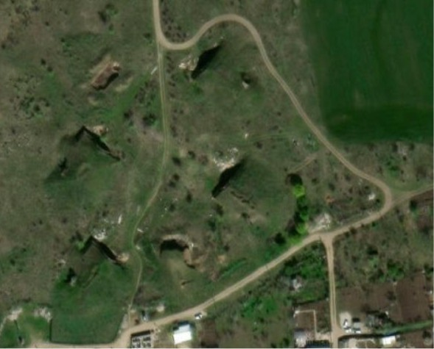
Camouflaged hangars on military airfield territory in Tiraspol. Source: Esra