
The Occupied Tskinvali Region
In the occupied Tskinvali region, April began with unscheduled training focused on the preparation of officers and unit commanders, conducted under the direct supervision of the de facto First Deputy Defence Minister Inal Sabanov. Held across three separate locations, the training aimed to strengthen the organisational skills required for the effective planning and execution of upcoming military drills. On the second day of training, the de facto Defense Minister Yuri Yarovitsky personally attended and inspected the activities being led by his deputy.
On April 2, the Special Purpose Battalion servicemen started “planned” live-fire drills on the shooting range. The exercises consisted of target shooting, weapon safety measures, and other related drills. The de facto ministry stated that every soldier was tested to meet the “set standards,” and all of them proved their combat readiness.
Ossetian officers were the first to participate in live-fire military drills on April 3. During the “planned” activities, they practiced marksmanship, grenade handling, and other combat disciplines under a range of tactical conditions. According to the “ministry,” all of the officers successfully completed their tasks, followed by a long-distance forced march.
On April 6, Yarovitsky and Sabanov checked the readiness of servicemen for the upcoming large-scale military exercises planned later in the month. The two personally inspected the soldiers’ uniforms and arms, confirming that both personnel and equipment were fully prepared for drills designed to closely replicate real combat conditions.
On April 13, the so-called ministry of defense announced that large-scale military exercises would take place at Dzartsem military range and would include various units and heavy equipment of Russia’s 4th Military Base. They sent out official invitations to government officials, MPs, commanders and officers of the 4th Military Base, as well as to representatives of civil society and media outlets.
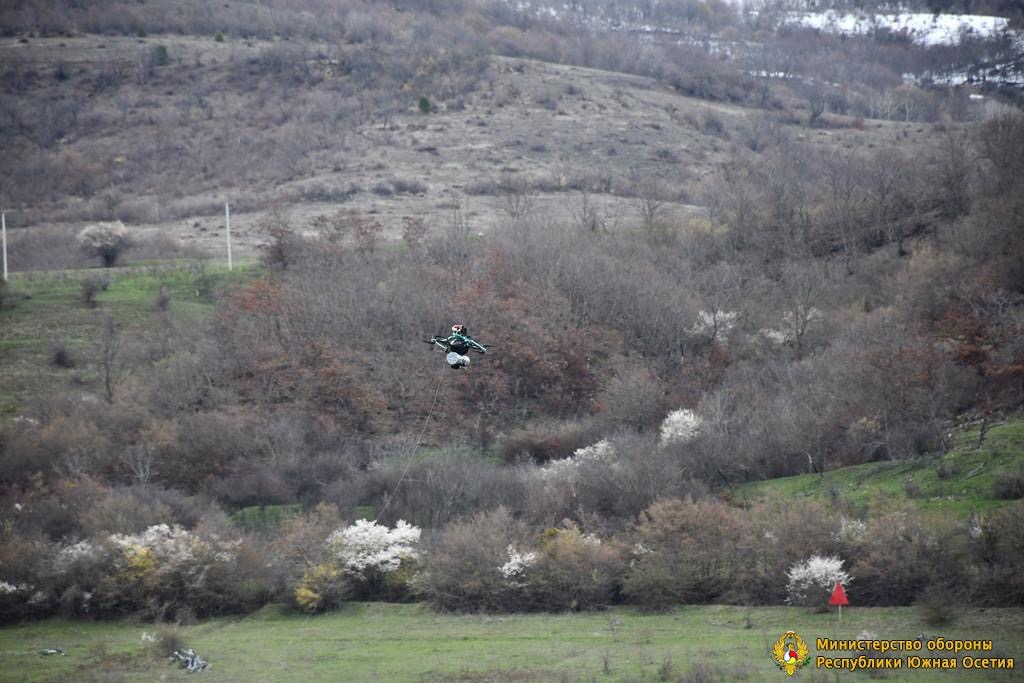
A Russian FPV drone operating on a fiber-optic cable in the occupied Tskhinvali region of Georgia
The Ossetian Armed Forces launched tactical exercises on April 15th, the so-called defence ministry of the occupied Tskhinvali region noted. The exercises, held in accordance with the plan, included various types of heavy and light equipment, including IFVs, armoured trucks, artillery pieces, a helicopter and a drone. While the ministry did not release imagery of the attack helicopter, they showed the maiden flight of a fiber-optic FPV drone received as part of a batch in February. The ministry stated that the exercises were held in tandem with Russia’s 4th Military Base – the heavy equipment and a portion of servicemen having been provided by the latter.
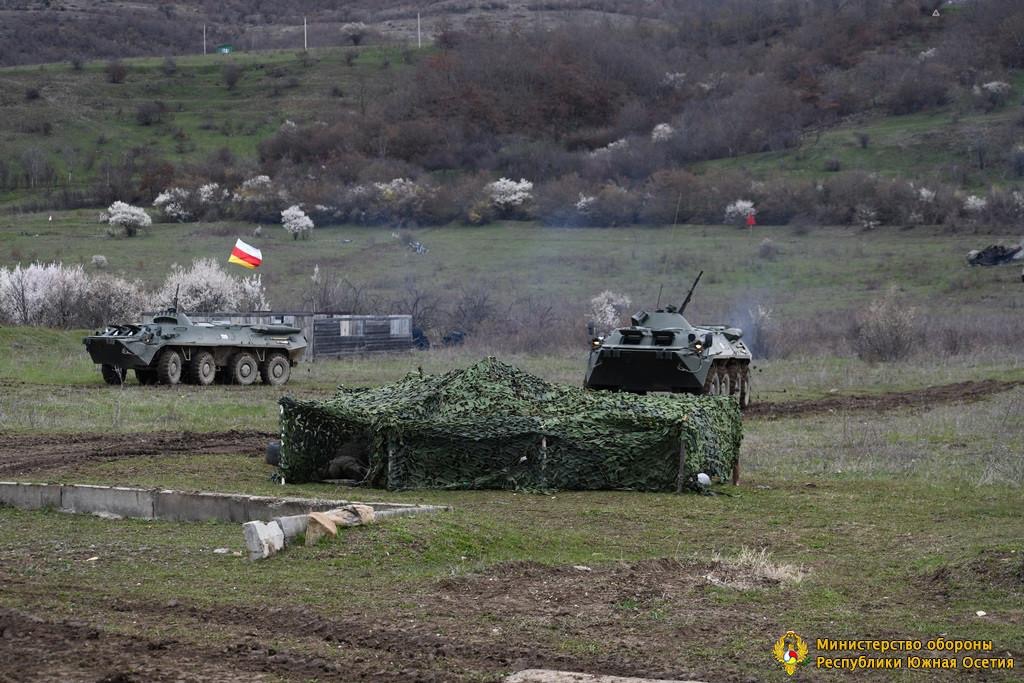
IFVs of Russia’s 4th Military Base
Yarovitsky announced the operational plan for the Ossetian military’s upcoming activities, noting that the summer exercise period will begin on June 1. Prior to that, the Ossetian servicemen will hold a training for the upcoming May 9th “Victory Parade,” joining Moscow’s celebration day.
Later in the month, the de facto defence ministry issued more statements regarding military exercises held in the Tskhinvali region. The special purpose battalion conducted further planned activities and trained in live-fire shooting, followed by PT tests. On April 28, another media release covered exercises held by the Honorary Guard Company, which, like the previous battalion, participated in live-fire and physical exercises. The statements underlined that all activities fully complied with the established standards, and that the servicemen had been evaluated by a commission.
Occupied Abkhazia
The Abkhazian “Armed Forces” started April with “planned” military exercises, focused on developing and polishing the skills necessary for executing tasks in harsh mountainous terrain. The so-called ministry integrated modern tools and equipment, including reconnaissance UAVs, and stated that “the servicemen must be ready to work effectively in such environments where heavy equipment becomes obsolete.”
Mid-April was dedicated to joint-staff exercises, combining every component of the command structure of the so-called Abkhazian Armed Forces. According to the “ministry,” particular attention was paid to the organizational and operational areas of the so-called air defence forces. This is likely due to the latest drone strikes on Sochi, Russia, where last month Ukraine guided dozens of attack drones through the entirety of the Abkhazian territory to reach military targets in the Russian Federation.
On April 21, the separatist government of occupied Abkhazia launched the spring draft of civilians to military service. These drafts are jointly organized by the ministries of internal affairs, health, and education, headed by the defence ministry.
The Abkhazian de facto ministry of defence marked Sultan Sosnaliev’s 84th birthday on April 23, with the higher representatives visiting his bust in Sokhumi. Sosnaliev was an ethnic Kabardian Russian officer put in command of the Confederation of Mountain Peoples of the Caucasus, whose armed groups entered the territory of Abkhazia, Georgia, from Russia, on August 15, 1992, the day after the war began, and commenced combat operations. Sosnaliev was in charge of pro-separatist Russian funded and trained military formations that played a significant role in Georgia’s defeat in the war in Abkhazia.
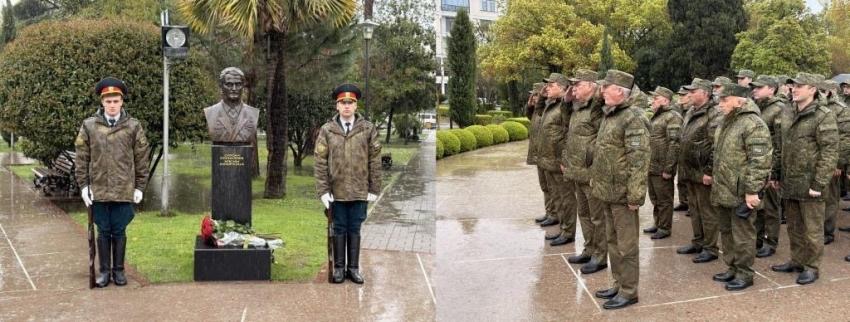
Commemoration of Abkhazia’s Russian separatist leader Sultan Sosnaliev
Students of the Sokhumi Higher Combined-Arms Command School participated in live-fire exercises on April 24. The facility prepares officers for the so-called Abkhazian army, who are sent to Russia’s military schools on a regular basis.