
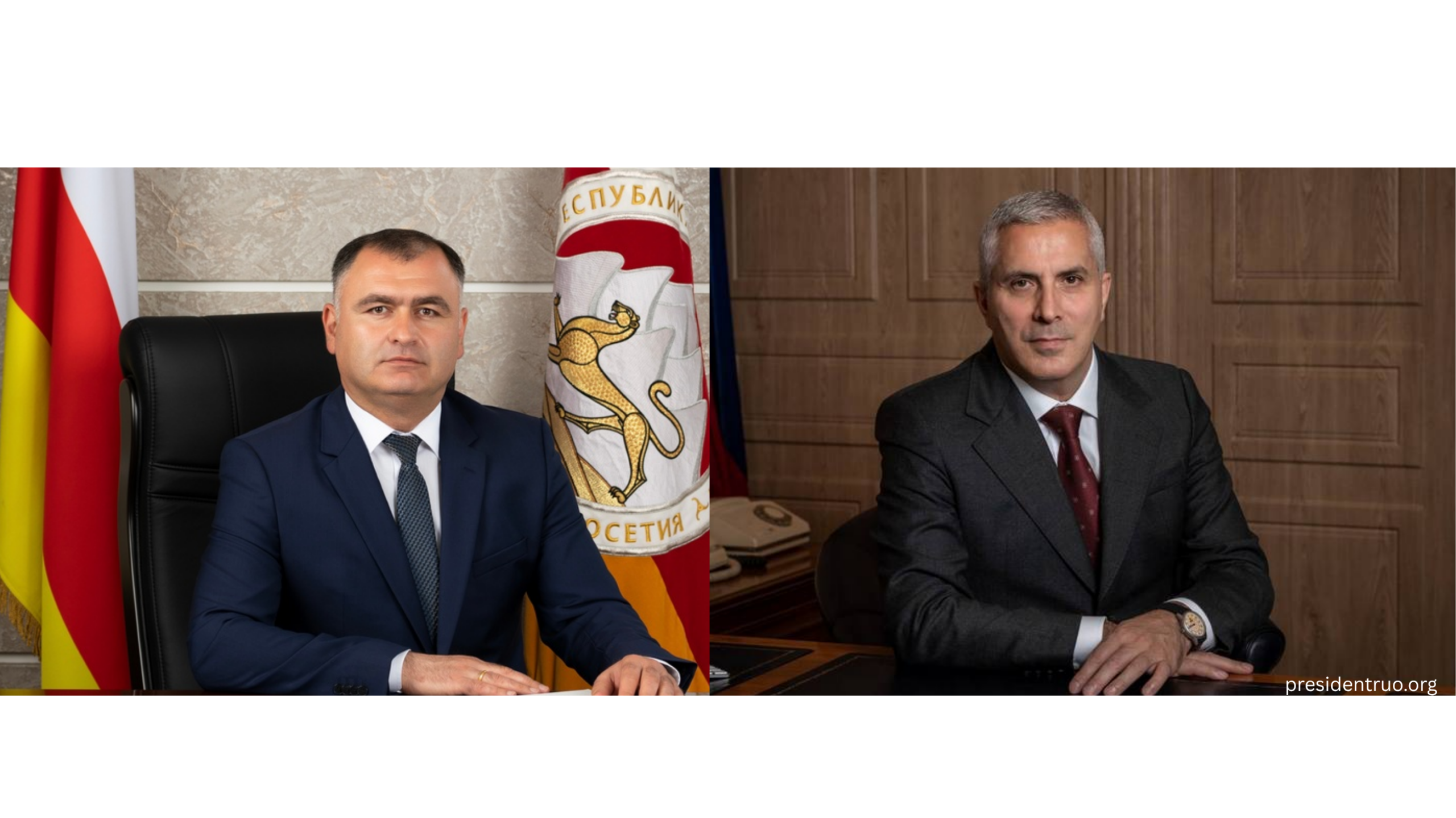
On 22 June 2026, Alan Gagloev, the de facto president of Georgia’s Russian-occupied Tskhinvali region (the so-called Republic of South Ossetia), met with Russian President Vladimir Putin at the Kremlin. The day after the meeting, Gagloev announced his resignation, and the same day was appointed as an adviser to President Putin. Marat Kambolov was designated Acting President until early “presidential elections” are held in Tskhinvali. It is expected that Kambolov will be the Kremlin’s preferred candidate in the upcoming “elections” and the sixth de facto “president” of the occupied region.
What Happens Following the Resignation of the “President”?
Under the existing “legal framework,” if the “president” of the occupied Tskhinvali region is unable to perform his duties, the de facto prime minister temporarily assumes office.
Within 14 days of the president’s resignation, the de facto parliament must schedule new “presidential elections.” These elections must take place within 90 days of the resignation. As per de facto parliament’s decision, elections will be held on September 18.
According to the current “legislation,” an individual who resigns before completing his term is prohibited from participating in the subsequent “presidential elections.” Consequently, Gagloev is not eligible to stand as a candidate.
Former “Presidents”
Since the Georgian–Ossetian conflict of 1992 ended, six illegitimate presidential elections have been held in the Tskhinvali region.
The first “election,” held in 1996, was won by Ludvig Chibirov, who had previously served as Chairman of the “Supreme Council.” In 2001, Chibirov was defeated by businessman Eduard Kokoity, who had returned from Moscow. Kokoity also won the 2006 “presidential election,” becoming the only de facto president to serve two terms. Owing to a combination of domestic and external factors, he resigned from office in 2011.
The 2011 “election” triggered a domestic political crisis, which was resolved through a new “election” in 2012, resulting in the victory of Leonid Tibilov. In 2017, Anatoly Bibilov won the election. He was defeated by Alan Gagloev in 2022.
The next illegitimate “presidential election” had originally been scheduled for 2027. However, Gagloev resigned several months before the expiration of his term.
What Happened Before Gagloev’s Resignation: A Chronology of Events
Gagloev’s resignation was preceded by a series of developments that have raised questions regarding Russia’s potential preparations for the annexation of the occupied region.
The 9 May Agreement
On 9 May 2026, Alan Gagloev and Vladimir Putin signed an agreement on the Deepening of Allied Cooperation. For the population and the de facto political elite of the occupied Tskhinvali region, deeper integration with Russia, and ultimately accession to the Russian Federation, has long represented a strategic objective. Unlike in occupied Abkhazia, the local political leadership has consistently demonstrated its willingness to voluntarily relinquish formal independence. The deepening of integration into Russia’s legal, political, and economic space, and eventual unification with the Russian Federation, has generated little domestic resistance. Consequently, the 9 May agreement has been portrayed locally as a historic step towards the reunification of the Ossetian people, meaning those living in the so-called Republic of South Ossetia and in the Republic of North Ossetia-Alania within the Russian Federation.
Particularly noteworthy is Article 2 of the agreement, which grants citizens of both parties the right to occupy state and municipal positions in Russia and the occupied Tskhinvali region. At the same time, residency requirements for holding public office were abolished. This provision created the legal basis for Gagloev’s appointment to the Russian presidential administration and for Kambolov’s appointment as de facto prime minister.
In practice, however, the appointment of Russian officials to senior positions in the occupied region is not unprecedented: a number of Russian citizens have already served as de facto prime ministers. Yury Morozov held the position between 2005 and 2008, including during the August 2008 Russia-Georgia war, while Vadim Brovtsev served from 2009 to 2012, and also acted as de facto president between December 2011 and April 2012. Russian citizens have likewise occupied numerous senior posts, particularly within the security sector.
Although the appointment of Russian nationals to key positions has long been common practice, all previous de facto presidents originated from the Tskhinvali region itself. Article 2 of the new agreement now enables Russian citizen Marat Kambolov to participate in the forthcoming “presidential elections.”
The Kremlin’s “Man” in Tskhinvali
On 27 May 2026, Gagloev appointed Russian citizen and ethnic Ossetian from the Republic of North Ossetia-Alania, Marat Kambolov, as “State Adviser to the President of South Ossetia.” His responsibilities included overseeing the implementation of the economic and social provisions of the 9 May 2026 Agreement on the Deepening of Allied Cooperation, signed between Moscow and Tskhinvali. He was also tasked with coordinating joint projects aimed at advancing integration, promoting investment cooperation, and implementing infrastructure development programmes.
Shortly after his appointment, on 3 June, Kambolov launched his own Telegram channel. One day later, he published his first post, which contained unusually critical remarks regarding governance in the occupied region. He referred to the daily hardships faced by ordinary citizens, while criticising a small group of individuals who, for years, “had treated the public budget as a source of personal privilege and enrichment.” “This cannot continue,” Kambolov wrote.
On 8 June, Gagloev dismissed the de facto government. On the same day, he nominated Kambolov as de facto prime minister. The de facto parliament unanimously approved the nomination on 16 June.
Later that day, Gagloev formally appointed Marat Kambolov as de facto Prime Minister of the occupied Tskhinvali region.
Meeting with Putin and Resignation
On 22 June 2026, Vladimir Putin received Alan Gagloev at the Kremlin. Following the meeting, both the Kremlin and Gagloev’s administration released identical brief statements: “The leaders discussed the current agenda of Russia–South Ossetia relations, cooperation across a broad range of issues, and prospects for strengthening bilateral dialogue, including the implementation of the bilateral agreement signed on 9 May.” Notably, neither side published any photographs of the meeting.
On 23 June, following his meeting with Putin, Gagloev released a video address announcing his resignation as “president.” In his speech, he emphasised what he described as the long-cherished aspiration of South Ossetia to reunite with North Ossetia and “greater Russia.” He portrayed remaining with Russia as the historical choice of the Ossetian people.
Referring to integration with Russia, Gagloev described the 9 May agreement as a decisive step towards this objective, and stated that, in his new role as an adviser to President Putin, he would continue to support its implementation.
Later that same day, by presidential decree, Vladimir Putin appointed Alan Gagloev as an Adviser to the President of the Russian Federation.
According to Kremlin spokesman Dmitry Peskov, Gagloev’s specific responsibilities have not yet been determined. Peskov noted that adjustments would be made within the Presidential Administration following Gagloev’s appointment, and that a separate document outlining the redistribution of responsibilities would be issued in due course.
Following Gagloev’s resignation, Marat Kambolov assumed the duties of Acting President.
Who Is Marat Kambolov?
Marat Kambolov was born in North Ossetia and has spent most of his professional career within the Russian federal administration. Over the years, he has held senior positions in the Ministry of Education and Science, the Ministry for Nationalities and Federal Relations, and later headed the Kurchatov Institute National Research Centre, one of Russia’s most influential scientific and technological institutions.
He is widely regarded as an experienced public administrator, with extensive expertise in strategic planning, implementation of major federal programmes, interregional relations, investment policy, and the management of large-scale scientific and technological projects.
From the moment of his appointment as Gagloev’s adviser, speculation emerged that the Kremlin was preparing Kambolov for the position of de facto president. The prevailing assumption was that he would gradually consolidate his political position before participating in the illegitimate presidential elections scheduled for 2027. Events, however, unfolded far more rapidly than anticipated.
Assessments in Russia
According to assessments widely circulated in Russia, the leadership changes in the occupied region are less closely associated with preparations for annexation than with Moscow’s efforts to improve governance and ensure more effective management of Russian financial assistance.
For years, Russian officials have expressed dissatisfaction with poor project management and corruption involving programmes financed by the Russian federal budget. Moscow repeatedly demanded that the de facto authorities eliminate the widespread practice of individuals simultaneously holding multiple positions in state-funded institutions, and address the problem of so-called “dead souls” – individuals who continued to exist on official payrolls or benefit lists despite no longer being eligible. One example frequently cited by Russian officials concerned the continued payment of Russian pensions after the death of beneficiaries. According to these assessments, local authorities often failed to notify the relevant Russian agencies of a pensioner’s death, allowing family members to continue receiving pension payments unlawfully.
The Kremlin’s Position
The first official Russian response to Gagloev’s resignation came from Kremlin spokesman Dmitry Peskov, who rejected suggestions that the leadership changes signaled the imminent incorporation of the occupied Tskhinvali region into the Russian Federation. When asked whether the personnel changes could be linked to prospects for South Ossetia’s accession to Russia, Peskov responded briefly: “No, they cannot.”
Assessments by Members of the State Duma
According to Konstantin Zatulin, a member of the Russian State Duma, Gagloev’s resignation is unlikely to accelerate the region’s integration into the Russian Federation. As Zatulin argued: “South Ossetia is, of course, closely connected with Russia. Without Russian support, its existence would be difficult to imagine. Military-political and economic cooperation already exists, but a number of issues still need to be resolved before any discussion of deeper integration can begin.”
Alexei Chepa, First Deputy Chairman of the State Duma Committee on International Affairs, stated that integration between Russia and South Ossetia had accelerated in recent years. He acknowledged that Georgia might object to these developments, but argued: “Russia seeks to assist people with whom it shares close historical ties. No one, including Georgia, should object if people’s lives improve.”
State Duma member Dmitry Kuznetsov argued that South Ossetia’s integration into Russia was already underway, albeit in an unconventional form. According to Kuznetsov: “The agreement on deepening allied cooperation is not merely a political declaration: it provides for coordination of foreign and defence policy, and the harmonisation of legislation, social standards, and the energy system. Whether integration proceeds rapidly or gradually remains to be seen.”
Expert Assessments
According to Caucasus expert Artur Ataev, the appointment of a former Russian federal official as the de facto president of South Ossetia is driven by two principal objectives: first, to deepen integration with Russia, and second, to strengthen Moscow’s oversight of Russian financial transfers to the occupied region.
Ataev did not rule out the possibility that these developments could represent another step towards the eventual unification of the two entities. In his view, the long-standing aspiration of the Ossetian people, repeatedly reinforced through local referendums, may now be entering a phase of practical implementation.
As he noted: “In effect, a Russian official has become acting president. Kambolov’s mission may be to provide new momentum to relations between the two sides, including the implementation of decisions adopted by the intergovernmental commission. It should also be remembered that Moscow has repeatedly expressed concerns regarding the management of financial resources allocated to Tskhinvali.”
Political analyst Konstantin Kalachev described Gagloev’s appointment as an adviser to President Putin not as a demotion, but as a significant career advancement. According to Kalachev: “Given South Ossetia’s population size, territory, and overall political significance, I believe this is, in reality, a career stepping-stone. Becoming an adviser to the President of Russia is certainly not a downgrade.” He added that the principal task of the new leadership would be to ensure that the residents of South Ossetia enjoy living standards at least comparable to, and preferably higher than, those in Georgia.
Nikolai Silaev, Research Fellow at the Centre for Caucasus Studies and Regional Security of the Moscow State Institute of International Relations (MGIMO), argued that despite the already advanced level of cooperation between Russia and South Ossetia, the region’s formal incorporation into the Russian Federation continues to face substantial economic and administrative obstacles.
According to Silaev, bilateral interaction is already highly developed, and Moscow’s immediate priority is to revitalise the region’s economy in order to curb continued population decline. Population loss was also identified by Marat Kambolov as one of the principal challenges facing the occupied region when he assumed the office of de facto prime minister.
Silaev concluded: “I do not expect South Ossetia to become part of the Russian Federation in the foreseeable future. Such a step would create unresolved administrative and budgetary challenges that would benefit neither side.”
Another MGIMO expert, Sergey Markedonov, similarly argued that Gagloev’s resignation should primarily be understood in the context of domestic governance challenges rather than preparations for annexation.
According to Markedonov, the resignation reflected persistent shortcomings within the de facto governing structures, criticism from members of the de facto parliament, and the growing demands associated with implementing the 9 May Agreement on the Deepening of Allied Cooperation.
In his assessment, successful implementation of the agreement requires a substantially higher standard of governance, more effective management of financial resources, and stricter administrative discipline. Consequently, Markedonov considers the recent personnel changes to be driven primarily by governance considerations rather than by immediate annexation plans.
According to the independent Russian media outlet Meduza, citing sources close to the Russian Presidential Administration, the Kremlin considered the possibility of incorporating both South Ossetia and Abkhazia into the Russian Federation, or alternatively into the Russia-Belarus Union State, in 2022.
Following Russia’s partial military withdrawal from occupied territories in Ukraine, such a move was reportedly viewed as a potential means of presenting a “territorial gain” to the Russian public. According to one of Meduza’s sources, the scenario was considered seriously, albeit only for a limited period.
Another source quoted by the publication stated: “South Ossetia is a grey zone where money laundering and illicit cash transactions are widespread, which is why the authorities ultimately decided not to proceed. However, it now appears that discussions about a ‘mini-Soviet Union’ project have resumed.”
According to a source within the Presidential Administration cited by the Russian newspaper Kommersant, the leadership change in South Ossetia reflects prolonged political and economic stagnation in the occupied region. The source argued: “The time has come to resolve the strategic question of South Ossetia’s status and to determine its future development. It is essential to overcome the region’s political, social, and economic isolation as quickly as possible.”
Tbilisi’s Response
The Georgian government has not issued an official statement regarding the recent developments in the occupied Tskhinvali region. In general, the Georgian authorities have consistently refrained from commenting on such developments, explaining this approach as part of their policy of strategic patience towards Russia. Only opposition political parties publicly characterised Moscow’s recent actions as another step towards the eventual annexation of the occupied region.
What Might the Kremlin Be Preparing?
The Kremlin’s recent actions have fuelled speculation that Russia may be laying the groundwork for the eventual annexation of the occupied Tskhinvali region. Nevertheless, most Russian politicians and analysts currently consider such a scenario unlikely in the short term.
The last time the Kremlin was confronted with the issue of South Ossetia’s possible accession to the Russian Federation was in 2022, when the de facto authorities proposed holding a referendum on joining Russia. At that time, Moscow declined to endorse the initiative publicly. Kremlin spokesman Dmitry Peskov stated that the wording of the proposed referendum required further legal refinement, as it created “a certain legal paradox.” In particular, he argued that the term “unification” implied the creation of a new state rather than the accession of one territory to another, making the proposal legally problematic. Peskov further emphasised that Russia was not taking any practical steps towards incorporating the occupied region into the Russian Federation, and that no such plans officially existed.
Yet the possibility of annexation remains an important political instrument in Moscow’s relations with Georgia. The threat itself serves as a source of strategic pressure on the Georgian government, which has pursued a policy of patience towards Russia, generally seeking to avoid direct political confrontation.
From this perspective, recent developments may also be interpreted as a political signal to Tbilisi: should the Georgian government adopt a more openly anti-Russian policy, the Kremlin could respond by accelerating the annexation of the occupied Tskhinvali region.
In the short term, the appointment of the Kremlin’s trusted representative is expected primarily to improve governance, strengthen oversight of Russian financial assistance, and increase the efficiency of implementing Moscow-funded projects in the occupied region.
However, should external or domestic political circumstances evolve in Russia’s favour, the Kremlin could ultimately decide to proceed with formal annexation and present such a move as foreign policy achievement.
General Biographical Information on Marat Kambolov
- Marat Kambolov was born on 2 January 1965 in the village of Khaznidon, Irafsky District, North Ossetian ASSR, Russian SFSR, Soviet Union. He completed his secondary education in his native village. According to local residents, his father died when he was still a child.
- In 1988, he graduated from the Agricultural Institute in Vladikavkaz.
- In 1994, he graduated from the Russian Presidential Academy of Public Administration.
- In 1996, he completed his studies at the Academy of National Economy under the Government of the Russian Federation.
- In 1998, he graduated from Moscow State Social University with a degree in Law.
- In 2005, he graduated from the Russian Academy of Public Administration under the President of the Russian Federation.
- He holds a Candidate of Legal Sciences degree. His dissertation was titled: Administrative and Legal Regulation of Scientific, Technical and Innovation Activities in the Russian Federation.
- In 2007, by decree of the President of the Russian Federation, he was awarded the civil service rank of Active State Councillor of the Russian Federation, Third Class.
- He has been awarded the Order For Merit to the Fatherland, IV Class (2014) and III Class (2018), as well as the Order of Friendship (2012).
Professional Career
- Between 1987 and 1990, he worked within the structures of the Communist Party.
- From 1991 to 1994, he served as a Chief Specialist at the State Committee of the Russian Federation for Anti-Monopoly Policy.
- Between 1994 and 1997, he held positions as Head of Division and Head of Department within the Ministry for Nationalities and Federal Relations. From 1997 to 2003, he served as Deputy Director of the Institute of the Peoples of Russia, affiliated with the same ministry.
- Between 2003 and 2004, he was an Advisor to the Minister of Industry, Science and Technology of the Russian Federation.
- From 2004 to 2005, he served as Advisor to the Head of the Federal Agency for Science and Innovation.
- On 24 June 2005, he was appointed Deputy Head of the Federal Agency for Science and Innovation.
- In August 2010, he was appointed Director of the Department for Investment Development and Federal Property within the Ministry of Education and Science.
- On 12 November 2010, he was appointed Deputy Minister of Education and Science. On 21 March 2013, his office was searched as part of an investigation into a bribery case involving Viktor Kozbanenko, the former rector of the State University of Management. On 2 August 2014, he left the position of Deputy Minister.
- In August 2014, he was appointed First Deputy Director General of the National Research Centre, The Kurchatov Institute (Institute of Atomic Energy). The President and Chairman of the Supervisory Board of the Kurchatov Institute is Mikhail Kovalchuk. His brother, Yuri Kovalchuk, is a close personal associate of Vladimir Putin and is widely regarded as one of the most influential figures in Russia.
- On 9 September 2021, Kambolov was appointed Director General of the Kurchatov Institute. He remained in this position until January 2025, after which he became the Centre’s First Vice President.
Career in the Tskhinvali region
- On 27 May 2026, he was appointed “State Advisor to the President of South Ossetia” by Alan Gagloev, the de facto President of the occupied Tskhinvali region.
- On 16 June 2026 Kambolov was appointed de facto Prime Minister of the occupied Tskhinvali region.
- On 23 June 2026, Kambolov became the acting de facto president.