
Occupied Tskhinvali Region
Military Exercises
June 1, 2026 marked the beginning of the summer training period for the “South Ossetian” military personnel. Yuri Yarovitsky, a Russian general in charge of “South Ossetia’s” de facto ministry of defence, addressed the opening ceremony and oversaw the formation of what appeared to be approximately 150 servicemen still remaining in service of the so-called “armed forces” of the Russian occupied Tskhinvali region. It is well-known that the majority of ethnic Ossetian military servicemen have been transferred to Russia’s 4th Military Base deployed in the region.
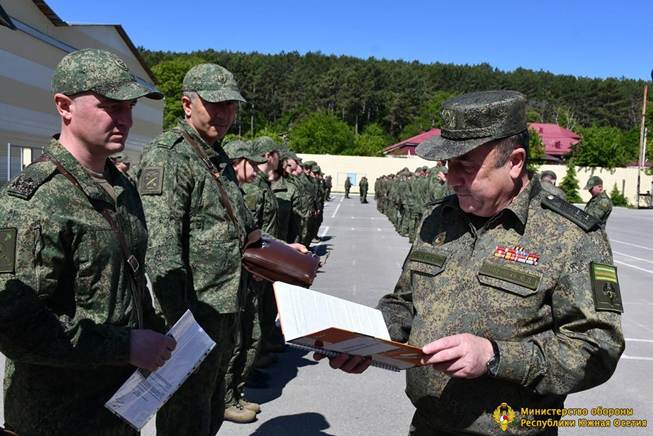
Ossetian servicemen in the First Formation of June 2026 (Yarovitsky on the right). Source: alaniamil.org
The first few days of June were spent on preparations. The servicemen participated in basic safety classes on June 2. The following day, the personnel underwent firearm handling training. On June 3 and 4, the “ministry” declared drill alerts and the “armed forces” began their preparations for the field exercises. According to Ossetian officials, every event was part of a plan.
The first fire drills were conducted on June 9 by the so-called “Special Forces” of the de facto ministry, one of only three units still remaining under direct subordination of the “defence ministry,” with the others being the Honorary Guard unit, and that of the conscripts. Fresh recruits joined the fire drills on June 11. The Honorary Guard unit held exercises in woodland on June 16. On June 19, the Russian de facto minister conducted another scheduled check of the vehicle pool and equipment storage areas.
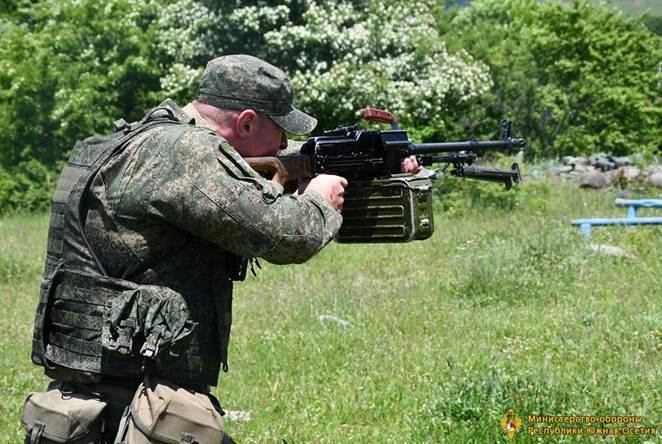
Ossetian fighter with a Soviet-made machine-gun. Source: alaniamil.org
The Tskhinvali School of UAV Systems
The de facto ministry reported that their servicemen are undergoing training in drone systems. According to the de facto ministry, the Centre for UAV and Radio-Electronic Warfare Systems was commissioned in Tskhinvali in late 2025, however, they had posted articles on their servicemen practicing their UAV control skills in simulators as early as 2024. The initial decision to incorporate FPV drones and other quadcopters into the so-called “armed forces” was made in July 2022, when ethnic Ossetian Vladimir Pukhaev briefly held the de facto ministerial position in Tskhinvali.
Occupied Abkhazia
Summer Training Period
Like that of the occupied Tskhinvali region, the Abkhazian de facto ministry of defence marked the beginning of the new military training period on June 1. However, unlike Tskhinvali, the military activities in Abkhazia were largely ceremonial. The new de facto defence minister, Beslan Tsvizhba, along with the Russian Chief of the General Staff, Vladimir Savchenko, oversaw the formation of the so-called ministry’s staff. Tsvizhba and Savchenko later inspected the condition of the military infrastructure and the maintenance of vehicles and equipment. In June, the two participated in numerous events organised by the Russian authorities.
Interview with Tsvizhba
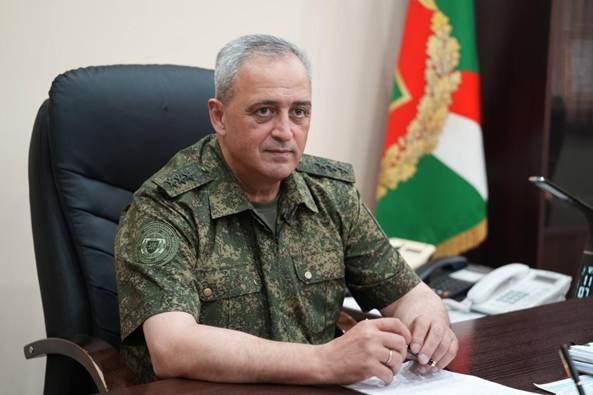
Abkhazia’s de facto Defence Minister Beslan Tsvizhba
On June 4, the Abkhazian “state” news agency Apsnypress released an interview with the new de facto defence minister, Beslan Tsvizhba. Tsvizhba identified key priorities of the de facto ministry under his command, noting that the main task of the “ministry” will be strengthening and enhancing the military capabilities of the “Abkhazian army,” among which will be prioritising the modernisation of technical capabilities, changing the approach to preparing and training staff, and optimising control mechanisms.
New Concern for Russians in Abkhazia
The de facto ministry has been publishing articles on the above goals for a number of years. The former de facto minister, Vladimir Anua, voiced similar plans and pledges, however, Russia’s full-scale war in Ukraine has brought forward a new challenge for Russia’s 7th Military Base stationed in Abkhazia and their Abkhaz proxies: the Ukrainian UAVs (unmanned aerial vehicles). In the abovementioned interview, Tsvizhba highlighted that his agency is developing countermeasures for the UAVs, including elements of electronic warfare.
These developments follow on from incidents that have occurred in occupied Abkhazia over recent months. In February, Abkhazian media outlet Apsnypress reported that a combat UAV had crashed and exploded approximately six kilometres northeast of the city of Gagra, in the vicinity of Mount Mamdzyshkha. The incident took place at a time when the Russian city of Sochi was reportedly being targeted by Ukrainian UAVs.
In early March, another swarm of Ukrainian UAVs used Abkhazian airspace to enter the Russian Federation, with military targets in Sochi. The Russian air defence equipment in Abkhazia was unable to neutralise these threats over Abkhazia. That same month, the de facto ministry issued a statement instructing the population how to behave should they encounter hostile UAVs.
On June 16, the de facto defence ministry, along with de facto president Badra Gunba, presented a new batch of military equipment provided by Russia. It comprised solely of anti-aircraft and mobility armaments.
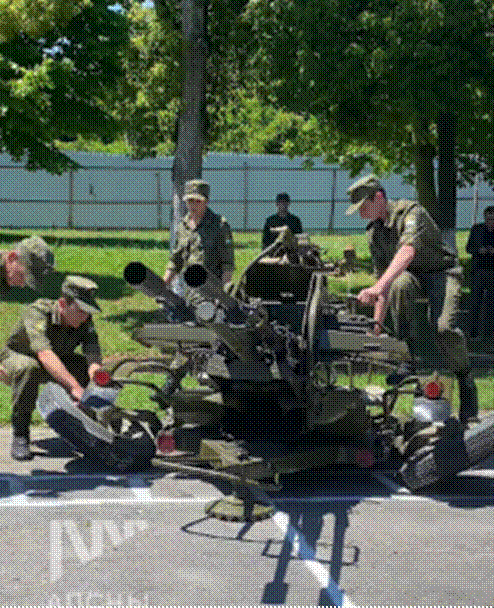
Abkhaz soldiers assembling recently donated anti-aircraft gun ZU-23-2
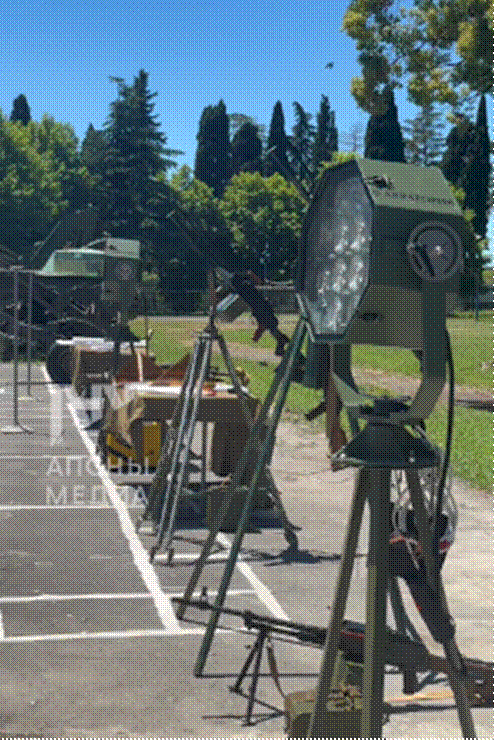
Projectors and Soviet-made SMGs provided by Russia to counter Ukrainian UAVs sent in night raids.
Abkhazia experienced multiple UAV encounters during the past month. On June 5 and 6, locals uploaded videos raising concerns that they had seen and heard fixed-wing drones flying overhead. On June 7, the de facto ministry issued a statement and assured the population that the situation was under control. On June 22, the de facto border between Russia and Abkhazia was once again closed due to a drone threat. Ukrainian drones also used Abkhazian airspace on June 22 and 23.