
Armenia’s Foreign Policy
On February 9-10, 2026, Vice President of the United States J. D. Vance visited the Republic of Armenia, where he met with Prime Minister Nikol Pashinyan.
On February 9, during his visit, Armenia and the United States signed a civil nuclear energy cooperation agreement.
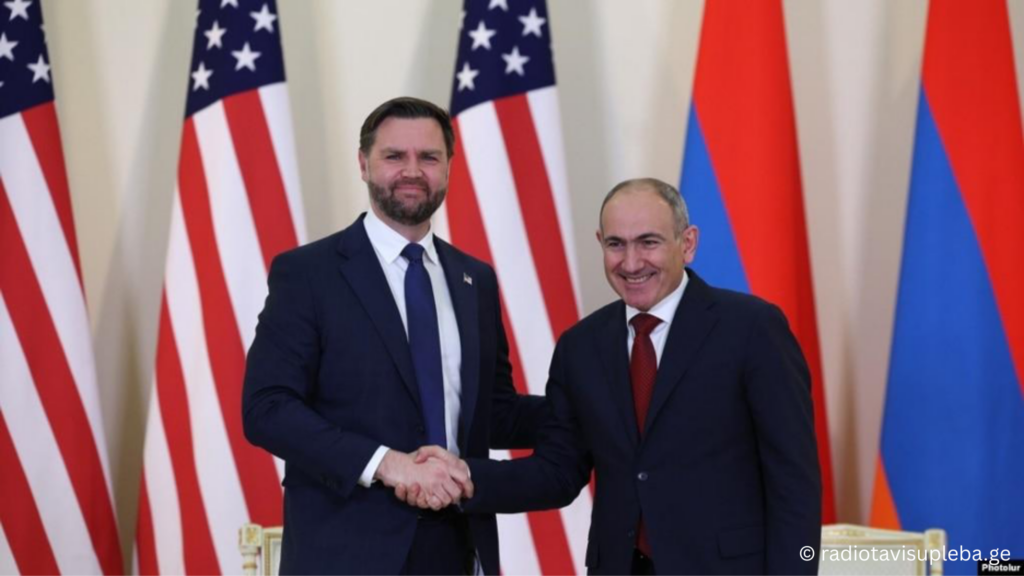
U.S. Vice President J. D. Vance and Armenian Prime Minister Nikol Pashinyan,
Yerevan, February 9, 2026
According to the DPA news agency, the multibillion-dollar agreement demonstrates that the United States is ready to enter a region previously dominated by Russia: to date, Moscow was the sole supplier of technology for Armenia’s only nuclear power plant.
“The agreement makes it possible to export U.S. technology worth $5 billion, as well as nuclear fuel contracts valued at $4 billion,” Vance said, following his meeting with Prime Minister Nikol Pashinyan.
“The U.S. has enough confidence in Armenia to supply it with this new technology,” the vice president added.
As part of its military assistance, the United States will provide Armenia with $11 million in V-BAT reconnaissance drones. The Armenian prime minister expressed hope that this transaction will lay the foundation for expanded bilateral cooperation.
“We have also made significant progress in the military and defense partnership between Armenia and the United States,” Pashinyan said. “As part of our ongoing bilateral security cooperation and the continuation of the joint Eagle Partner military exercises, which have been conducted annually for over three years, Armenia has purchased V-BAT unmanned aerial vehicles from the United States. Their effectiveness has been demonstrated through long-term operational use, and they will significantly strengthen our defense capabilities. I expressed my hope that this transaction, completed under the U.S. Foreign Military Sales program, will serve as a foundation for future cooperation.”
On February 10, Vance described his visit in the following terms:
“I think prosperity is a driving issue for both Armenia and the American people. We are pleased to be departing for Azerbaijan next. Obviously, President Donald Trump’s achievement of a peace agreement is the first step. But maintaining peace is what we are doing today: building on that agreement to ensure economic cooperation between Armenia and Azerbaijan, which is essential for the viability of the peace deal.”
The U.S. vice president also stated that Washington remains concerned about the long-term effectiveness and sustainability of the peace agreement between Armenia and Azerbaijan.
J. D. Vance was questioned regarding the significance of his visit to the Genocide Memorial during his trip to Armenia, as well as whether the visit constituted recognition of the Armenian Genocide. Vance responded:
“Tomorrow, we will also visit significant sites in Azerbaijan. When we consulted with Armenian officials, they emphasized that this memorial is of great importance to them. As the first U.S. vice president to visit Armenia, and at their request, I considered it appropriate to visit this site. It is clear that a tragic event occurred over a century ago, and this memorial is of considerable cultural significance to the Armenian people. Therefore, as a gesture of respect for both the victims and the government of Armenia, which is an important partner for the United States, and for Prime Minister Nikol Pashinyan, I wished to pay my respects here.”
Vance further addressed ongoing and prospective U.S. investments in Armenia, emphasizing that the multibillion-dollar agreement represents only one aspect of the broader economic cooperation between the two nations:
“During these meetings, we are facilitating a range of investments in Armenia, building upon agreements established between President Donald Trump and Prime Minister Pashinyan,” the U.S. vice president said. “One such initiative is the development of a large-scale data center, which, to my knowledge, is already underway. This project could attract up to $4 billion in investment to Armenia and generate substantial employment opportunities for Americans. This represents a mutually beneficial outcome. Significant investment is already evident in Armenia, and we anticipate this trend will continue.”
Azerbaijan’s Foreign Policy
On February 10 and 11, 2026, Vice President J. D. Vance visited Azerbaijan and met with President Ilham Aliyev.
During the visit, on February 10, Vice President Vance and President Aliyev signed a Charter of Strategic Partnership between the two countries.
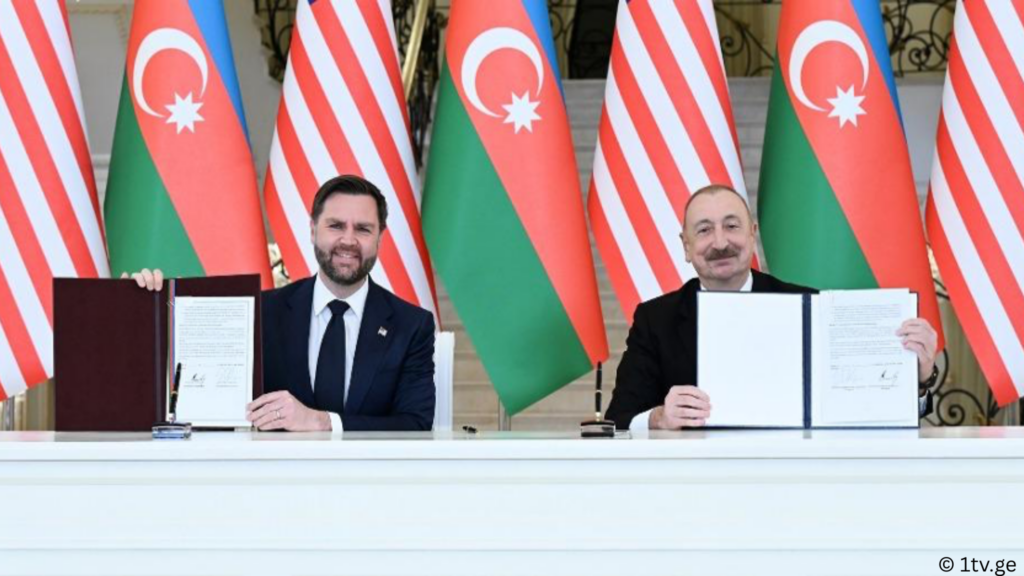
U.S. Vice President J. D. Vance and Azerbaijani President Ilham Aliyev at the signing ceremony of the Strategic Partnership Charter, Baku, February 10, 2026.
J. D. Vance stated that the agreement would formalize the partnership and clearly demonstrate the strength of the U.S.-Azerbaijani relationship. He also announced that the United States would send new ships to Azerbaijan to help protect its territorial waters.
According to Vance, Air Force Two flew over the planned “Trump Route for International Peace and Prosperity” (TRIPP) from Yerevan to Baku. The route is designed to connect Azerbaijan to its Nakhichevan exclave through Armenian territory. The U.S. vice president noted that TRIPP could create new economic opportunities for Azerbaijan, and facilitate the export of natural resources. He noted that the project aims to support the long-term sustainability of the peace agreement between Armenia and Azerbaijan.
“One of the greatest ways to prevent conflict and war is for two nations to work together to achieve greater prosperity. Peace was achieved thanks to the President of the United States, the President of Azerbaijan, and the Prime Minister of Armenia. As a result of joint efforts, peace was achieved where there was war before. In the future, we will create prosperity where there was only war and conflict,” Vance said.
The U.S. vice president also emphasized the longstanding and important strategic partnership between Washington and Baku, noting that Azerbaijan was among the last countries to withdraw from Afghanistan. He added, “We both conducted operations in difficult conditions and were both able to maintain our reputation.”
President Ilham Aliyev thanked the Trump administration for its “very positive attitude toward Azerbaijan.” He stated that signing the Strategic Partnership Charter reflects the productive work of both countries’ teams over the past six months.
“During these six months, we have already been living in a peaceful environment. We are learning to live in peace, and we are very grateful for this major contribution by the United States government,” Aliyev said.
Aliyev added that Azerbaijan has lifted all restrictions on cargo transit to Armenia and has begun supplying oil products, effectively initiating trade and cooperation between the two countries.
Aliyev also highlighted the implementation of the Trans-Caspian international route (“TRIPP”) as a key outcome of the Trump administration’s efforts in the region. He stated, “The Trans-Caspian international route will not only connect the two parts of Azerbaijan, but will also become a reliable, secure, and large-scale transport corridor linking Asia and Europe through the territories of Azerbaijan, Armenia, and other neighboring countries.”
Aliyev stated that relations between the United States and Azerbaijan are “entering an entirely new phase.” He explained that the signed charter provides for cooperation in areas such as security, counterterrorism, and energy security. He also noted that the two countries are beginning cooperation in the defense sector, which he described as “very promising.”