
Armenia’s Foreign Policy
On February 26, 2026, Armenian Prime Minister Nikol Pashinyan announced that significant progress toward opening the land border between Armenia and Turkey is anticipated in the near future.
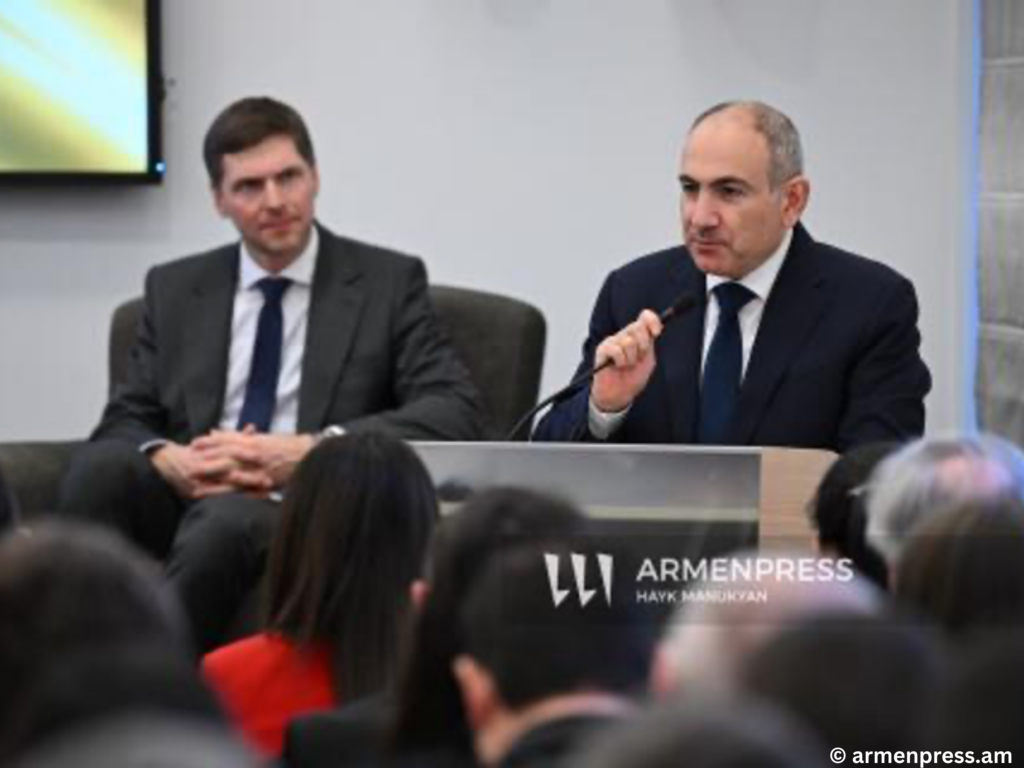
Prime Minister of Armenia Nikol Pashinyan
Nikol Pashinyan addressed foreign ambassadors, diplomats, and representatives of accredited think tanks at the Polish Institute of International Affairs. In response to a question regarding the normalization of relations between Armenia and Turkey, Pashinyan stated: “We have a very positive dialogue with Turkey. We hold regular meetings and consultations. However, the most important development that we hope to see is the establishment of diplomatic relations between Armenia and Turkey, along with the opening of the land border between the two countries. I emphasize the land border because air travel is already possible, with regular flights operating between Armenia and Turkey. My expectation is that the volume of bilateral flights will increase, but we also hope that the land border will be opened. This will require new infrastructure along the border with Turkey, and discussions are currently underway on how the European Union can assist in this process. There is progress, and I believe that we will see some results very soon.”
He further noted a general consensus regarding the eventual opening of the border, while emphasizing that the ultimate decision rests with Turkey.
“There are no obstacles from the Armenian side; we are ready to proceed at any time. In recent months, we have consistently stated our readiness to provide a route for trucks traveling between Turkey and Azerbaijan. The necessary infrastructure is fully operational, and now we await Turkey’s decision,” Pashinyan said.
The Armenian Prime Minister began a working visit to the United States on February 18, 2026. On February 19, he attended the inaugural meeting of the Peace Council in Washington and met with Azerbaijani President Ilham Aliyev.
Simultaneously, Russian border guards were withdrawn from the Akhuriki checkpoint on the Armenian-Turkish border. Consequently, all Armenian border crossings, including those with Iran and Georgia, are now under the control of Armenia’s National Security Service.
Russian border guards were first withdrawn from Zvartnots International Airport, and later from the Armenia–Iran border. These steps have reduced Russia’s oversight of Armenia’s borders.
According to a report published by the National Security Service of Armenia, beginning in 2026, the Akhurik checkpoint on the Armenian-Turkish state border will be staffed exclusively by military personnel from the Border Troops of the National Security Service of Armenia. The report further notes that all operational checkpoints on the Armenian state border are currently under the full control of the National Security Service of Armenia’s border guards.
Armenia’s Domestic Politics
Armenia is undergoing a period of political realignment in anticipation of parliamentary elections scheduled for June 7, 2026. Opposition figures have announced the formation of a new alliance, which they claim is intended to establish a “center of power.” The ruling party has cautioned that this development may represent a “national rehearsal” of the Gyumri scenario.
Pro-Russian politician Andranik Tevanyan, leader of the Mother Armenia party, and businessman Gagik Tsarukyan, leader of the Prosperous Armenia party, announced the formation of the new political bloc. Tevanyan previously served as a member of the opposition faction led by former President Robert Kocharyan.
Tevanyan stated that the alliance represents the creation of a “serious program and team,” with the objective of changing the government. He emphasized that 2026 “should be the year of the end of the current regime.”
The Tevanyan-Tsarukyan alliance may be joined by the Democratic Alternative party, led by political scientist Suren Surenyants. Media reports indicate that former National Security Service head Artur Vanetsyan could also enter the race, although no official decision has been announced.
Businessman Samvel Karapetyan, whose party Strong Armenia has expressed intentions to secure a qualified majority, is pursuing an independent campaign. Karapetyan is currently under house arrest, facing charges of publicly calling for a seizure of power. Although the party has nominated him as its candidate for prime minister, constitutional restrictions on his Russian and Cypriot citizenship complicate his candidacy.
Karapetyan’s team has publicly dismissed the possibility of coalition arrangements, and expresses confidence in their prospects for victory. They assert that “this government will no longer exist on June 8.”
Prime Minister Nikol Pashinyan has issued strong responses to his opponents, characterizing the return of oligarchs and former presidents to politics as an effort to discredit the country. Pashinyan maintains that following the elections, “not a single oligarch or a single former president” will remain active in the political arena.
The opposition interprets these statements as indicative of fear. According to Kocharyan’s office, after June 8, “there will be no leader who will make the nation ashamed.”
Former President Serzh Sargsyan’s party has not yet announced its participation in the elections, but it continues to criticize the ruling party for what it describes as the “failure of the country” under Pashinyan.
The confrontation is driven by more than internal power struggles. The ruling party asserts that the bloc led by Kocharyan and two businessmen has not explicitly confirmed whether it would sign the peace agreement with Azerbaijan if it assumes power. According to Rubinyan, the bloc has discussed the “revision” of the agreement and the need for “additional guarantees,” but has not provided a direct commitment.
Within this context, the elections extend beyond the allocation of parliamentary mandates: the outcome will determine whether Armenia maintains its current peace framework or seeks to revise it, as well as the potential costs of such changes.
Recently, representatives of the ruling party have raised concerns about the possibility of a scenario similar to “Operation Gyumri-2,” referencing the early municipal elections in Gyumri in spring 2025, during which no party secured 50%+1 of the vote.
Although the “Civil Contract” party received the most votes in Gyumri, Armenia’s second-largest city, opposition parties declined to form a coalition. Ultimately, three opposition parties united to support the Communist Party of Armenia’s candidate, Vardan Ghukasyan, who became Gyumri’s mayor. Ghukasyan was subsequently arrested on corruption charges.
The Gyumri case demonstrated that receiving the most votes does not guarantee political power. The current question is whether the opposition can replicate this strategy nationally, and whether the electorate is prepared for the potential return of oligarchs and former presidents.
The outcome of the June 7 elections will determine not only the next Prime Minister, but also the country’s future direction.
On February 25, 2026, Vice President of the National Assembly of Armenia Ruben Rubinyan stated that the June 7 parliamentary elections will be a choice between the current government and the bloc led by former President Robert Kocharyan and the “two oligarchs.” He warned that a return to power by Kocharyan, Gagik Tsarukyan, and Samvel Karapetyan would restore corruption and threaten the peace with Azerbaijan.
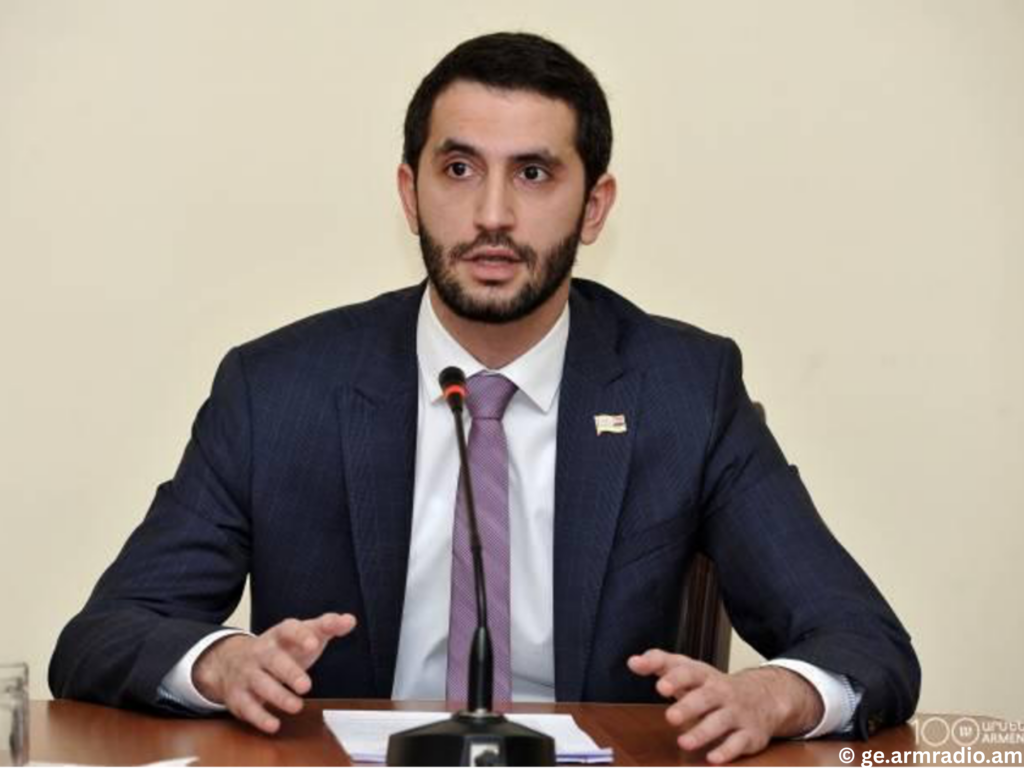
Vice President of the National Assembly of Armenia Ruben Rubinyan
Rubinyan, a leader of the ruling party “Civil Contract,” stated that the party seeks a constitutional majority. He added, “Robert Kocharyan and the two oligarchs, and in fact all oligarchs, must be expelled from the political arena and from parliament.”
He added that parliament can serve as a “platform for normal political debate” only if voters fully distance themselves from Kocharyan and his associated business circles, and noted that all public opinion polls indicate the ruling party’s advantage, though he did not cite specific studies. He emphasized that the government is not concerned about defeat, but voters should be informed about “what is happening” in the political arena.
He asserted that the opposition seeks to create the appearance of division among groups, while in reality they are acting in coordination. He cited Aram Vardevanyan, a former MP from Kocharyan’s team who, according to Rubinyan, now represents Karapetyan’s interests, and Andranik Tevanyan, who moved from Kocharyan’s bloc to work with Tsarukyan.
Rubinyan emphasized that both political platforms and a clear vision for the future, along with personnel, should be decisive in the pre-election campaign.
Azerbaijan’s Foreign Policy
On February 19, 2026, Azerbaijani President Ilham Aliyev attended the Peace Council meeting in Washington, where he met with Armenian Prime Minister Nikol Pashinyan.
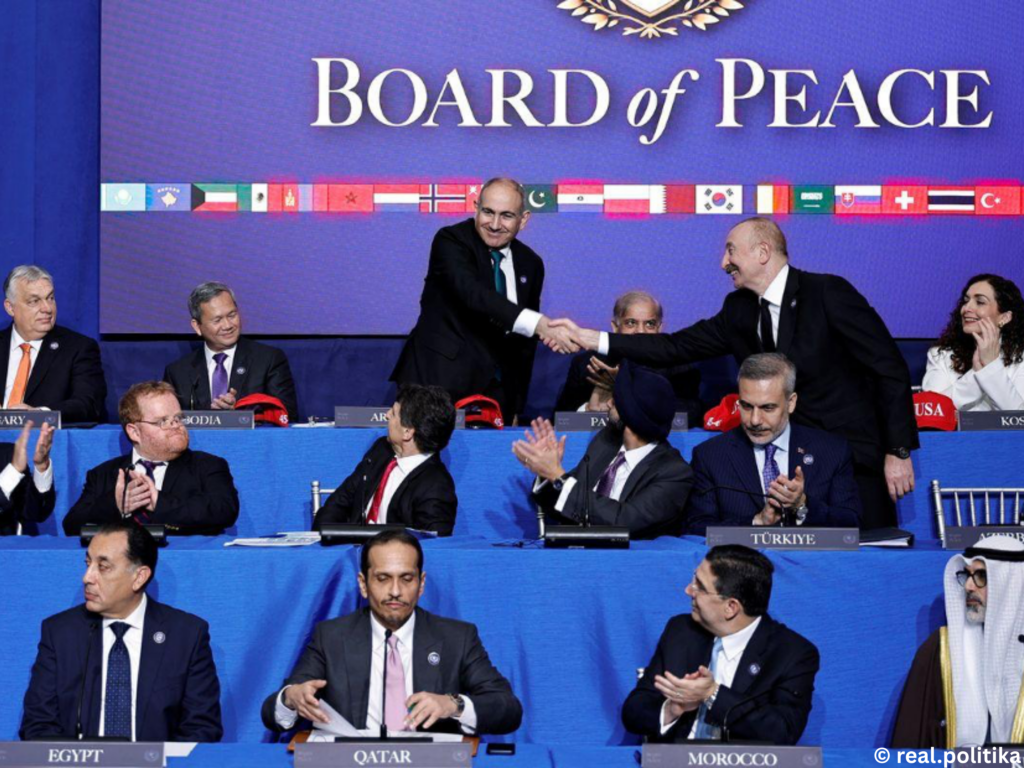
Azerbaijani and Armenian leaders at the first meeting of the Peace Council
During the inaugural session of the Peace Council, US President Donald Trump addressed Armenian-Azerbaijani relations, stating that the leaders of Armenia and Azerbaijan have become “good friends.”
“After 30 years of fighting, you have realized that there is nothing more important than peace. You and your new friend have done something great. We resolved this conflict in about 24 hours. I think they became friends. For 32 years, they were killing each other. It was very uncomfortable for them to be next to each other in the Oval Office,” Trump emphasized. “I asked: can you come closer? An hour later, they were already next to each other. We reached an agreement. They signed, and we made peace with two very important countries. I will never forget that,” Trump noted, urging Pashinyan and Aliyev to shake hands.