
Introduction
On October 9, 2026, Abkhazian Telegram channels circulated a statement by de facto president Badra Gunba announcing that Russian and Abkhazian forces would be carrying out joint large-scale joint operational-tactical exercises. The de facto defence ministry subsequently released further details about the planned activities and warned civilians to expect the sounds of explosions. It urged residents “to remain calm, not to panic, and receive this with an understanding,” assuring them that everything was being executed “in the strictest accordance with the plan.”
The scale of the exercises was particularly noteworthy, given the limited capabilities of the so-called Abkhazian military and the size of the remaining Russian military contingent in the territory. All reported activities took place in the eastern part of occupied Abkhazia. At least in part, the exercises appear to have been a response to the growing number of Ukrainian UAV attacks targeting Sochi, which Abkhazian forces have largely failed to intercept before the drones reach Russian airspace.
The article provides an overview of the activities conducted during the exercises from 12-16 October, and assesses the available visual evidence. All images presented below, with the exception of satellite imagery, are taken from videos published by Abkhazian and Russian online media outlets.
Abkhazian “Armed Forces”
According to the Abkhazian “legislation,” the “armed forces” of Abkhazia are not solely restricted by the de facto defence ministry, but include every “government body” whose personnel are permitted to carry service weapons (firearms). These bodies are: military units of the so-called defence ministry; armed units of the so-called Ministry of Internal Affairs and so-called Ministry of Emergency Situations; units of the so-called State Security Service; special units of the so-called State Protection Service; special units of the Agency for Government Communications; and the so-called Immigration Service of the Republic of Abkhazia.
The “Abkhazian army” is a mixed paramilitary formation created on a partially professional basis. It includes active service members (soldiers) and, in order to increase its numbers, relies on a compulsory reserve, which in turn is formed by the “citizens” of occupied Abkhazia. The so-called “Law on Reserve” of Abkhazia obligates its “citizens” to enlist for the reserve. The reserve constitutes a part of the armed forces and is subordinate to the General Staff of the de facto defence ministry.
Nearly all of the aforementioned de facto authorities, aside from the “Immigration Service” and the “Agency for Government Communications” had a role in the October 12-16 activities.
Types of Exercises and the Units Involved
The initial announcements set the aims of the exercises and pointed out three main directions of operation: to repel a UAV attack against critical infrastructure, to counter and execute diversion and reconnaissance groups (saboteur units) attempting to penetrate their territory, and coordination.
The exercises included military personnel from the de facto defence ministry, the “State Security Service of Abkhazia,” units from the “Ministry of Emergency Situations,” reserve forces, and Russia’s 7th Military Base, including a jet squadron. According to a local media outlet, over 4500 personnel have been involved in various activities, along with 90 different types of weapons, and other military equipment. On October 16, Sputnik Abkhazia stated: “The exercises involved operational personnel from the Ministry of Defence and the General Staff of the Armed Forces, standing readiness military units, wartime reserve formations, territorial defence forces and assets, military units and organisations of various ministries and departments, as well as military enlistment offices.”
The entirety of the Abkhazian “armed forces” were utilised during the exercises. The drills were carried out in coordination with the Armed Forces of the Russian Federation, represented locally by Russia’s 7th Military Base, under the Joint Command. “Joint Command” was mentioned by only a single media outlet, however, it most likely refers to the Joint Military Group, established based on the November 2015 agreement between Russia and Abkhazia. The agreement entered into force in 2016.
The 2nd Motorized Rifle Battalion of the Abkhazian “armed forces” was tasked with repelling a simulated coastal assault near Ochamchire. Tank and artillery units provided direct fire against the opposing force to clear a path for the advancing infantry. Meanwhile, anti-aircraft units using ZU-23 guns and machine gun-mounted pickup trucks engaged enemy drones, supported from above by Russian jet aircraft.
At the Tsebelda training range, Andrey Bartsits, commander of the Kodor Operational Group, led heavy vehicle maneuvering and infantry drills against infiltrating sabotage units belonging to the enemy. The units deployed reconnaissance quadcopters and FPV drones, including those capable of dropping munitions. Ground operations were supported by a Mil Mi-8 helicopter equipped with rocket pods, while Russia’s 7th Military Base provided BTR-82 armoured personnel carriers for additional manoeuvres.
Meanwhile, the Abkhazian Ministry of Emergency Situations organised a large-scale drill centred on the port and city of Ochamchire. The scenario simulated an enemy UAV attack on the port area. Naval vessels secured the perimeter, while a fireboat tackled fires on the water. In the city centre, authorities managed evacuations and put out fires after a building was “hit.”
They also mobilised reserve forces composed of civilians. Under local “legislation,” these reserves form part of Abkhazia’s “armed forces.” They fall directly under the de facto General Staff during wartime. Notably, these forces lack a uniform, with some individuals dressing in ordinary jeans, reflecting a broader supply issue within the Abkhazian military. Even regular forces lack modern equipment, including helmets and body armour. Only a few specialised formations, such as the armed units of the so-called State Security Service, possess relatively modernised, standardised uniforms and protective gear.
Locations
The exercises took place in multiple locations, however, the Abkhazian and Russian military conducted the majority of their activities at the Port of Ochamchire, Tsebelda Range, Nagvalou Range, and within Ochamchire itself.
Ochamchire, Port, and the Nagvalou Military Range
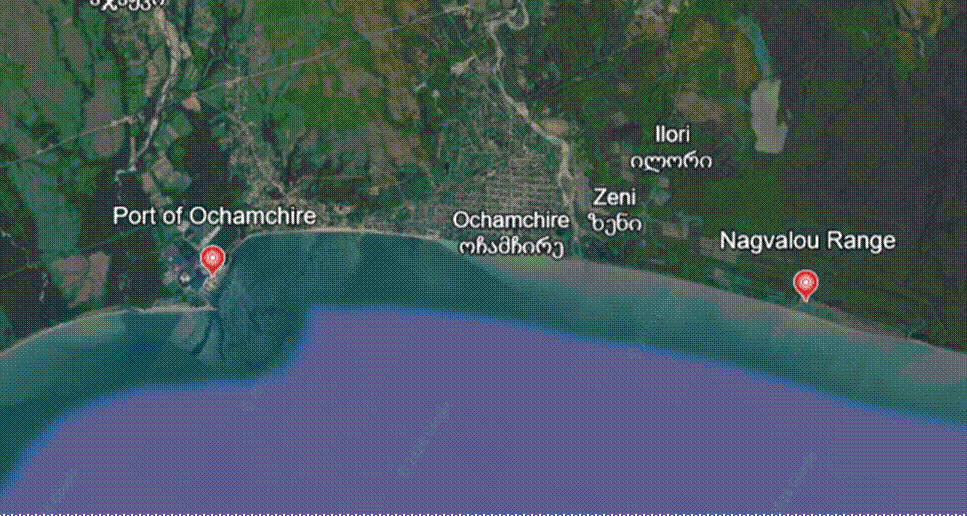
Satellite view of Ochamchire, with the port on the left and the Nagvalou Military Range on the right. Source: Google Earth
Tsebelda Range (Tsabal/Цабал)
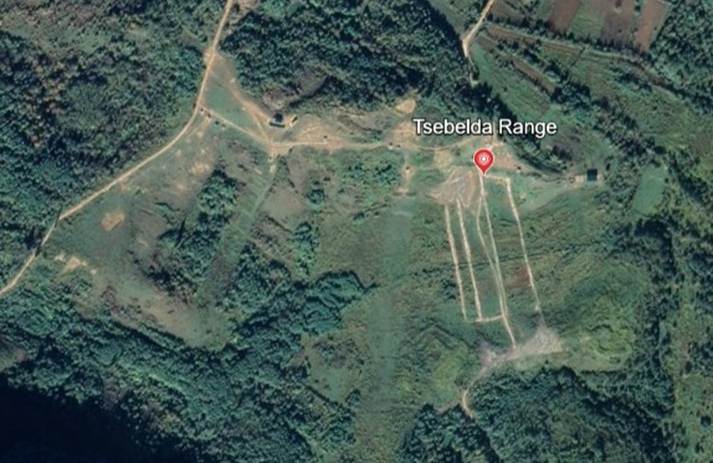
Satellite view of the Tsebelda Military Range. Source: Google Earth
Coordinates: 43°00’52.02″N 41°16’28.24″E
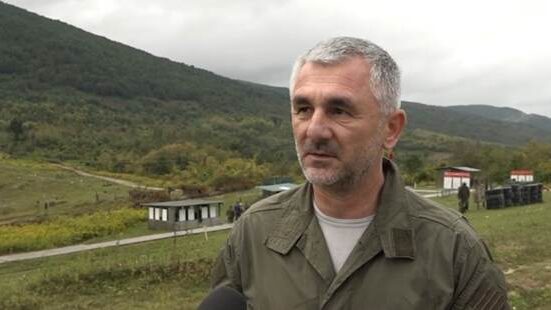
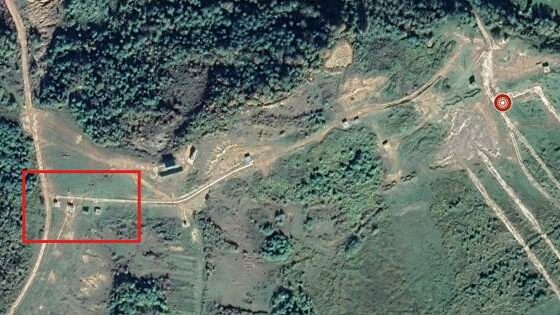
On the left, Raul Lolua, de facto secretary of the so-called Security Board of Abkhazia. On the right, the exact location of the background infrastructure behind him at the Tsebelda Range.
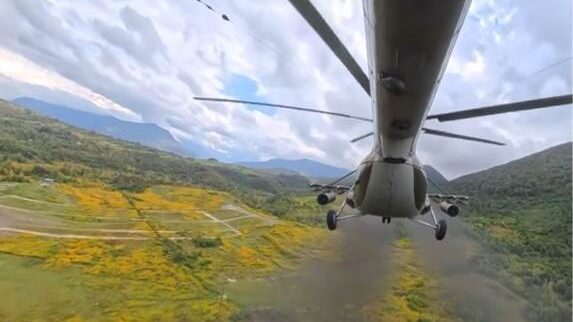
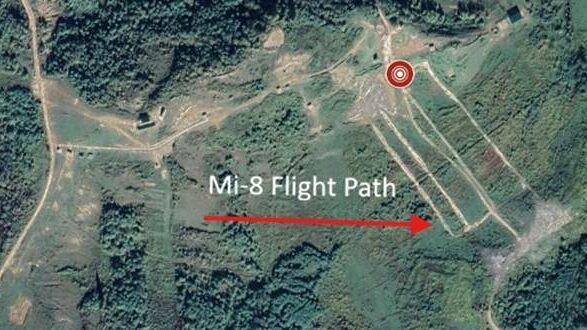
An Mi-8 helicopter executing a mock-assault phase, launching a rocket barrage during recent exercises. The image on the right shows its flight path.
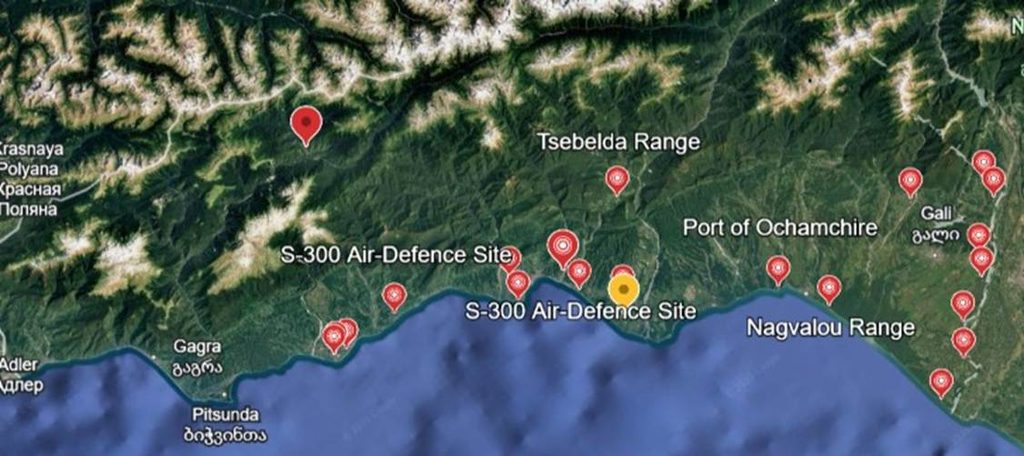
A wider view of the Tsebelda Range, located alongside other military-purpose sites in occupied Abkhazia.
Equipment
Russian and Abkhazian media provided extensive photo and video material showing the activities during the exercises. The footage enabled us to identify various military equipment currently in service in the occupied region.
Jets
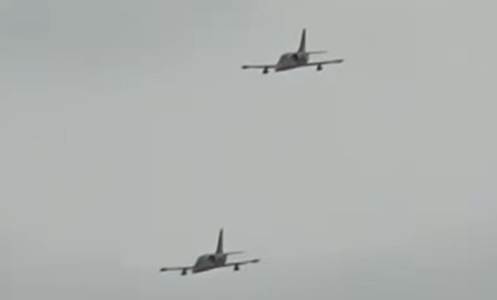
In several videos published during and after the exercises, the Abkhazian de facto authorities and journalists claimed the involvement of reconnaissance and attack aviation, and aired footage of two jet aircraft launching a barrage from a distance. The two jet aircraft have distinct features that point towards them being Czechoslovakian-made Aero L Albatross training jets, currently used in the Russian military and also present at the Russian airbase in Gudauta in occupied Abkhazia.
Helicopters
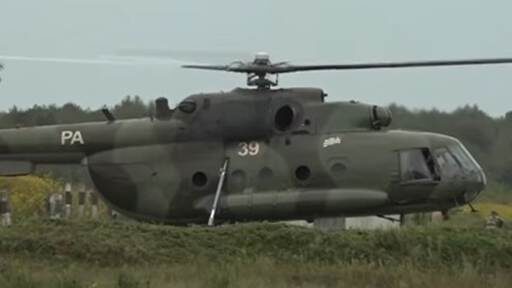
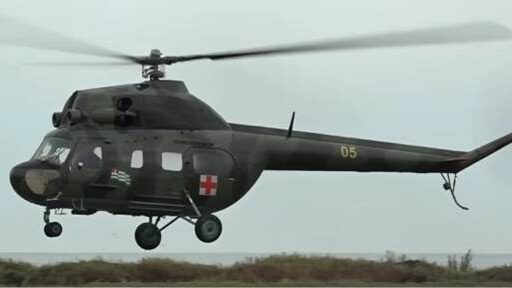
The Abkhazian de facto authorities also used two helicopters: Mil Mi-2 and Mil Mi-8. The Mil Mi-8 shown in the footage is an older variant of the Mi-8. The Mil Mi-2 is also an older variant of the aircraft that was introduced in 1965. During the exercises at the Tsebelda Range, the Abkhazian military showcased another Mil Mi-8 mounted with rocket launchers, however, the weapons were most likely mounted to the same Mi-8 that was used earlier at the Nagvalou Range for different purposes. Footage released by another local media outlet clearly shows that these Mi-8s share the same number: 39.
Tanks
The Abkhazian military utilised 8 to 10 units of T-55 tanks during the exercises. T-55 is a derivative of the T-54 tank, and was introduced to the Soviet army in 1956.
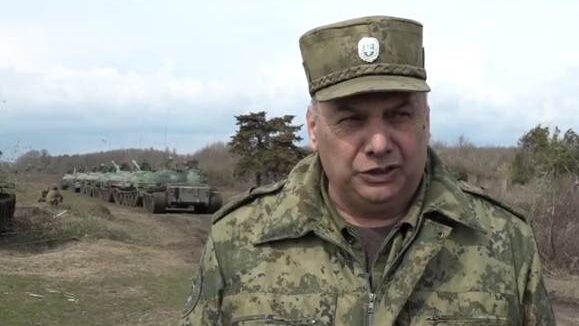
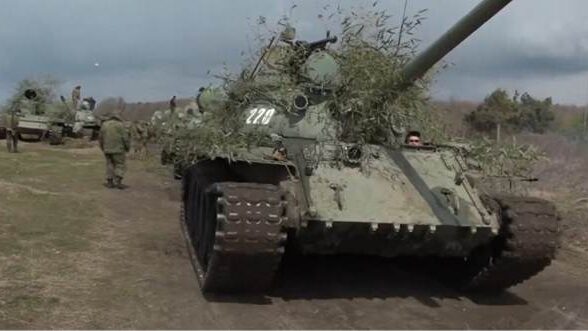
On the left, Deputy de facto defence minister of occupied Abkhazia, Lizbert Potskhor-Ogli, with T-55 tanks in the background.
Armoured Personnel Carriers / Infantry Fighting Vehicles
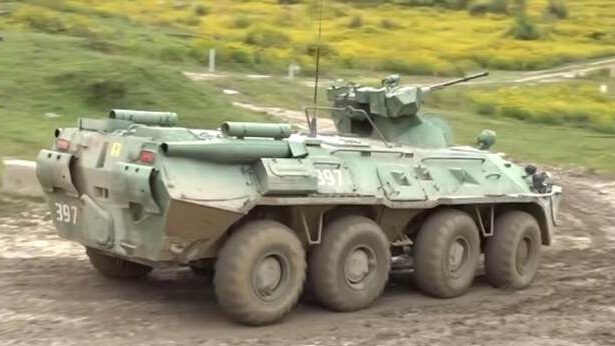
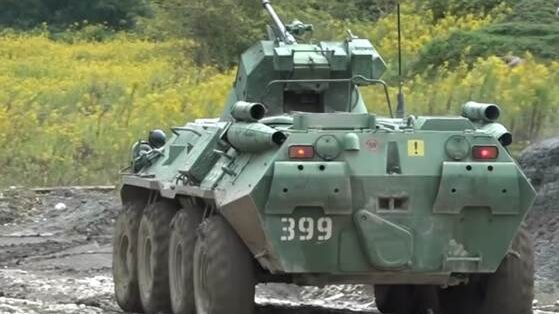
The footage from the Tsebelda Range showed BTR-82 Infantry Fighting Vehicles participating in the exercises. These armoured vehicles belong to Russia’s 7th Military Base deployed in occupied Abkhazia. There are no reports indicating the Russian defence ministry ever transferred these modernised BTRs to the Abkhazian military. Both of these BTR-82s have a “У” symbol on the front.
Anti-aircraft guns
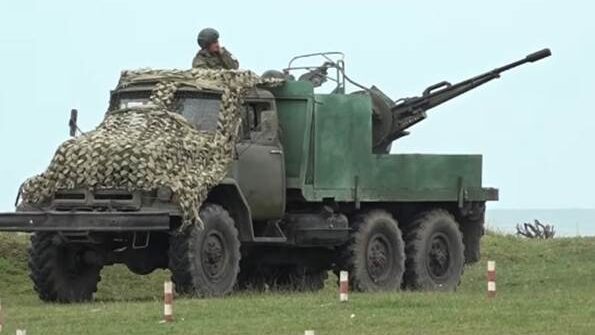
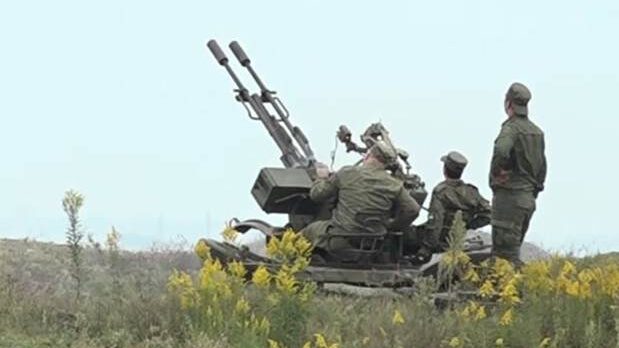
On the left, a Soviet-made ZU-23 mounted on a Soviet-made ZIL 6×6 truck. On the right, a towed variant of the same ZU-23.
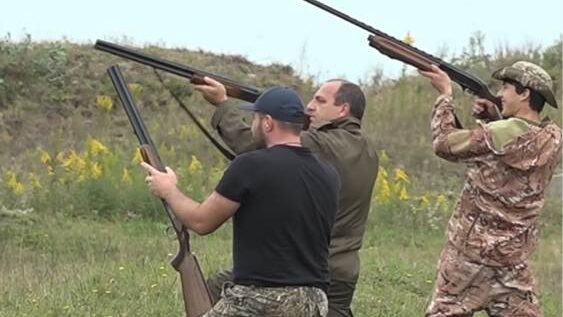
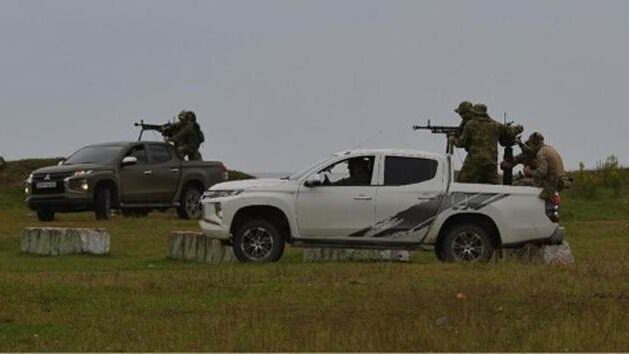
On the left, double- and single-barreled shotguns used by Abkhazian personnel for anti-drone purposes. On the right, machine-guns mounted on pickup trucks. This specific setup has become widely adopted in the Russo-Ukrainian war, where mobile air defence units hunt down enemy UAVs using machine guns mounted on pickup-trucks.
Naval Vessels
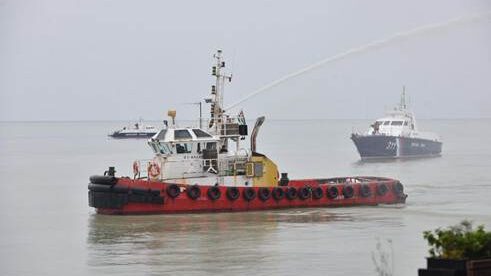
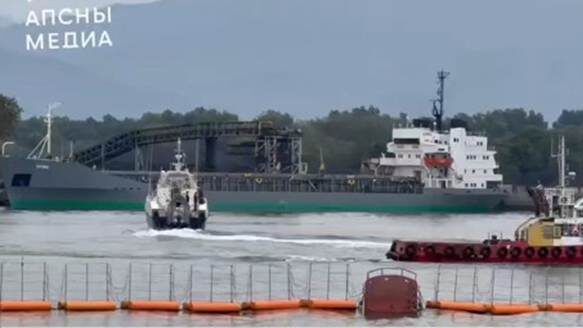
Although local and Russian media provided limited footage of naval vessels, the available material allowed us to identify several craft. The most prominent vessel featured in the exercise was a fireboat operating out of the port of Ochamchire. Russian FSB Border Guard vessels were also present, with Russian flags and the label “Coast Guard” (Russian: береговая охрана). Additional footage showed a large freighter docked at the port.
Other Equipment
In addition to the previously mentioned vehicles, Russian and Abkhazian forces used Mavic reconnaissance drones, standard FPV strike drones, AGS-17 grenade launchers, RPG-7 rocket-propelled grenade launchers, Chinese-made motorcycles, MT-LB armoured vehicles fitted with a ZU-23 anti-aircraft guns, mortars of various calibres, and standard small arms.
Conclusion
The October 12-16 maneuvers appear to be the largest military exercises conducted by the Abkhazian “armed forces” in 2026. While Russia’s 7th Military Base has rarely disclosed details regarding its tactical exercises in recent years, the 49th Combined Arms Army of Russia’s Southern Military District, which the base subordinates, remains heavily engaged in the war in Ukraine.
Several observations can be made based on the analysed footage:
- The Abkhazian military is attempting to project strength, and to reassure the local population that it remains a credible, functional force;
- Although marketed as joint Abkhazian-Russian manoeuvers, direct Russian military involvement was minimal. The available footage revealed only two Russian training jets and two BTR-82 armoured personnel carriers from the 7th Military Base;
- Russia has provided equipment to boost Abkhazia’s anti-UAV capabilities. Since the beginning of the year, Russian forces have been transferring machine-gun-mounted pickup trucks and ZU-23 anti-aircraft guns to the de facto Ministry of Defence;
- The primary operational focus was on counter-UAV tactics. Both Russian and Abkhazian forces are attempting to adapt to Ukrainian UAV threats, which have increasingly utilised Abkhazian airspace to target infrastructure in Sochi, Russia;
- Even regular Abkhazian units lack modern equipment. Personnel predominantly wear outdated uniforms and body armour ill-suited to modern warfare, while their heavy equipment consists largely of obsolete legacy systems, including T-55 tanks, ZIL trucks, and MT-LBs;
- Lastly, Russians and Abkhazians drew particular attention to the port of Ochamchire. Concentrating most of their drills in and around Ochamchire underlines the strategic importance of the port.