
Introduction
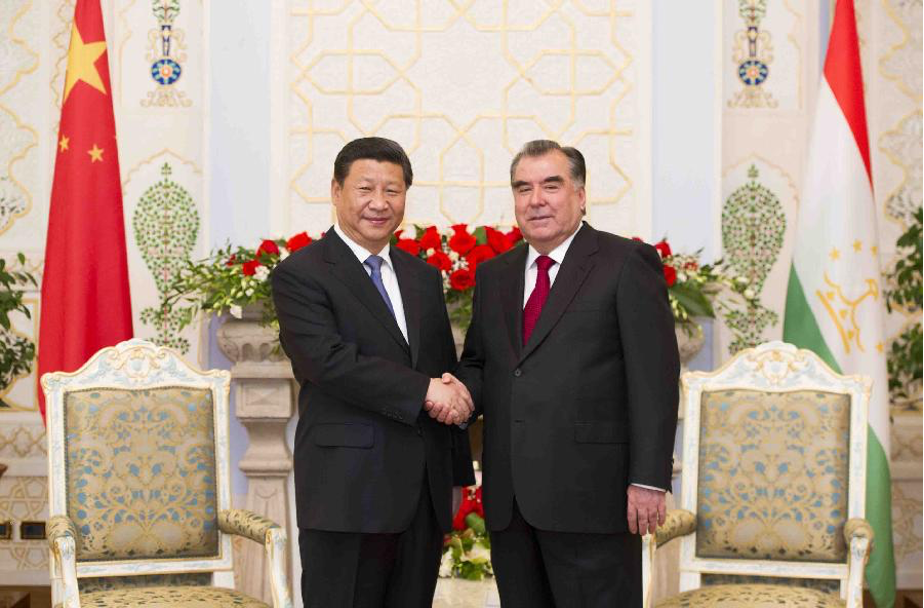
Tajikistan has welcomed both Russia and China in wide-ranging and comprehensive partnerships. In 1993, shortly after the collapse of the Soviet Union, Russia signed an agreement with Tajikistan on Friendship, Cooperation and Mutual Assistance. Such agreements had been used by the Soviet Union to form alliances that were later adopted by the Russian Federation. China moved to sign a similar agreement on Good-Neighbourliness, Friendship and Cooperation in 2007, marking a significant change in its policy towards Tajikistan and the wider region. The treaty was later amplified by China and Tajikistan declaring “strategic partnership.”
The article overviews important developments in post-Soviet Tajikistan, with a particular focus on China’s growing involvement and advancing of its interests in the country. Russia and China have both played roles in Tajikistan’s state-building and economic development, from border security to economic initiatives. Tajikistan is considered to be the poorest country in the region, with most of its land area made up of mountains, despite it being rich in natural resources, including precious metals.
Russia in the Post-Soviet Tajikistan
Conception of the 201st Military Base
On October 17, 2004, the president of Tajikistan, Emomali Rahmon, and the Russian president, Vladimir Putin, attended the opening ceremony of the 201st Military Base in Tajikistan. According to Putin, the military base would ensure peace and stability in Central Asia and security for the whole Commonwealth of Independent States (CIS). Upon its conception in 2004, the base was designated as the 4th Military Base, until this designation was transferred to another Russian post, also beyond its borders, in Georgia’s occupied Tskhinvali region (also known as South Ossetia).
The 201st Military Base was founded on the structure of the 201st Division, which in turn was a descendant of a disbanded Soviet Army brigade which suffered irreversible losses during the Siege of Leningrad in World War II. The 201st Division had been stationed in the Baltics before being transferred to Stalinabad in the latter half of 1945. Stalinabad would later be renamed Dushanbe, the capital of Tajikistan.
The division was deployed to Afghanistan in 1980 to participate in the Soviet-Afghan War, being one of the last Soviet military formations to leave the country in 1989, when it returned to Tajikistan. For its “achievements” during the war in Afghanistan, the division was awarded the Second Order of the Red Banner, first conferred during World War II.
A civil war broke out in Tajikistan in 1992 following the collapse of the Soviet Union. The same year, Emomali Rahmon (then Rahmonov) took charge of the country with direct support of the now-Russian 201st Division units. He was elected President of Tajikistan in 1994, a position that he still holds. The Russian military exercised effective control over Tajikistan’s borders and civil order, and secured government and military sites, particularly until the end of the civil conflict in 1997.
Current State
Russia’s 201st Military Base is known to be the largest among the extraterritorial military formations, originally accommodating and hosting thousands of Russian servicemen and a stockpile of heavy equipment. The large-scale military reform launched in Russia following the Russo-Georgian War in 2008 also affected the 201st Military Base, seeing it undergo a major reshuffle and the start of participation in combined military exercises.
Eventually, the division was reinforced with modern heavy equipment, and started forming new units at the company and battalion levels. The reform launched in 2008 concluded in 2020 with the introduction, rearming, and modernising of the tank battalion pool, the aviation group, missile launchers, stockpiles, and the command structure.
The units of the 201st Military Base have been actively engaged in the full-scale invasion of Ukraine since 2022. In 2024, the Russian defence minister, Andrey Belousov, thanked the servicemen and commanders of the 201st base for the courage and heroism shown in the battles around Pokrovsk of the Donetsk Oblast in Ukraine.
According to the latest data, the Commander of the 201st Military Base is Major-General Andrey Marushkin, who has held this position since 2022. Ukraine has designated him a war criminal, and included him on its wanted criminals list.
Border Control
Soon after the collapse of the Soviet Union, the Russian Federation began reorganizing the legal foundations of its relations with the former Soviet republics. Tajikistan was among them. Changes were made not only at the borders, but in the reinforcement of Russia’s interests in the newly formed republic, which, at the time, was experiencing a civil war.
In 1993, Russia and Tajikistan signed an agreement on the legal status of Russian border forces in Tajikistan. Prior to this, Russia had controlled Tajikistan’s borders via a 1992 agreement between the Russian and Tajik delegations. The agreement allowed Russia to inherit effective oversight of Tajikistan’s borders with Afghanistan and China. The document was comprehensive, and gave Russia the right to control and oversee all cross-border traffic, including the entry of civilians, light vehicles, trucks, goods, etc. The agreement further granted the Russian Border Force and its servicemen immunity and legal status. Russia exercised control over Tajikistan’s borders under this agreement until 2005, with a formal transition completed by 2006. In 2003, Russia formally introduced the Federal Security Service (FSB) Border Force as a key entity in ensuring Russia’s interests at Tajikistan’s borders.
In 2004, Russia and Tajikistan signed a separate agreement which placed Tajikistan’s border with Afghanistan under direct Russian control. This document also allowed Tajik citizens to undergo military service in the Russian FSB’s border forces. However, unlike the 1993 agreement, there was no mention of Tajikistan’s border section with China.
From 2006 onward, Russia shifted from a total-control approach at Tajikistan’s borders to supporting and training local government forces to carry out some of the tasks, while maintaining its own significant leverage. The current agreement concerning Tajikistan’s borders was signed in 2011, and established a Group of Border Cooperation. Based on this agreement, Russia assumed responsibility for, among other things, ensuring border security, prevention of human, illegal arms, and drugs trafficking. It also cooperated with its Tajik counterparts in other security domains.
Tajikistan-China Border Disputes and Settlement
Chinese claims to parts of the eastern territories under the control of Tajikistan, within the Gorno-Badakhshan Autonomous Region, formed the core of the Sino-Tajik territorial dispute. The roots of this dispute lay in 19th-century relations between the Russian Empire and China’s Qing dynasty. The Convention of Peking (1860) initiated this process, followed by the Protocol of Chuguchak (1864), which aimed to demarcate the boundary between the mountain ranges.
While the northern sections were further demarcated through agreements in 1869–1870, the southern boundary, including the Pamir region, was only finalized later, through surveys linked to the Treaty of Saint Petersburg (1881). These disputes were passed from Imperial Russia to the Soviet Union, which Tajikistan was a part of.
Tajikistan inherited disputed border issues with China after the dissolution of the Soviet Union, which were repeatedly addressed, yet remained unsolved until 2011. In 1993, the two countries signed a joint declaration and agreed on the principles of a peaceful resolution. Years of bilateral negotiations culminated in Tajikistan transferring jurisdiction on some of the disputed territories to China, thus creating a legal basis for the consequent conclusion of the demarcation process in 2011.
The demarcation of the border did not receive the support of all Tajik communities, with some arguing that the ceded territories contained significant deposits of precious metals, gems and uranium, although the exact details and locations of these have not been identified or proven. Several political figures in Tajikistan claimed that China sought economic interests in these regions, not merely political ones.
Russia’s Departure from the Sino-Tajik Border
On October 17, 2002, Russia and Tajikistan signed an agreement on transferring the China-Tajikistan border section overseen by Russia’s Border Forces to Tajikistan’s effective control. The document emphasized Tajikistan’s readiness “to receive the section of the border,” along with equipment and infrastructure at the time utilized by Russian servicemen. The agreement was signed in Yerevan, Armenia, and entered into force the same day. The document became a significant part of the Sino-Tajikistan border dispute resolution process, which allowed China to address the issue directly with Tajik officials without Russia’s participation.
China’s Growing Involvement in Tajikistan’s Economy
China began accelerating economic initiatives in Tajikistan once Emomali Rahmon consolidated power in the late 1990s. In 2001, Tajikistan became a founding member of the Shanghai Cooperation Organization (SCO) along with China, Russia, Kyrgyzstan, and Kazakhstan. The SCO primarily focused on regional stability, safe borders, and further development of economic relations.
In 2006, China invested $1.5 billion in Tajikistan through loans and grants. The funds were directed to the 500 kV North-South power transmission line project and the first stage of the Dushanbe-Khujand-Chanak road construction. By 2022, Chinese direct investments amounted to $6.4 billion, with 84% as a direct loan. All loans were provided by the Chinese Export-Import Bank, China Development Bank, and China’s Ministry of Commerce.
Following these major commitments, Tajikistan and China signed the strategic ‘Treaty of Good-Neighbourliness, Friendship and Cooperation between Tajikistan and China’ on January 15, 2007. This treaty was further amplified by the 2008 joint declaration of China and Tajikistan on further development of friendship and cooperation. The treaty and subsequent declaration emphasised the importance of deepening and strengthening economic ties; however, one of the more significant statements concerned the One China policy.
Tajikistan “firmly” acknowledged and followed the One China Principle, according to which the government of the People’s Republic of China was the sole legal entity governing and representing the whole of China, including Taiwan. The latter was acknowledged by Tajikistan to be an inseparable part of China. The Tajik government further pledged to oppose and refrain from joining any regional or international organisation not following the aforementioned principle.
China’s growing interest in Tajikistan’s economy was also reflected in the operations of Tajikistan’s consulate in China. In 2007, the number of Tajikistan visas issued for Chinese citizens stood at 4000. Following the new investment and agreements, that number doubled in 2008.
By 2012, several of the major infrastructure projects funded by the Chinese government had been completed. According to the National Bank of Tajikistan, China’s direct investment flows in Tajikistan peaked in 2014-2015. This was not due to lack of interest or commitment, but rather the “upper ceiling” imposed by the economic capacity of the target country itself. To date, China remains Tajikistan’s largest creditor.
In 2025, China overtook Russia to become Tajikistan’s largest trading partner. Trade between the two countries grew by 30% from 2024 to 2025. China had already become Tajikistan’s largest investor, overtaking Russia, back in 2017. Chinese companies currently operate in Tajikistan’s energy, mining, chemical, infrastructure, textile and other sectors.
Tajikistan has imposed annual quotas on its foreign workforce for years, with a large share consistently allocated to Chinese citizens. Official data suggests that around 70% of these quotas have been given to workers from China, while Russian citizens tend to receive 2-3%. These numbers have been stable since at least 2019. Presumably, this workforce has been utilized by Chinese companies in various industries predominantly registered within the Free Economic Zones created within Tajikistan.
Tajikistan’s Free Economic Zones
Tajikistan operates five Free Economic Zones (FEZ): Sugd, Danghara, Panj, Ishkoshim, and Kulob. These zones create a micro economic environment for foreign investments, and exempt investing companies from paying the majority of local taxes, including import tax for raw materials. In addition, the government guarantees the legal frameworks over a number of years, granting the foreign companies stability in their operations for the foreseeable future.
Access to these zones requires a one-off $5,000 certification fee, complemented by low-cost land leases fixed at $1 per square meter annually. To mitigate political risk, the legal framework includes clauses that protect current investors from future shifts in national legislation for a specified duration. These FEZs host Chinese oil refineries, metal plants, mining companies and other manufacturing industrial factories built and operated primarily by Chinese and Russian enterprises. Russia is the main provider of oil for Tajikistan, which is refined at Chinese plants registered at FEZ Danghara.
Sino-Tajik Projects in Education and Culture
In parallel to investing billions of dollars and amplifying trade turnovers, China has pursued cultural and educational approximation projects in Tajikistan. In recent years, China and Tajikistan have signed multiple bilateral memoranda, and agreements on cooperation in education and exchange programmes, which include “Chinese Bridge,” allowing Tajik students to do their post-graduate studies in China. Several Tajik universities have introduced the “Specialty + Chinese Language” programme, which focuses on technical subjects while obtaining some proficiency in Chinese.
Meanwhile, Russia has been steadily raising quotas for Tajik students willing to enroll at Russian universities. The number has grown from 600 in 2017, to over 1000 today.
Further, Tajikistan has been annually celebrating China culture days, with the president of Tajikistan issuing official congratulations to his Chinese counterpart on the Chinese New Year.
China’s Growing Presence in Tajikistan’s Security Sector
Tajikistan has been introducing a growing Chinese presence in its security sector in recent years. While Russia has remained a dominant security guarantor through its military base and the FSB Border Forces, primarily focusing on the Tajik-Afghan border section, President of Tajikistan Emomali Rahmon has pushed for Chinese arms and technology to be utilized in law-enforcement, civil order, surveillance systems and other domains. China’s increasing interest in investing and broadening its presence beyond economic activities in Tajikistan can be linked to Beijing’s security-related concerns; particularly, but not limited to, its border with Tajikistan.
Under the SCO framework China introduced the concept of “three evils” – terrorism, separatism, and extremism – through which the Chinese government pushed its security-related interests by encouraging the SCO countries to form a multilateral international legal foundation. Regional Anti-Terrorist Structure representations have since launched in many of the member states, including Kazakhstan and Uzbekistan. Uzbekistan has hosted a Chinese regional counterterrorism center since 2004. In 2024, President Rahmon justified the need to create a Chinese counterterrorism center through the SCO in Tajikistan.
In 2016, speculations emerged in Tajikistan that the Chinese government had built posts along the Afghanistan border. At the time, it was thought to be connected to the alleged traffic of Uyghur militants from Afghanistan to China via Tajikistan. This claim could be substantiated by multiple field-specific treaties signed by the two countries during the same period, among them the ‘Treaty between the People’s Republic of China and the Republic of Tajikistan on the Transfer of Sentenced Persons’ that entered into force in 2017; ‘Treaty on Extradition between the People’s Republic of China and the Republic of Tajikistan’ that entered into force in 2017; and the ‘Agreement between the Government of the People’s Republic of China and the Government of the Republic of Tajikistan on the Management System of the China–Tajikistan State Border’ that entered into force in 2015.
Some of the issues stated in these treaties were already addressed in the initial agreements signed between China and Tajikistan in early 2000s, soon after the conception of the SCO. For instance, the 2003 treaty concerning extremism and terrorism included clauses prohibiting signatory countries from refusing the extradition of persons of interest (POIs), and the abstention from exercising the right of granting asylum to POIs included in investigations concerning terrorist or extremist activities.
The new treaties introduced more detailed mechanisms and procedures, including enforcement. However, the Chinese government website on bilateral treaties does not present any document mentioning the military facilities or Chinese armed posts within the territory of Tajikistan. This obscurity is likely what led to researchers naming the new constructions along the Tajik-Afghan border a “secret” military base.
In 2021, when the Taliban came to power in Afghanistan, the Chinese government amplified its security cooperation with the regional countries within the SCO framework. Tajikistan appeared to be the only regional country to formally oppose the Taliban’s takeover of Afghanistan. The Taliban and Tajikistan’s government have since accused each other of fuelling instability.
In 2026, China publicly and officially committed $59.4 million to finance the construction of nine border facilities in Tajikistan’s regions adjacent to Afghanistan. The Tajik parliament approved the agreement on March 4. Murodali Rajabzoda, First Deputy Chairman of the State Committee for National Security of Tajikistan, stated that the total construction area will encompass 17,109 square meters. The project aims to enhance the material and technical capacity of Tajikistan’s border troops. Comparable facilities have previously been constructed with Chinese funding.
This move by China is associated with two incidents that occurred along the Tajik-Afghan border in the autumn of 2025. On November 26, a drone strike originating from Afghanistan killed three Chinese workers employed by a mining company, and injured one. On November 30, gunfire from across the border resulted in the deaths of two Chinese workers involved in a road construction project, and injured two others.
Despite the formal referrals to the situation in Afghanistan, China’s accelerating presence in the region could be dated back to the 2010s. In 2016, China initiated the Quadrilateral Cooperation and Coordination Mechanism, which included China, Pakistan, Tajikistan and Afghanistan. The mechanism was assumed to be a lever for China to grow its military presence in the region in response to the US reducing the number of troops in Afghanistan, followed by China’s concerns regarding Tajik-Afghan border. This assumption was soon confirmed by the emerging news in 2017 that China had begun constructing border posts along the Tajik-Afghan border.
Rumours about the Chinese “secret” base began emerging in the media as early as 2016. Some media outlets pinpointed the exact location of the base on open source maps. The reason it was called a “secret” was because neither the Chinese and Tajikistan governments admitted to its existence or direct ties of this construction to the Chinese military. However, it has since been proven beyond reasonable doubt that this particular base is indeed funded by the Chinese government.
The base is located in the Wakhan Corridor – a gorge within rough mountainous terrain, which theoretically allows foot traffic from Afghanistan to China. When compared to the rest of the Tajik-Afghan border, the corridor has been relatively weakly guarded considering the number of border outposts.
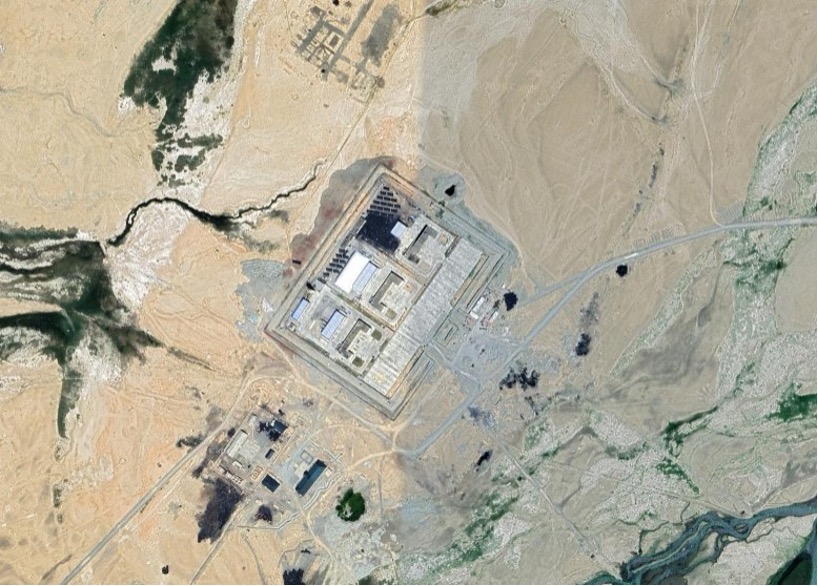
The “secret” Chinese base in Wakhan Corridor in Tajikistan. The satellite image is likely a few years old and does not reflect the current stage of construction. Coordinates: 37°28’27.82″N 74°48’25.52″E. Source: Google Earth
The aforementioned base is not the only military site in the area: there is another military compound located 10-15 kilometers south-west of the base, of a similar design, and built within the same post-2016 period. The second base, like the first, has trench systems surrounding it and is constructed next to an older military outpost.
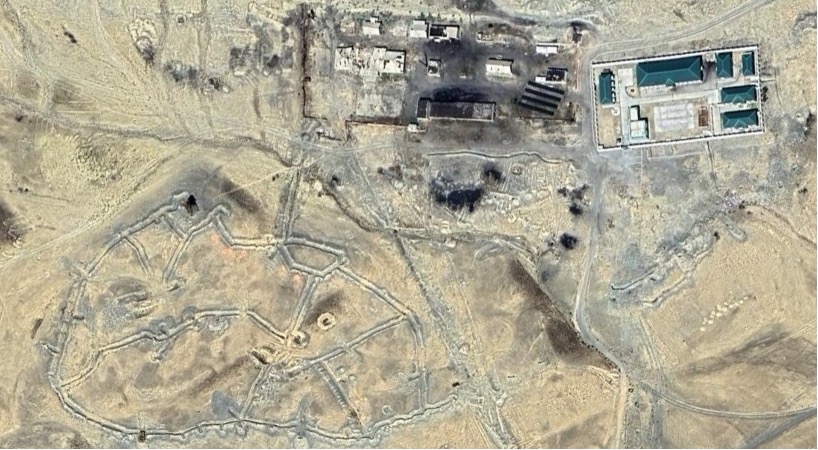
The second new military outpost in the Wakhan Corridor, near to the so-called “secret” military base. Coordinates: 37°25’17.81″N 74°41’54.00″E. Source: Google Earth
Alongside the Wakhan Corridor, the Tajik-Afghan border follows the Panj River, where border outposts have been in place since the Soviet era. The satellite imagery confirms that the majority of these outposts are in the process of being replaced by more modern ones that share planning and design similarities with the Chinese military outposts in the Wakhan Corridor.
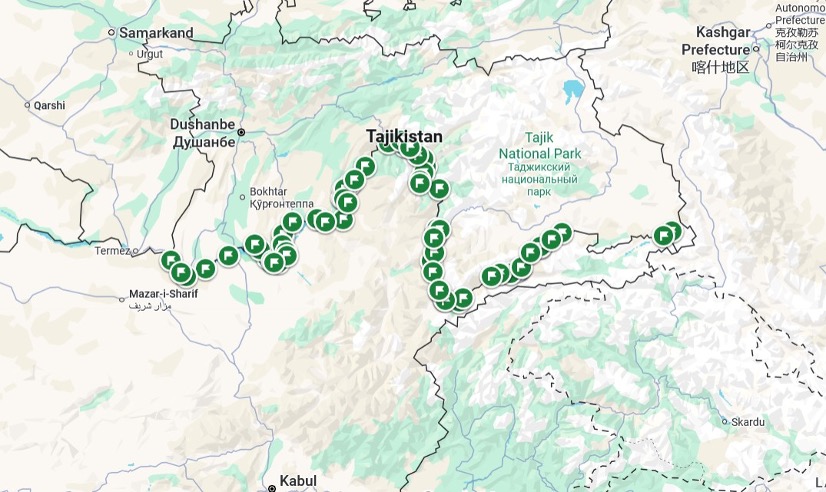
Tajik-Afghan border outposts along the Panj River. Source: Google Earth
Conclusion
The open source satellite imagery suggests that the majority of Tajikistan’s border posts along the Panj River are being refurbished or rebuilt using a consistent design which bears strong similarities with the initial “secret” Chinese base in the Wakhan Corridor.
Post-2016 development and construction suggest China has pushed Russia’s FSB Border Force aside to become the dominant power, and has significant leverage over neighbouring Tajikistan’s border with Afghanistan.
Beyond the military domain, the analysis confirms that China has also been accelerating and amplifying its positions in Tajikistan’s economy, education and culture, effectively working to replace Russia as the principal foreign actor in the country.