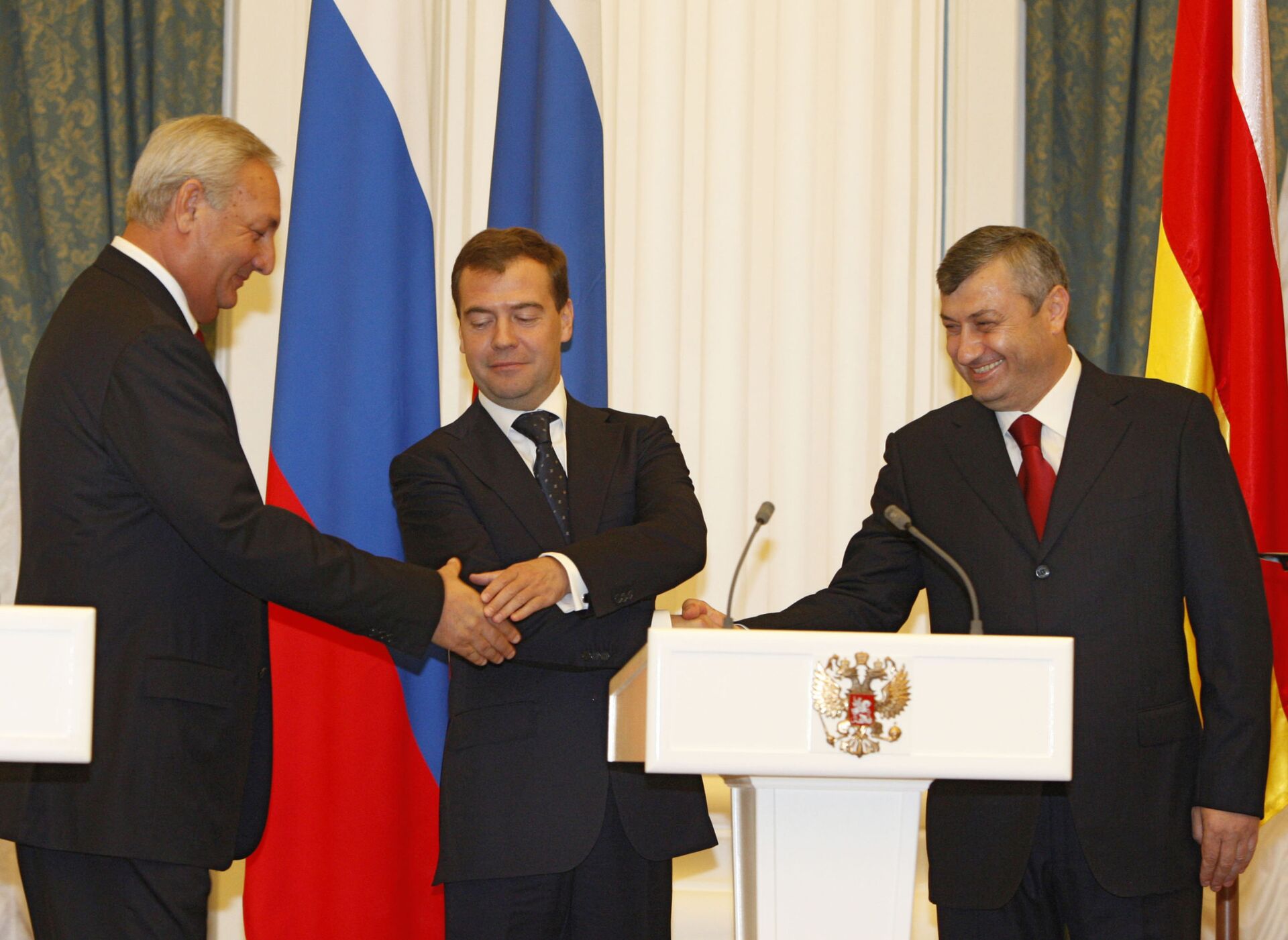
Russia recognized the independence of Georgia’s separatist regions of Abkhazia and so-called South Ossetia shortly after the 2008 Russo-Georgian War, and established diplomatic relations with them. As of 2025, the Russian Federation has concluded over 200 agreements with occupied Abkhazia and over 100 agreements with the occupied Tskhinvali region (so-called Republic of South Ossetia), covering the full range of bilateral relations.
The article concerns the main agreements in the strategic, military, economic, and social domains that establish a legal framework in relations between Georgia’s occupied regions and the Russian Federation.
Strategic Framework Agreements
Treaty on Friendship, Cooperation, and Mutual Assistance – A Tool of International Influence for the Russian Federation
The concept of a Treaty on Friendship, Cooperation, and Mutual Assistance was not created by the Russian Federation. A treaty with this exact title was concluded in 1955 in Warsaw, and is more commonly known as the Warsaw Pact. The Warsaw Pact (the Warsaw Treaty Organization) was an alliance initiated by the Soviet Union, whose primary focus foresaw international cooperation in the military and security domains. The Soviet Union established the Warsaw Pact as its own counterpart to deter the West and NATO after West Germany became a NATO member in 1955.
The Treaty on Friendship, Cooperation, and Mutual Assistance, or the Warsaw Pact, obligated its signatory states to provide military assistance to any member that came under an armed attack – envisioning a collective defense commitment just like the North Atlantic Treaty Organization (NATO). The founding signatories of the treaty were the Soviet Union, the German Democratic Republic, Romania, Bulgaria, Czechoslovakia, Poland, and Albania. However, in practice, the Soviet Union dominated over the alliance, exercising effective control, and repeatedly intervened in the internal political affairs of other signatory states.
Following the dissolution of the Soviet Union, the Russian Federation began concluding treaties on friendship, cooperation, and mutual assistance with various states. Although the specific provisions of these agreements were adapted to reflect the particular circumstances of each participating state, their overall content remained largely consistent. These treaties closely resembled the Warsaw Pact, serving as a general framework for establishing allied relations, and widely employed by the Russian Federation. Through the use of this framework agreement, Russia established an international legal groundwork for its military, political, and economic relations with the co-signatory states. The subsequently concluded bilateral agreements are based on this framework document.
Since the dissolution of the Soviet Union, the Russian Federation has concluded identical treaties, titled “On Friendship, Cooperation, and Mutual Assistance,” with the following entities:
- Kazakhstan – 25 May 1992;
- Kyrgyzstan – 10 June 1992;
- Tajikistan – 25 May 1993;
- Armenia – 29 August 1997;
- The so-called Republic of South Ossetia – 17 September 2008;
- The so-called Republic of Abkhazia – 17 September 2008;
- The so-called Luhansk People’s Republic – 21 February 2022;
- The so-called Donetsk People’s Republic – 21 February 2022.
Russia also concluded similar agreements, though with certain differences, with the following states:
- Belarus, in 1995 – On Friendship, Good-Neighborliness, and Cooperation;
- Ukraine, in 1997 – On Friendship, Cooperation, and Partnership;
- Azerbaijan, in 1997 – On Friendship, Cooperation, and Common Security;
- China, in 2001 – On Friendship, Good-Neighborliness, and Friendly Cooperation;
- North Korea, in 2024 – On Comprehensive Strategic Partnership.
In 2024, Russia concluded a Comprehensive Strategic Partnership agreement with North Korea after failing to achieve its objectives in the full-scale war that commenced in Ukraine in 2022, leaving the Russian Federation’s army in a critical situation on the frontline. Russia used this agreement in 2024 as a legal basis for deploying North Korean military units to Kursk Oblast and so as to replenish shortages in artillery and other combat supplies.
On 21 February 2022, following the agreements concluded with the so-called Donetsk and Luhansk People’s Republics, Russia proceeded, on 30 September of the same year, to sign agreements with these entities providing for their incorporation as new subjects of the Russian Federation, thereby completing the full annexation of the occupied regions of Ukraine.
The remaining agreements between Russia and several post-Soviet states were largely shaped by shared borders, and established an international legal mechanism for “good neighbourhood” relations between the entities. No such agreement has been concluded between the Russian Federation and Georgia. It should also be noted that, in 2018, the de facto President of Abkhazia, Raul Khajimba, signed a Treaty on Friendship and Cooperation with the Syrian Arab Republic.
One month after the 2008 Russia–Georgia war, on 17 September, Russia concluded treaties on Friendship, Cooperation, and Mutual Assistance with the de facto governments of Georgia’s occupied territories. The agreements established general principles for conducting foreign policy and cooperation in the military sphere.
The agreements concluded with the so-called Republic of South Ossetia and the so-called Republic of Abkhazia are, in fact, identical. Both documents were concluded for a term of 10 years, with an automatic renewal clause, and create a legal framework for cooperation between Russia and the separatist governments in Georgia’s occupied territories. The cooperation encompasses military, political, social, educational, economic, and other areas. As a framework agreement, the documents contain several provisions stipulating that the parties will conclude separate treaties to deepen relations in various fields. For example, under Article 5, the parties undertook the obligation to conclude additional agreements on cooperation in the military domain.
Given that the Russian ruble is the dominant currency in Georgia’s occupied territories, under Article 16 of the agreements, the Russian Federation assumed the obligation to support the financial and banking systems of occupied Abkhazia and the so-called Republic of South Ossetia. Under Article 19, the de facto governments of the separatist regions undertook the obligation to further enhance the teaching of the Russian language in kindergartens, schools, and other educational facilities. Overall, the agreements effectively provide the basis for the Russification of the occupied regions.
The agreements concluded between the Russian Federation and the unrecognized so-called Donetsk and Luhansk People’s Republics contain identical provisions. The difference is that Russia did not oblige the Donetsk and Luhansk separatists to enhance Russian language educational activities, as there was no such need in these territories.
The Treaty on Alliance and Strategic Partnership of 24 November 2014, between the Russian Federation and the so-called Republic of Abkhazia
The Treaty on Alliance and Strategic Partnership is one of the most important documents illustrating the difference in relations between Russia and occupied Abkhazia compared to that held with the occupied Tskhinvali region. While Russia pursued a path of comprehensive integration with Tskhinvali, the same did not occur in Abkhazia, and the agreement fell within the framework of a largely formal strategic partnership. This is due to internal political processes in occupied Abkhazia, where political rhetoric emphasising the so-called state sovereignty of Abkhazia is more prominent. Even in the so-called Republic of South Ossetia, there was no full consensus on complete military integration.
The Abkhazian version of the alliance agreement with Russia, similar to the Ossetian one, effectively covers all areas, specifically: the implementation of coordinated foreign policy; the creation of a common defense and security domain; the formation of a shared economic and social sphere; the creation of conditions for the full integration of Abkhazia into the post-Soviet space with Russian participation; and preservation of a common cultural and spiritual sphere.
Unlike the Ossetian version, according to which Russia assumes responsibility for increasing the salaries of employees in government institutions, the Abkhazian version states that Abkhazia itself will ensure the gradual increase of salaries, albeit with Russian financial participation. The salaries of so-called Abkhazian public officials must, according to the agreement, reach the levels of Russia’s Southern Federal District. In addition to Russia’s financial participation in the increase of salaries for public officials, Russia assumed responsibility for raising the pensions of Russian citizens permanently residing in Abkhazia.
The same agreement also included a provision for the creation of an Abkhazian–Russian joint military formation, which was to be established within six months of the agreement entering into force. The agreement between Russia and the de facto government of Abkhazia on the joint military formation was concluded in 2017, despite missing the specified deadline.
In addition to deepening cooperation in the social and economic spheres, agreements were concluded under this treaty to establish a joint information and coordination center serving both the common defense sector and law enforcement agencies. Furthermore, the Russian Federation undertook an obligation to simplify the procedures for issuing Russian passports to “citizens” of Abkhazia.
The Treaty on Alliance and Integration of 18 March 2015, between the Russian Federation and the so-called Republic of South Ossetia
The 18 March 2015 agreement, signed by the then-de facto president Leonid Tibilov, was based on a Treaty on Friendship, Cooperation, and Mutual Assistance signed in Moscow on 17 September 2008. The preamble states that strengthening allied relations falls within the interests of both states due to the “historical and spiritual” ties between Russia and the so-called Republic of South Ossetia. It also notes that both parties reaffirm their commitment to the principles and goals of the UN Charter.
Under this agreement, the Russian Federation formally and legally assumed full responsibility for the defense and border security of the occupied Tskhinvali region, making the de facto defense ministry there effectively obsolete. This process was finalized and shaped in the agreement concluded on 31 March 2017, on the incorporation of separate Ossetian military units into the Russian military base. Under Article 2 of the Treaty on Alliance and Integration, all law enforcement agencies of the so-called Republic of South Ossetia, including the de facto ministry of defense, were placed under the structural subordination of the Russian Armed Forces and other Russian law enforcement bodies. The provision stipulated that the process of integrating Ossetian military units into the Russian army would be regulated by a separate agreement.
In addition to the integration of law enforcement agencies, under this agreement, Russia assumed the obligation to amend its own legislation, according to which: 1. The procedures for issuing Russian passports to citizens of the so-called Republic of South Ossetia were further simplified; 2. Restrictions on employment at Russian federal agencies do not apply to Russian citizens who hold a passport of the so-called Republic of South Ossetia and reside in the occupied territory on a permanent basis. Additionally, a joint information and coordination center of the Russian and so-called South Ossetian ministries of internal affairs was established.
Under the same agreement, the Russian Federation assumed responsibility for increasing the average salaries of employees in the state structures of the so-called Republic of South Ossetia. Russia also promised to raise pensions and social benefits for permanent residents of the occupied Tskhinvali region. All this was so as to reach the levels of Russia’s North Caucasus Federal District. In addition, the agreement covers cooperation in the education, science, and culture spheres. Russia effectively extended its full jurisdiction over the occupied Tskhinvali region.
Principal Agreements in the Military Domain
Agreements on Russian Military Bases on the Occupied Territories
On 15 September 2009, Russia concluded agreements with the so-called Republics of Abkhazia and South Ossetia on cooperation in the military domain. These agreements serve as framework documents for military cooperation, and provide the legal basis for subsequent treaties. These agreements also contained the first legal provisions regarding Russian military bases on the occupied territories.
Based on the treaties on Friendship, Cooperation, and Mutual Assistance of 2008, Russia concluded agreements with the de facto governments of Abkhazia and the so-called Republic of South Ossetia on joint Russian military bases in 2010. These agreements serve to formalize the presence of the Russian armed forces deployed in the occupied territories, and to regulate the legal status of Russian personnel, equipment, and facilities. The agreements concluded by Russia with both entities are, in fact, identical.
According to Articles 15 and 16 of the agreement, the so-called Republics of Abkhazia and South Ossetia recognized the legality of all Russian state documents of all Russian military personnel and their family members on their territories. In addition to military personnel, the same rule applied to legal entities and individuals registered in the Russian Federation who cooperate with the Military Bases as suppliers or contractors.
The agreement grants Russian military ground and air equipment a special legal status. As a result, Russia can use the airspace of both occupied regions of Georgia without limitations, while its ground vehicles and heavy equipment are permitted to operate within their territory without restrictions.
The agreement also regulates contractors of the 4th and 7th Military Bases. A contractor – a provider of services – may be a legal or natural person registered either in Russia or in the so-called Republic of South Ossetia. This definition allows locals in the occupied Tskhinvali region to engage in economic activities with the Russian military bases. Military-purpose and medical supplies, however, are provided directly by Russia, and are not included in the agreement.
In addition, the agreement grants Russia ownership of real estate and accompanying legal protections. For instance, if members of the Russian Armed Forces, their personnel, or their family members suffer harm caused by “citizens” of the so-called Republics of South Ossetia and Abkhazia, the latter is obligated to provide compensation.
The following territories of the occupied Tskhinvali region were allocated for the deployment of the Russian Armed Forces: 1. Aviation Base – Java; 2. Radiolocation Unit of the Aviation Base – 4 kilometers northwest of Tskhinvali; 3. Joint Airfield – Kurta; 4. Military Town (Barracks, or a military settlement) 12B – Tskhinvali; 5. Military Town 12G – Tskhinvali; 6. Military Town 47/1 – Tskhinvali District; and 7. Military Town 47/2 – Java.
The following territories of the occupied Abkhazia region were allocated for the deployment of the Russian Armed Forces: Military Towns #1, #2, #3, #4, and #5 – Gudauta; Military Town “Gumanista” – Eshera; Military Town – Village of Nagvalou (Ochamchire District); Air Defense Technical Positions – Agudzera, Babushara, Bomboda, and Primorskoe; Aviation Command Post – Babushara; Naval-Military Fleet Material-Technical Support Post – Ochamchire, and its territorial waters; Military Sanatoriums – Sokhumi, Gagra, and Gudauta.
Agreement “On the Creation of a Joint Military Group”
Based on the Treaty on Strategic Partnership, on 21 November 2015, the Russian Federation and the “Republic of Abkhazia” signed an agreement on the creation of a Joint Military Group of armed forces. From the Abkhazian side, the formation included two separate motorized rifle battalions, one artillery group, an aviation group, and a special purpose unit.
According to the agreement, a joint military group of the armed forces was established, along with the joint command and an operational group. The joint command serves as an oversight body of the joint group, exercising its authority in both wartime and during peace. The operational group is an oversight body that exercises its authority only during peacetime, and is composed solely of military personnel assigned to the military group.
The agreement defines the functions and purpose of this formation, the procedure for appointing its commanders, and other related matters. The commander is appointed by the Russian side, while the deputy commander is appointed by the Abkhazian side. According to the agreement, the primary purpose of the joint military group is a prompt detection and countering of any preparations of an inevitable armed attack against either party. This must be executed in coordination with other units, military formations, and the relevant government agencies of both parties. Ultimately, the joint group operates as a unit that performs a supporting role to other main military units and formations.
The list of functions and purposes is extensive, and includes, among others: continuous and interminable aerial radar reconnaissance; providing air transport and naval assistance in emergency situations; holding positions and defending facilities taken by other main units while they advance further; and participating in the defense of the state borders of the Russian Federation and the “Republic of Abkhazia” in the air and outer space.
Agreement of March 31, 2017, between the Russian Federation and the “Republic of South Ossetia,” on the procedure for the incorporation of certain units of the so-called “Armed Forces of the Republic of South Ossetia” into the Armed Forces of the Russian Federation
The Agreement of March 31, 2017, on the incorporation of certain Ossetian military units into the Russian military base is significant not only for its implications for the “Ossetian army,” but also because it reflects the political processes leading up to the agreement, and highlights the disagreements between Ossetian military and political circles regarding full integration into the Russian Federation. This was the agreement that Tibilov cited as evidence that, following his considerable efforts, the “Ossetian army” would not be entirely abolished.
The agreement defines the term “citizen” exclusively as residents of the so-called Republic of South Ossetia who hold Russian passports. This means that anyone seeking employment at the Russian 4th Military Base would be required to possess Russian citizenship. According to Article 3 of the agreement, the Russian Federation would define both the tasks and the structure of the armed forces of the so-called Republic of South Ossetia in times of peace and war.
Further, the agreement states that Russian citizens residing in the Tskhinvali region who wish to serve at the 4th Military Base are required to enlist through the North Ossetia (Russia) Commissariat. Before their transfer to the Russian Army, members of the Ossetian military are obliged to leave the ranks of the de facto defense ministry. Ossetian personnel are permitted to serve at the 4th Military Base in the ranks of junior officers, sergeants, and privates.
Agreements on Military and Technical Cooperation
In 2010, Russia concluded agreements with Abkhazia and the so-called Republic of South Ossetia on military-technical cooperation. The implementing bodies of the agreements were the de facto ministries of defense from the occupied territories, while the Russian side was represented by the Federal Service for Military-Technical Cooperation. One of the deputy heads of the Russian federal agency is Mikhail Babich – one of the coordinators of relations with the occupied territories of Georgia in the role of a deputy minister of economic development of Russia from 2019 to 2021.
The agreements concluded with Abkhazia and the so-called Republic of South Ossetia are virtually identical, and primarily serve to provide logistical support for the Russian military equipment deployed in the occupied regions.
Agreements on Joint Efforts on Protecting Borders of the So-called Republics of Abkhazia and South Ossetia
Following the treaties on Friendship, Cooperation, and Mutual Assistance concluded on 17 September 2008 between Russia and the de facto governments of Abkhazia and the Tskhinvali region, Russia signed a new agreement with both de facto entities on 30 April 2009. The agreements on joint efforts on protecting the so-called borders with Abkhazia and the so-called Republic of South Ossetia are virtually identical. The only differences concern the designated authorities of the entities and the geographic names.
Both de facto states delegated “border” protection powers to Russia. According to Article 3, Russia assumed responsibility for protecting the self-declared borders temporarily, until the de facto authorities in the occupied regions set up their own border forces. The authority was to be handed back upon request, but Russia has retained control of the occupation line ever since.
The document defines the meaning of the term “state border.” In the case of Abkhazia, this includes the “border” with Georgia, as well as Abkhazia’s maritime zone. In the case of the so-called Republic of South Ossetia, the “state border” refers only to the occupation line with Georgia.
On the Russian side, the Federal Security Service (FSB) was designated as the authority responsible for controlling the occupation lines. The agreement regulates the legal basis for the activities of Russian security personnel (border guards) in the occupied territories of Georgia, and establishes the rules related to the airspace and maritime border of Abkhazia under Russian authority.
The agreements stipulate that Russian border-guard operations in the occupied territories are financed entirely by Russia. Pursuant to Article 7, any real estate or facilities acquired from local legal or natural persons for the purpose of “border” protection become the property of the Russian Federation, with the obligation to return them only when the Russian services no longer require their use.
Additionally, the agreements tasked the so-called State Security Service of Abkhazia and the State Security Committee of the so-called Republic of South Ossetia (KGB of SO) with controlling the “border” together with Russia. The agreements also regulate the legal status of servicemen of the Russian “border guard” and their family members in the occupied territories, granting them the same rights and privileges as “citizens” of Abkhazia and the so-called Republic of South Ossetia.
Both agreements state that the documents are not directed against third parties. Nevertheless, following the 2008 Russia–Georgia war, the first signs of “creeping occupation” appeared in 2009, shortly after the conclusion of these agreements. Further, during their entry into force in 2010, illegal borderization became increasingly active. The Russian Federation formally began exercising effective control over Georgia’s occupation lines through these agreements.
Primary Agreements in Social and Economic Spheres
Visa-Free Entry and Russian Passports
In 2009, Russia concluded a visa-free travel agreement with occupied Abkhazia, and in 2010 with the occupied Tskhinvali region. These agreements allowed the “citizens” of Abkhazia and the so-called Republic of South Ossetia to stay in Russia visa-free for 90 days, and laid out the procedures and the list of documents required for this purpose.
The second part of Article 2 is particularly noteworthy: it exempts Russian military personnel and their family members stationed in Georgia’s occupied territories from visa requirements. In addition, Russian conscripts serving compulsory military duty in these occupied regions enjoy the right to stay for an unlimited period throughout their term of service.
It should be noted that the 90-day visa-free stay in Russia for the “citizens” of Abkhazia and the occupied Tskhinvali region is largely of a formal nature. Using other agreements, Russia had already simplified the procedures for issuing Russian passports to residents of Georgia’s occupied territories. As early as 2002, 70% of the population of occupied Abkhazia held Russian passports, and, by 2019, this figure had risen to 80%. The former de facto president of the so-called Republic of South Ossetia, Anatoly Bibilov, stated that 95% of the population of the Tskhinvali region held Russian passports.
In 2025, the President of the Russian Federation issued a decree titled “On the Admission to Citizenship of the Russian Federation of Citizens of the Republic of Abkhazia and the Republic of South Ossetia,” which further simplified the process for issuing Russian passports to residents of these self-proclaimed republics. Effective from 2025, applicants are exempt from requirements to demonstrate proficiency in the Russian language, knowledge of Russian history, or familiarity with the basic legislation of the Russian Federation.
Agreements on Assistance in Social and Economic Development
In August 2009, Russia concluded agreements with Abkhazia and the so-called Republic of South Ossetia on assistance in social and economic development. The agreements are identical, seeing Russia assuming responsibility for the development of the economic and social sectors of Georgia’s occupied regions. Furthermore, all work carried out by the Russian Federation is fully exempt from local taxes.
Agreements on Investment and Capital Protection
On October 9, 2009, the Russian Federation concluded an agreement with Abkhazia on the protection of investments. In the same year, a similar agreement, focusing on capital protection, was signed between Russia and the so-called Republic of South Ossetia. Both agreements are fundamentally similar, and establish legal guarantees regarding real estate, shares, financial and material obligations, intellectual property rights, and related matters.
The formal purpose of the agreements is to provide a “state-level” legal framework for entrepreneurial and investment activities, creating equal conditions for both Russian and local parties within their respective jurisdictions. However, these agreements grant legal guarantees primarily to Russian citizens and legal entities operating in Georgia’s occupied territories.
For example, Article 5 of both agreements addresses expropriation. Expropriation is the forced seizure of real estate or property rights by a state in exchange for appropriate compensation. According to the provisions, the occupied territories of Abkhazia and the so-called Republic of South Ossetia are prohibited from directly or indirectly expropriating or nationalizing Russian investments and capital, unless this is consistent with the interests of the Russian party.
One of the key provisions establishes retroactive legal power over investments, capital, and property rights acquired by Russia, Russian nationals, and companies in the occupied territories long before the agreements were signed. In the case of Abkhazia, the date is set to January 1, 1994, and in the case of the so-called Republic of South Ossetia – January 1, 1992.
Other Agreements
This article scrutinized just a small number of the agreements concluded between Russia and de facto governments of the occupied regions of Georgia. Indeed, the range of documents is particularly broad, and includes agreements in practically every direction of bilateral relations. Russia has concluded agreements with the occupied regions in numerous domains, among them:
- Cooperation between the (de facto) ministries of justice;
- Cooperation between prosecutor’s offices – a joint investigation committee;
- Cooperation in international relations;
- Cooperation between so-called election commissions;
- Cooperation agreements with Russia’s Federal Security Service;
- Cooperation between Russia and the so-called ministry of internal affairs – centralization of operational information and activities with Russia’s participation;
- Energy;
- Customs;
- Education;
- Budget;
- Healthcare, and more.