The Russian-occupied Georgian regions of Abkhazia and the Tskhinvali region (formerly the autonomous region of South Ossetia) have had their independence recognized by only five UN member states. After the 2008 Russo-Georgian War, Russia was the first to extend recognition, followed by Nicaragua, Venezuela, Nauru, and Syria.
When it comes to “foreign policy” activity, the Tskhinvali region is notably less active than Abkhazia. Due to its limited resources, it pursues only modest goals on the international stage.
The “foreign policy” of the occupied Tskhinvali region is almost entirely reliant on Russia’s political, diplomatic, and logistical backing. This close cooperation is formalized through a legal framework that governs their “foreign policy” interactions.
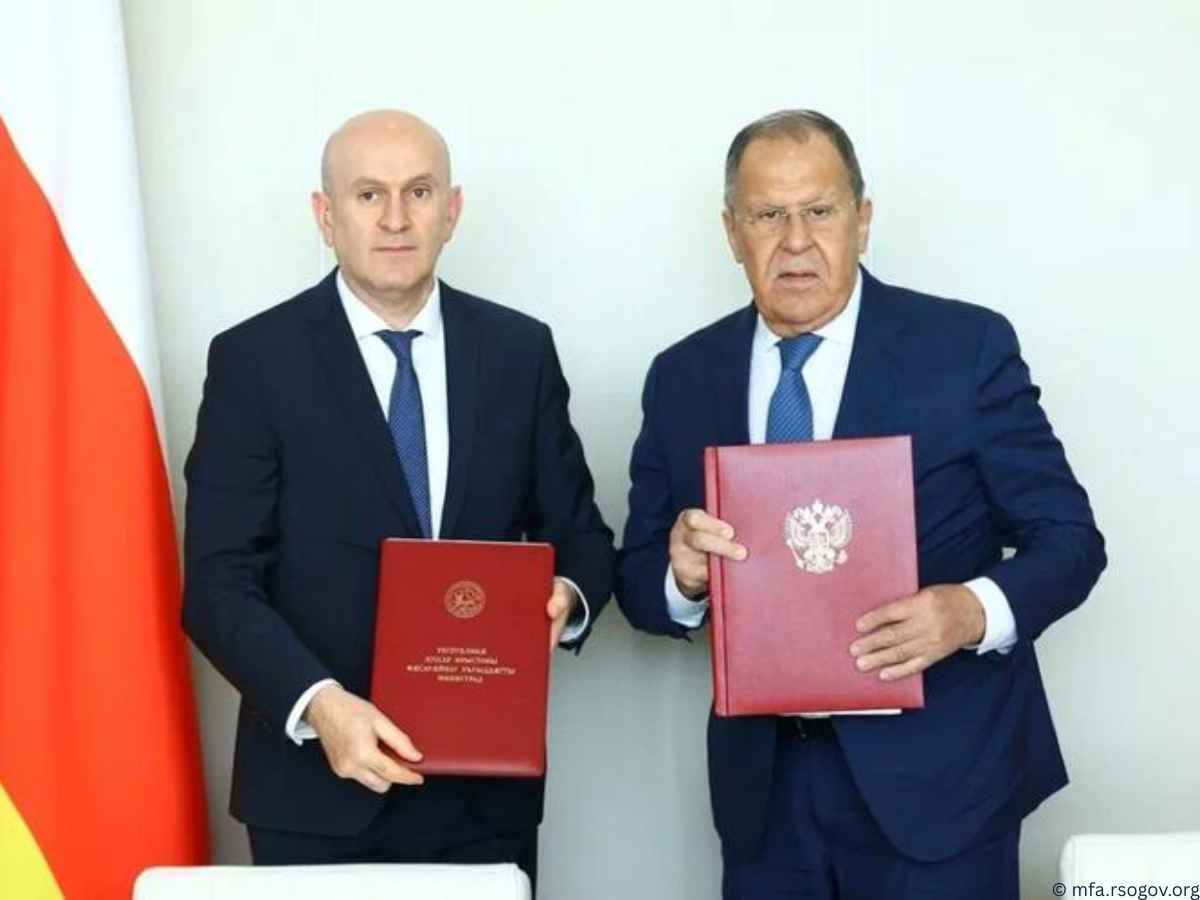
On October 1, 2025, in Sochi, Russian Foreign Minister Sergei Lavrov and the de facto Foreign Minister of the Tskhinvali region, Akhsar Dzhioev, signed the Plan of Consultations between the Ministry of Foreign Affairs of the Republic of South Ossetia and the Ministry of Foreign Affairs of the Russian Federation for 2026–2027. A similar agreement was signed in 2023: on October 3, 2023, Lavrov and Dzhioev signed the Plan of Consultations between their diplomatic agencies for 2024–2025.
The Consultation Plan includes discussions on key bilateral issues, the development of a comprehensive legal and contractual framework, and the exchange of information regarding both sides’ foreign policy activities. It also provides for the organizing of joint scientific and practical seminars, conferences, and round tables, as well as supporting cultural and sporting events.
This article offers a concise overview of recent “foreign policy” activities in the occupied Tskhinvali region.
UN member states that recognize the independence of the Tskhinvali region (the so-called Republic of South Ossetia)
The de facto authorities of the occupied Tskhinvali region maintain their most substantial diplomatic ties with Nicaragua, whereas interactions with Syria, Venezuela, and Nauru are primarily symbolic. Official meetings with representatives from these states are usually held in Moscow and seldom yield substantive outcomes, serving mainly to project an image of diplomatic activity.
Nicaragua maintains the most active relations with the Tskhinvali region. Nicaragua’s Foreign Minister, Waldrach Djentske Whitaker, visited Tskhinvali on September 19, 2025. A Nicaraguan delegation also participated in events in Tskhinvali commemorating the 35th anniversary of the proclamation of the “Republic of South Ossetia.” The de facto leaders of the occupied Tskhinvali region have reciprocated by visiting Nicaragua. For instance, in 2024, de facto Foreign Minister Akhsar Dzhioev attended events in Nicaragua marking the 45th anniversary of the Sandinista Revolution. However, these exchanges have not led to significant progress in bilateral relations, primarily due to the geographical distance and limited resources on both sides.
Post-Soviet Countries
The occupied Tskhinvali region maintains a passive stance in its relations with Belarus, in contrast to occupied Abkhazia. High-level contacts are virtually absent, and the Belarusian government has shown no interest in engaging. An exception occurred during a brief meeting in the Kremlin on May 9, 2025, where Belarusian President Alexander Lukashenko and the de facto leaders of the occupied Tskhinvali region and Abkhazia, Alan Gagloev and Badra Gunba, described their interaction as “warm and friendly.” This characterization reflects Tskhinvali’s assessment of the encounter.
In 2025, the Tskhinvali region primarily participated in events in Belarus that lacked political significance. Although relations between Tskhinvali and Minsk remain limited, periodic meetings with representatives of the Belarusian-Russian Union State continue. Through these interactions, Tskhinvali aims to demonstrate diplomatic engagement and advocate for membership in the Union State, a goal that remains unattainable without formal recognition from Belarus.
Europe
The diplomatic activity of the Tskhinvali region in Europe remains minimal, and is primarily driven by individual private actors. The occupied Tskhinvali region has maintained a so-called representative in Italy for an extended period; the Italian state does not recognize this individual. Relations between Tskhinvali and Italy are almost exclusively based on the efforts of Mario Murja, who identifies himself as the representative of the “Republic of South Ossetia” in Italy. Murja serves as a lobbyist for the occupied Tskhinvali region in Italy and frequently visits the region.
Patrick Poppel, a pro-Russian expert, acts as the self-proclaimed representative of the de facto Foreign Ministry of the occupied Tskhinvali region in Austria. He is a private individual without official recognition from the Austrian state. Poppel frequently visits Russia and periodically travels to the occupied regions. His public statements consistently reflect Kremlin-aligned narratives.
Key Challenges in the “Foreign Policy” of the Tskhinvali Region
In contrast to occupied Abkhazia, the “foreign policy” ambitions of the occupied Tskhinvali region are limited. The region remains wholly dependent on Russia, and prevailing attitudes among both local political groups and the general population are strongly pro-Russian. The majority appear willing to renounce independence and support unification with Russia, a stance that constitutes a “red line” in occupied Abkhazia. Given these circumstances, the “foreign policy” of the de facto government in the Tskhinvali region remains largely passive.