


Victoria Vdovychenko
Centre for Geopolitics, University of Cambridge
- Introduction
For a brief period in 2024 and early 2025, it seemed that the worst of the Black Sea’s wartime disruption was behind it. Ukraine’s unilateral shipping corridor, launched in August 2023 after Russia tore up the UN-brokered Grain Initiative, proved remarkably resilient. By January 2026, it had carried well over 160 million tonnes of cargo, including close to 100 million tonnes of grain (Ukrainska Pravda, 2026). That picture changed abruptly in the summer of 2026. In July, Russian missile and drone strikes hit dozens of merchant vessels in Ukrainian waters and ports within weeks, killing seafarers and dockworkers and sinking at least one foreign-flagged bulk carrier off Odesa. On 22 July, for the first time since the corridor opened, no commercial ship entered a Ukrainian Black Sea port. Major carriers suspended calls (Fastmarkets, 2026). Grain exports fell by roughly a third, and freight costs into and out of the country doubled within weeks.
Ukraine’s ports Odesa, Chornomorsk and Yuzhny remain the country’s highest-capacity export gateways. The Danube ports of Izmail and Reni, together with Ukraine’s rail network, provide the principal alternatives when maritime routes are disrupted. Subsea cables and, increasingly, contested satellite-navigation coverage underpin the digital and logistical systems that support this trade. Energy infrastructure, pipelines, interconnectors, offshore platforms, refineries and LNG-linked logistics on both shores of the basin run alongside these trade routes and are exposed to many of the same threats, particularly missile and drone strikes.
What makes the current situation particularly significant is that, in addition to floating mines, electronic warfare (EW), and kinetic strikes, the Black Sea is increasingly experiencing forms of all-domain warfare that impact national economies, as well as the free movement of goods by sea. Sabotage, cyber operations, jamming, spoofing, disinformation, and coercive signalling are no longer background risks for commercial shipping. Russia’s aggression has developed into a broader campaign against Black Sea connectivity that now threatens NATO and EU states directly, not only Ukraine.
This article examines how Russia’s aggression against Ukraine has transformed the Black Sea from a theatre of naval confrontation into an arena of all-domain warfare, and what this transformation implies for maritime trade, energy, and regional connectivity. It argues that, although Ukraine has achieved sea denial against Russia’s Black Sea fleet, Russia retains and is expanding its ability to apply pressure through an all-domain coercive spectrum of tools that threaten shipping, ports, digital connectivity and navigational safety across the wider region, including EU and NATO countries.
To develop this argument, the article proceeds in two steps. Section 2 examines how the maritime balance has changed since 2022 and traces the impact of the 2026 strike campaigns on Ukraine’s export routes and ports, as well as those of other countries. Section 3 analyses the wider spectrum of all-domain threats, from electronic warfare and risks to critical undersea infrastructure to drone incursions into NATO countries’ airspace. The conclusion summarises the main findings and sets out their implications for Ukraine, NATO, and EU member states.
2. What Has Changed?
By 2026, the Black Sea ‘theatre of operations’ was no longer what it had been since 2022. Russia had lost maritime dominance, but retained, and in some respects expanded, its ability to project power from the air over the sea. This is possible because Ukraine’s achievement is one of sea denial rather than sea control. Russia retains the capacity to impose real costs on Ukraine’s maritime economy, even where its fleet’s freedom of manoeuvre is constrained. Understood this way, strikes on ports, terminals, vessels, logistics nodes, power infrastructure and insurance confidence are best analysed as a single coercive system.
Between January and March 2026, Russian armed forces carried out more than 73 attacks using missiles and UAVs of various types against the ports of Greater Odesa, and the energy, industrial, and civilian infrastructure of Odesa Oblast (BSS Monitoring Group, 2026). These attacks were launched from both the temporarily occupied territory of the Autonomous Republic of Crimea and the territory of the Russian Federation. Most strikes involved Shahed-136/131, Geran/Herbera, and similar strike and decoy UAVs, causing damage to infrastructure as well as civilian casualties.
By early August, Ukrainian authorities had recorded 67 strikes on port facilities and 57 on vessels, prompting around 90% of shipping operators to suspend calls to Greater Odesa and significantly disrupting commercial traffic (MFA of Ukraine, 2026).
During the first two weeks of August, grain exports fell by 75% year on year, with Ukrainian agricultural producers warning of a threat to the upcoming sowing season. Ukraine is expected to export approximately 64.4 million tonnes of agricultural produce in 2026-2027, averaging 5.4 million tonnes per month; however, August exports are projected at approximately 1.6 million tonnes (Ministry of Agriculture, 2026).
Efforts to maximise use of the Danube as an alternative transport route have been constrained by prolonged drought. Barges have seen their loading capacity reduced by approximately 30 to 60%, with some vessels operating at just one-third of normal carrying capacity (Scutaru, 2026, p.4). The route is also exposed to strikes far from the front line. On August 21, 2026, Russian drones damaged the Tabaky border crossing between the Odesa region in Ukraine and Moldova, leading to the temporary suspension of passenger and vehicle traffic (Euronews, 2026).
Alternative export routes are expected to be gradually restored, but their combined throughput may reach no more than 2.9 million tonnes per month. Total export volumes could therefore amount to only approximately 29.6 million tonnes (Radio Svoboda, 2026). The disruptions are also expected to contribute to higher domestic inflation, as strikes on the Greater Odesa area damage imported goods and destroy warehouses where supplies are stored (CES, August 2026).
Ukraine has proposed to Russia a mutual cessation of attacks on civilian targets in the Black Sea. Russia rejected the proposal as of August, 14, with Foreign Ministry spokeswoman Maria Zakharova saying there were no grounds for “a half measure that would give Kyiv breathing space” (The Moscow Times, August 2026). Turkish Foreign Minister Hakan Fidan said that a proposal for a mutual moratorium on attacks in the Black Sea had already been presented to both Russia and Ukraine. Türkiye has repeatedly served as an intermediary on issues related to shipping security and grain exports.
The threat is not confined to Ukraine alone. Intensifying attacks on vessels and ports are disrupting agricultural exports from the wider Black Sea region and adding to pressure on global markets. At the same time, Ukraine’s armed forces has developed both a maritime component, including uncrewed surface vessels, and an aerial component involving UAVs and cruise missiles. Since April 2026, Ukrainian forces have increased the frequency and sophistication of strikes against targets across the Azov-Black Sea maritime space. Rather than relying on a single dominant capability, Ukraine has fused coastal-defense missiles, naval drones, aerial ISR, cyber operations, electronic
warfare, and Western intelligence support into a layered system designed to constrain Russian maritime activity (Raveendran, 2025). Targets have included oil terminals and tank farms, as well as tankers and port infrastructure. There was no single element that was decisive alone, as seen in the strike on the Moskva, where real-time ISR, radar suppression, and precision missile engagement worked together to create layered effects that degraded Russia’s operational freedom (Raveendran, 2025).
3. All-Domain Threats in the Black Sea
Missiles and drones are the most visible tools of disruption, but they are not the only ones, and arguably not the most consequential over the long run. A parallel campaign of hybrid activity has degraded the safety and predictability of Black Sea trade without a single formal closure of a sea lane. The intensification of hostilities in the Black Sea during the summer of 2026 substantially disrupted regional and global trade flows, particularly affecting grain trade and maritime shipping (Farm Policy News, 2026).
Russian strikes on Ukrainian port infrastructure severely disrupted the grain trade, prompting some shipowners to avoid calls at Ukrainian terminals and several agricultural firms to suspend procurement entirely (Reuters, 2026). The attacks also increased the cost of maritime commerce: war-risk insurance premiums for vessels calling at Black Sea ports rose to as much as 2% of vessel value, while tanker freight rates increased markedly (Reuters, 2026).
Such disruptions further contributed to the upward trajectory of global wheat prices, as diminished export capacity from the region constrained supply in international markets. Given Ukraine’s centrality to global wheat export markets, sustained impairment of its export capacity had broader implications for global food security.
Figure 1. Opportunities and Risks in the Black Sea Region related to the Russian kinetic and non-kinetic attacks
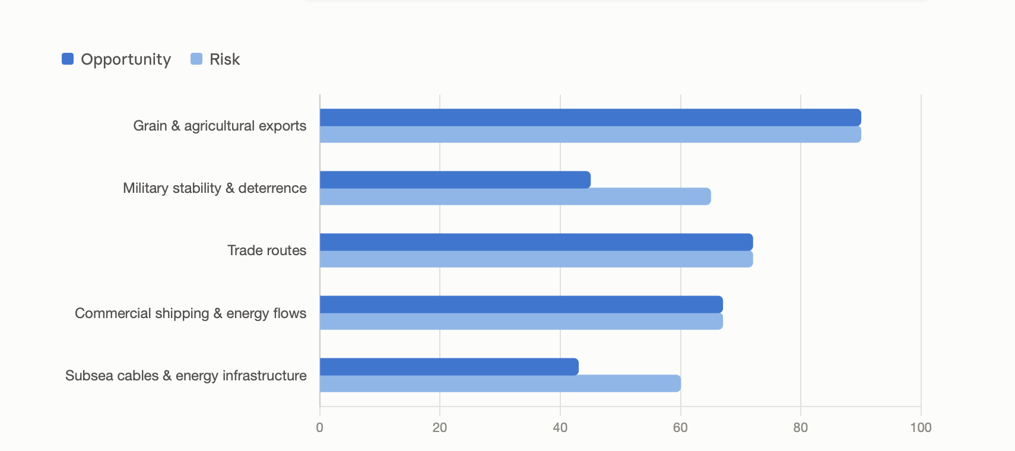
Source: Author’s analysis (assessment based on the quantity of attributed attacks and projection for alleged attacks by the Russian Federation in January-July 2026)
Alongside kinetic drone operations by the Russian Federation in the Black Sea, a second, less visible stratum of hybrid activity targets the cables and pipelines that carry Europe’s data and gas. The European Commission’s 2025 Joint Communication on submarine cable security explicitly identifies the Black Sea, alongside the Baltic, Mediterranean, North Sea, and Atlantic, as a region where the risk of deliberate sabotage is increasingly being taken into account (European Commission and EEAS, 2025). The Black Sea has comparable exposure: a dense, if less publicly mapped, network of telecommunications and energy cables serving Ukraine, Romania, Bulgaria, Georgia and Türkiye.
This assessment aligns with the pattern already documented in the Baltic Sea, where at least 11 cables and pipelines have sustained damage since late 2023, prompting NATO to establish a Critical Undersea Infrastructure Network and a dedicated Maritime Centre for the Security of Critical Undersea Infrastructure (CEPA, 2026). Analysts increasingly regard Russia’s so-called ‘shadow fleet’ as a dual-purpose asset capable of anchor-dragging and seabed mapping, in addition to sanctions evasion (Jamestown Foundation, 2025).
Regarding the Black Sea, Romanian officials have provided some of the clearest public accounts. Romania’s Chief of Defence confirmed in 2025 that spoofing and jamming occur weekly along the Romanian coastline, characterising this as part of a deliberate hybrid-warfare strategy that frequently coincides with naval movements and drone activity. By spring 2025, spoofed signals over the Black Sea had become near-daily occurrences, with vessels east of Constanta and south of Snake Island most severely affected, displaying erroneous positions as inland, rotating, or substantially removed from their charted course (Spire Global, 2026).
Commercial maritime-intelligence providers report that the Black Sea now accounts for approximately one-fifth of all GPS jamming events tracked globally on a quarterly basis, second only to the Middle East Gulf. They note that jamming is now found at every Russian Black Sea oil-export port, deployed specifically to impede Ukrainian drone-targeting of tanker loading operations (Windward and Hellenic Shipping News, 2026).
Physical sabotage against energy assets follows a similar trajectory. On 8 August 2026, a drone crossed from Romanian into Bulgarian airspace and detonated near Kardam, close to the Trans-Balkan gas pipeline. Bulgarian authorities assessed the drone as likely to be of Ukrainian origin, illustrating that spillover risks are no longer confined to systems operated by one side of the conflict (Associated Press, 2026). Three days earlier, Romania had intercepted and destroyed three separate Russian drones that entered its airspace between 24 and 26 July, and, on 11 August, it downed two further unidentified Gerbera-type drones near the Neptun Deep offshore gas development (Romanian Ministry of National Defence, 2026a, 2026b).
Analysts characterise these incidents as rehearsals, contending that the same low-cost operational playbook of drones, floating mines, GNSS jamming, and sabotage, previously tested against Ukrainian energy infrastructure, is now being trialled against Romanian waters and airspace, with Neptun Deep (a €4 billion, 100-billion-cubic-metre gas field scheduled to come on-stream in 2027) constituting the principal asset at risk (Atlas Institute for International Affairs, 2026a).
Attribution ambiguity is itself a hybrid instrument. In each of the incidents described earlier (Kardam, Neptun Deep, the airspace intrusions), public assessments were initially provisional, with officials weighing whether the incidents originated in Russia or Ukraine, before settling (or, in some cases, not settling) on an attribution.
This ambiguity remains non-incidental because it continues to test the threshold of NATO’s Article 5, to sow uncertainty among the domestic public about who is responsible for their own airspace violations, and to complicate the coordination of a collective response and support for Ukraine.
The European Union’s foreign policy chief has explicitly catalogued this pattern as part of “Russia’s persistent hybrid campaigns,” spanning cyberattacks, sabotage, disruption of critical infrastructure, physical attacks, and information manipulation, all presented as a single, coordinated toolkit rather than disconnected incidents (Atlantic Council, 2025).
Disinformation campaigns reinforce this by planting doubt about who is responsible for any given incident, muddying the operating picture for insurers, flag states and port authorities alike, and making coordinated response harder to organise. Both belligerents contest the narrative of who is responsible for the collapse in grain flows, with Russian state media and shipping-industry channels emphasising Ukrainian strikes on Russian civilian infrastructure and food-security risk to the Global South, while Ukrainian officials frame their campaign as targeting the military-logistics backbone of the shadow fleet and the naval base co-located with Novorossiysk’s grain terminals (Ministry of Foreign Affairs of Ukraine, 2026).
The Kyiv School of Economics Institute estimates that, in June 2026, Russia used 325 unique tankers to move roughly 6.0 million barrels per day of seaborne crude and products, of which 176 vessels, or 54 percent, belonged to the sanctioned shadow fleet, with China and Russia-linked ship managers jointly handling 56 percent of shadow-fleet exports (KSE Institute, 2026a). The same series shows Russian reliance on Western-insured maritime services rising to 42 % in May 2026, after Ukrainian strikes on refineries forced Russia to export more unrefined crude than its shadow fleet alone could absorb (KSE Institute, 2026b). This exposure became concrete in August 2026, when the Greek-run tanker Skiros was struck near the Caspian Pipeline Consortium terminal while carrying Russian-origin cargo (Euromaidan Press, 18 August, 2026).
The Black Sea’s emerging role as a European gas hub makes it an attractive all-domain target. Türkiye’s Sakarya field is estimated at 405 billion cubic metres, with total Turkish Black Sea offshore reserves near 540 billion cubic metres, Romania’s Neptun Deep holds an estimated 100 billion cubic metres and is expected to make Romania the EU’s largest gas producer when it reaches first gas in 2027, and Bulgaria’s Khan Asparuh field is estimated at 60 billion cubic metres (Atlantic Council, 2025).
Neptun Deep alone represents a roughly €4 billion investment and a projected 7-8 billion cubic metres of annual output, with potential revenues equivalent to several years of Romania’s current defence budget (Atlantic Council, 2025; Offshore Energy, 2026). Romania’s 2025-2030 draft national defence strategy explicitly names the protection of Neptun Deep and closer cooperation with Black Sea allies as a strategic priority, citing floating mines and repeated airspace incursions as active risks to project completion (Reuters/MarketScreener, 2026; EU Alive, 2025).
Connectivity ambitions extend beyond hydrocarbons. The EU’s 2026 Connectivity Agenda seeks to strengthen links between Europe, Türkiye, the South Caucasus and Central Asia via the Black Sea corridor, while Bulgaria, Romania and Greece are jointly advancing a Black Sea-Aegean transport corridor to reinforce North-South links between the region’s ports (European Commission, 2026a, 2026b). Each of these projects raises the strategic value of the exact infrastructure (cables, pipelines, port terminals) that hybrid operations are already targeting.
At the same time, no single institution currently possesses either the mandate nor the capability to address the integrated threat in the Black Sea. NATO’s advantage lies in deterrence, operational interoperability, maritime domain awareness, and air and missile defence. The European Union’s priority is within the infrastructure protection regulation, connectivity financing, regulatory alignment, and investment de-risking. In this way, the absence of a clearly agreed division of labour between the two organisations, and the current reliance on ad hoc, incident-driven responses in the Black Sea, is itself a policy gap: neither organisation alone can address a threat that spans sea denial, commercial insurance, and energy-infrastructure protection simultaneously.
Conclusions
The article examines how the latest Russia’s strikes on Ukrainian ports and territory in European/NATO member states has changed the dynamics of maritime trade, energy infrastructure and regional security.
It asks how Russia has adapted its strategy following Ukraine’s successful use of sea-denial capabilities, and what this adaptation means for Ukrainian trade and European (NATO and EU) security. The central finding is that Ukraine’s achievements at sea have constrained and reduced Russia’s fleet’s ability to exercise maritime control, but they have not removed Russia’s capability to impose substantial economic costs. Ukraine’s combined use of naval drones, coastal-defence missiles, ISR, electronic warfare, and partner intelligence support has constrained the Black Sea fleet’s freedom of manoeuvre. Yet sea denial has not translated into safe commercial navigation, as Russia retains the ability to strike ports, vessels, and logistics nodes from the air.
Second, alternative routes provide resilience but not substitution. Drought and limited capacity have constrained Danube ports and rail links. Moreover, they are also subject to strikes, as the attack on the Tabaky border-crossing demonstrated.
Third, the most consequential threats are increasingly non-kinetic, cumulative, and commercially disruptive. Jamming and spoofing, threats to undersea cables and pipelines, drone incursions near energy assets, and deliberately ambiguous attribution erode the predictability that insurers, shipowners, and investors depend on. Rising war-risk premiums and the withdrawal of shipping operators from Ukrainian ports demonstrate that this campaign affects markets not only through physical destruction, but by raising uncertainty, disrupting trade, and making normal commercial activity more costly.
Fourth, the threat is no longer bound by Ukraine’s borders: it now directly affects NATO and EU members, commercial shipping, and the infrastructure on which the EU’s Black Sea energy and connectivity ambitions depend. Yet the response remains fragmented: no single institution combines the necessary mandate, capabilities, and regional reach. Without a clearer NATO-EU division of labour, action is likely to remain reactive, ad hoc, and driven by individual incidents rather than a coherent strategy.
Taken together, the Black Sea in 2026 is best understood as a contested strategic system in which Ukraine has achieved durable sea denial against Russia’s fleet, while Russia has substituted a distributed, all-domain coercive architecture, integrating kinetic and non-kinetic instruments to impose real costs on Ukraine’s maritime economy and, increasingly, on NATO and EU states. The desired end-state is a Black Sea order in which Russia is unable to use residual maritime or hybrid capabilities to coerce regional countries, disrupt commercial navigation, or effectively deny Ukraine access to global trade.
Achieving such an end-state requires recognition that commercial shipping through Greater Odesa depends on an ecosystem: physical port security, air and missile defence, demining, maritime domain awareness, terminal repair capacity, charter-party confidence among shipowners, and credible war-risk insurance and risk-sharing mechanisms. Alternative routes via the Danube or Constanta, or through Bulgarian or Turkish transshipment, meaningfully enhance resilience and should be expanded, yet they cannot substitute for the scale, cost-efficiency, and logistical integration of Greater Odesa. As such, policy should treat them as complements rather than replacements. Correspondingly, port reconstruction, terminal concessions, containerisation, feeder-shipping links, and long-term private investment in Ukraine’s core ports should be understood as instruments of European strategic resilience.
References
Ag Policy & Markets Daily. Russia’s Port War Chokes Ukraine’s Grain Lifeline at Peak Harvest. Special report. Ag Bull Trading, July 27, 2026. https://www.agbull.com/russias-port-war-chokes-ukraines-grain-lifeline-at-peak-harvest/.
Associated Press. Drone Explodes in Bulgaria near a Gas Pipeline Close to Romanian Border. AP News, August 8, 2026. https://apnews.com/article/bulgaria-romania-drone-explosion-gas-pipeline-427dcc0875f5e416dadfee0c022f1cb4.
Atlantic Council. Putin’s Hybrid War against Europe Continues to Escalate. August 25, 2025. https://www.atlanticcouncil.org/blogs/ukrainealert/putins-hybrid-war-against-europe-continues-to-escalate/.
Atlantic Council. A New Black Sea Natural Gas Project Could Be a Game Changer for the Region—and a Challenge for Putin. July 18, 2025. https://www.atlanticcouncil.org/blogs/turkeysource/a-new-black-sea-natural-gas-project-could-be-a-game-changer-for-the-region-and-a-challenge-for-putin/.
Atlas Institute for International Affairs. NATO’s Eastern Sentry Meets the Black Sea: Romania’s Push for a Dedicated Mission and the Rising Hybrid Risks to Energy Infrastructure and Investments. March 24, 2026. https://atlasinstitute.org/natos-eastern-sentry-meets-the-black-sea-romanias-push-for-a-dedicated-mission-and-the-rising-hybrid-risks-to-energy-infrastructure-and-investments/.
Atlas Institute for International Affairs. Black Sea Insecurity, Türkiye, and the Political Risks to Maritime Trade and Security. April 30, 2026. https://atlasinstitute.org/black-sea-insecurity-turkiye-and-the-political-risks-to-maritime-trade-and-security/.
BBC News. Russia Says UK ‘Will Pay’ for Supplying Drones to Ukraine. August 18, 2026.https://www.bbc.com/news/articles/cy5dz0kkn0wo
BlackSeaNews and Institute for Black Sea Strategic Studies Monitoring Group. Російські атаки на українські порти Чорного моря в січні-березні 2026 року. База даних [Russian attacks on Ukrainian Black Sea ports, January–March 2026: Database]. BlackSeaNews, April 9, 2026. https://www.blackseanews.net/read/243655.
Bloomberg. Ukraine Strikes Grain Terminals at Russia’s Key Black Sea Port. August 12, 2026. https://www.bloomberg.com/news/articles/2026-08-12/ukraine-strikes-grain-terminals-at-russia-s-key-black-sea-port.
Carnegie Endowment for International Peace. Managing Montreux: Turkey and the Russia-Ukraine War in the Black Sea. July 2026. https://carnegieendowment.org/europe/research/2026/07/managing-montreux-turkey-and-the-russia-ukraine-war-in-the-black-sea.
Centre for Economic Strategy (ЦЕС). Море в облозі. Як Україні зберегти експорт? [The Sea Under Siege: How Can Ukraine Save Its Exports?]. YouTube webinar, August 2026.https://youtu.be/1pFJJZge_nM?si=MAGHhaplMbE8V9Z-
CEPA. Cable Danger: Look Beyond the Sea to the Shore. May 18, 2026. https://cepa.org/article/cable-danger-look-beyond-the-sea-to-the-shore/.
Congressional Research Service. Russian Hybrid Warfare Activities in Europe: Considerations for Congress. R49134.
Washington, DC: Congressional Research Service, August 11, 2026. https://www.congress.gov/crs_external_products/R/PDF/R49134/R49134.1.pdf.
European Commission. Baltic Sea–Black Sea–Aegean Sea Corridor. Accessed August 15, 2026. https://transport.ec.europa.eu/transport-themes/infrastructure-and-investment/trans-european-transport-network-ten-t/baltic-sea-black-sea-aegean-sea-corridor_en.
European Commission. EU Launches Connectivity Agenda Platform to Strengthen Links between Europe and Central Asia through the Black Sea Region and South Caucasus. June 23, 2026. https://enlargement.ec.europa.eu/news/eu-launches-connectivity-agenda-platform-strengthen-links-between-europe-and-central-asia-through-2026-06-23_en.
European Commission and European External Action Service. Joint Communication on an EU Action Plan on Cable Security, JOIN (2025) 9 final. EUR-Lex, 2025. https://eur-lex.europa.eu/legal-content/EN/TXT/HTML/?uri=CELEX%3A52025JC0009.
EU Alive. Romania’s 2025–2030 Defence Strategy: Securing Black Sea Energy amid Russian Threats. November 13, 2025. https://eualive.net/romanias-2025-2030-defence-strategy-securing-black-sea-energy-amid-russian-threats/.
Euromaidan Press. Greek-Run Tanker Carrying Russian Oil Hit Off Russia’s Black Sea Coast, Bloomberg Reports. August 18, 2026. https://euromaidanpress.com/2026/08/18/greek-tanker-russian-oil-black-sea/#google_vignette
Euronews. Russian Drones Hit Border Crossing with Moldova in Overnight Strike, Ukraine Says. August 21,
2026. https://www.euronews.com/my-europe/2026/08/21/russian-drones-hit-border-crossing-with-moldova-in-overnight-strike-ukraine-says
Farm Policy News. Russia-Ukraine War Surge Again Disrupting Black Sea Grain. University of Illinois, August 2026. https://farmpolicynews.illinois.edu/2026/08/russia-ukraine-war-surge-again-disrupting-black-sea-grain/.
Fastmarkets. Russian Attacks Disrupt Ukrainian Grain Trade as Shipowners Shun Black Sea Ports. July 15, 2026. https://www.fastmarkets.com/insights/russian-attacks-disrupt-ukrainian-grain-trade-shipowners-shun-black-sea/.
Foreign Policy. The Black Sea’s Trade Crisis Is at the Center of the Russia-Ukraine War Again. August 6, 2026. https://foreignpolicy.com/2026/08/06/russia-ukraine-war-black-sea-shipping-ports-exports-grain-food-agriculture-drones-missiles/.
George C. Marshall European Center for Security Studies. A New Security Reality: Strategic Approaches for the Wider Black Sea Region. October 26, 2024. https://www.marshallcenter.org/en/publications/clock-tower-series/new-security-reality-strategic-approaches-wider-black-sea-region/new-security-reality-strategic-approaches-wider.
Jamestown Foundation. Hybrid Attacks Rise on Undersea Cables in Baltic and Arctic Regions. July 22, 2025. https://jamestown.org/hybrid-attacks-rise-on-undersea-cables-in-baltic-and-arctic-regions/.
Kyiv School of Economics Institute. Russian Shadow Fleet Tracker – July 2026: Chinese and Russian Ship Managers Handled 56% of Shadow Fleet Exports. August 2026. https://kse.ua/about-the-school/news/russian-shadow-fleet-tracker-july-2026-chinese-and-russian-ship-managers-handled-56-of-shadow-fleet-exports/.
Kyiv School of Economics Institute. Russian Oil Tracker – June 2026: Russia Ramps Up Crude Exports after Refinery Strikes, as a Shadow Fleet Shortage Deepens Its Reliance on Western Maritime Services. July 1, 2026. https://kse.ua/about-the-school/news/russian-oil-tracker-june-2026-russia-ramps-up-crude-exports-after-refinery-strikes-as-a-shadow-fleet-shortage-deepens-its-reliance-on-western-maritime-services/.
Maritime Security Forum. Romania’s Fleet and the Autonomous Naval Revolution: Toward NATO’s First Hybrid Fleet in the Black Sea. May 18, 2026. https://www.forumulsecuritatiimaritime.ro/romanias-fleet-and-the-autonomous-naval-revolution-toward-natos-first-hybrid-fleet-in-the-black-sea/.
Ministry of Agrarian Policy and Food of Ukraine. Taras Vysotskyi: Ukraina Posyliuie Finansovu Pidtrymku Ahrariiv na Tli Blokady Portiv [Taras Vysotskyi: Ukraine Strengthens Financial Support for Farmers Amid Port Blockade].
Minagro.gov.ua. Accessed August 16, 2026. https://minagro.gov.ua/news/taras-vysotskyi-ukraina-posyliuie-finansovu-pidtrymku-ahrariiv-na-tli-blokady-portiv.
Ministry of Foreign Affairs of Ukraine. Statement Concerning Russian Attacks on Ukrainian Ports and Vessels in the Black Sea. 2026. https://mfa.gov.ua/en/news/zayava-mzs-shchodo-zagroz-dlya-inozemnih-suden-yaki-pryamuyut-do-ta-z-rosijskih-portiv-u-chornomu-mori.
News on Air. Tensions in Black Sea Rise Sharply after Turkish-Managed Oil Tanker, Altura, Hit by Drone near Bosporus Strait. March 26, 2026. https://www.newsonair.gov.in/tensions-in-black-sea-rise-sharply-after-turkish-managed-oil-tanker-altura-hit-by-drone-near-bosporus-strait.
Open-source commentary. NASA FIRMS Satellite Fire-Mapping Analysis of the 12 August Novorossiysk Strike and Its Cascading Effects on Russian and Regional Grain-Export Capacity. Unverified open-source analysis. NASA Fire Information for Resource Management System (FIRMS), August 2026. https://firms.modaps.eosdis.nasa.gov/.
Offshore Energy. Saipem’s Heavy-Lifting and Pipe-Laying Vessel Gearing Up for Work on €4B Black Sea Gas Project. 2026. https://www.offshore-energy.biz/saipems-heavy-lifting-and-pipe-laying-vessel-gearing-up-for-work-on-e4b-black-sea-gas-project/.
Peacelink. The Black Sea as a Battleground: The Escalation That Paralyses Grain and Oil. July 2026. https://www.peacelink.it/en/a/51478.html.
Radio Svoboda. У серпні експорт зерна з України впав на 75% через атаки РФ – портова адміністрація [Ukraine’s grain exports fell 75% in August due to Russian attacks – port administration]. August 13, 2026. https://www.radiosvoboda.org/amp/news-ukraina-eksport-zerna-ataky-rf/33830199.html.
Raveendran, Jithin. Sea Denial: The Ukrainian Case Study and the Future of Naval Warfare. Journal of Strategic Security 18, no. 4 (2025): 96–111.https://digitalcommons.usf.edu/cgi/viewcontent.cgi?article=2564&context=jss
Reuters. Ukraine Pounds Grain Terminals at Russia’s Black Sea Novorossiysk Port. Republished via Yahoo News, August 12, 2026. https://www.reuters.com.
Reuters, via MarketScreener. Romanian National Defence Strategy Highlights Risks to Black Sea Infrastructure. 2026. https://uk.marketscreener.com/news/romanian-national-defence-strategy-highlights-risks-to-black-sea-infrastructure-ce7d5fdfdb8cf02d.
Romanian Ministry of National Defence. Romania Destroys Two Unidentified Drones near the Neptun Deep Offshore Gas Project. August 11, 2026. https://english.mapn.ro.
Romanian Ministry of National Defence. Russian Drone Enters Romanian Airspace over the Black Sea. July 24, 2026. https://english.mapn.ro.
Scutaru, George. Russia Strongly Escalates in the Black Sea: What Could Moscow’s Next Move Be? Brief Report. New Strategy Center, July 2026. https://newstrategycenter.ro/wp-content/uploads/2026/07/Russia-Strongly-Escalates-in-the-Black-Sea.-What-Could-Moscow-Next-Move-Be.pdf.
Spire Global. GNSS Interference Report: Russia – Part 4 of 4: Black Sea & Romanian Airspace. March 10, 2026. https://spire.com/blog/space-reconnaissance/gnss-interference-report-black-sea-romanian-airspace/.
The Moscow Times. Russia Dismisses Calls for Black Sea Ceasefire. August 14,
2026. https://www.themoscowtimes.com/2026/08/14/russia-dismisses-calls-for-black-sea-ceasefire-a93499
The Moscow Times. 3 Killed, 2 Grain Terminals Halt Work in Novorossiysk after Ukrainian Attack, Sources Say. August 12, 2026. https://www.themoscowtimes.com/2026/08/12/drones-kill-one-reportedly-halt-work-at-novorossiysk-grain-terminal-a93465.
UK Ministry of Defence. Defence Secretary No.9 Speech. Transcript. April 9, 2026. https://www.gov.uk/government/speeches/defence-secretary-no9-speech-09-april-2026.
Ukrainska Pravda. 2026. Ukrainian Ports Met 98% of Transshipment Target in Q1 2026 Despite Russian Attacks. April 20, 2026. https://www.pravda.com.ua/eng/news/2026/04/20/8030949/.
UNN, citing Reuters and Financial Times. Two Grain Terminals in Russia’s Novorossiysk Suspended Operations after a Drone Attack. August 12, 2026. https://unn.ua/en/amp/two-grain-terminals-in-russias-novorossiysk-suspended-operations-after-a-drone-attack-reuters.
University of Navarra, Global Affairs and Strategic Studies. Sabotage of Undersea Cables: Russia’s and China’s Hybrid Warfare Strategy. May 4, 2026. https://en.unav.edu/web/global-affairs/undersea-cable-sabotages-russia-s-and-china-s-hybrid-warfare-strategy.
Windward, via Hellenic Shipping News Worldwide. GPS Jamming Is Now a Mainstream Maritime Threat: What Changed between 2025 and 2026. June 25, 2026. https://www.hellenicshippingnews.com/gps-jamming-is-now-a-mainstream-maritime-threat-what-changed-between-2025-and-2026/.
All rights reserved and belong to Georgian Foundation for Strategic and International Studies – Estonia. No part of this publication may be reproduced in any form, including electronic and mechanical, without the prior written permission of the publisher. The opinions and conclusions expressed are those of the author/s and do not necessarily reflect the views of the Georgian Foundation for Strategic and International Studies – Estonia.
Copyright © 2026 Georgian Foundation for Strategic and International Studies – Estonia