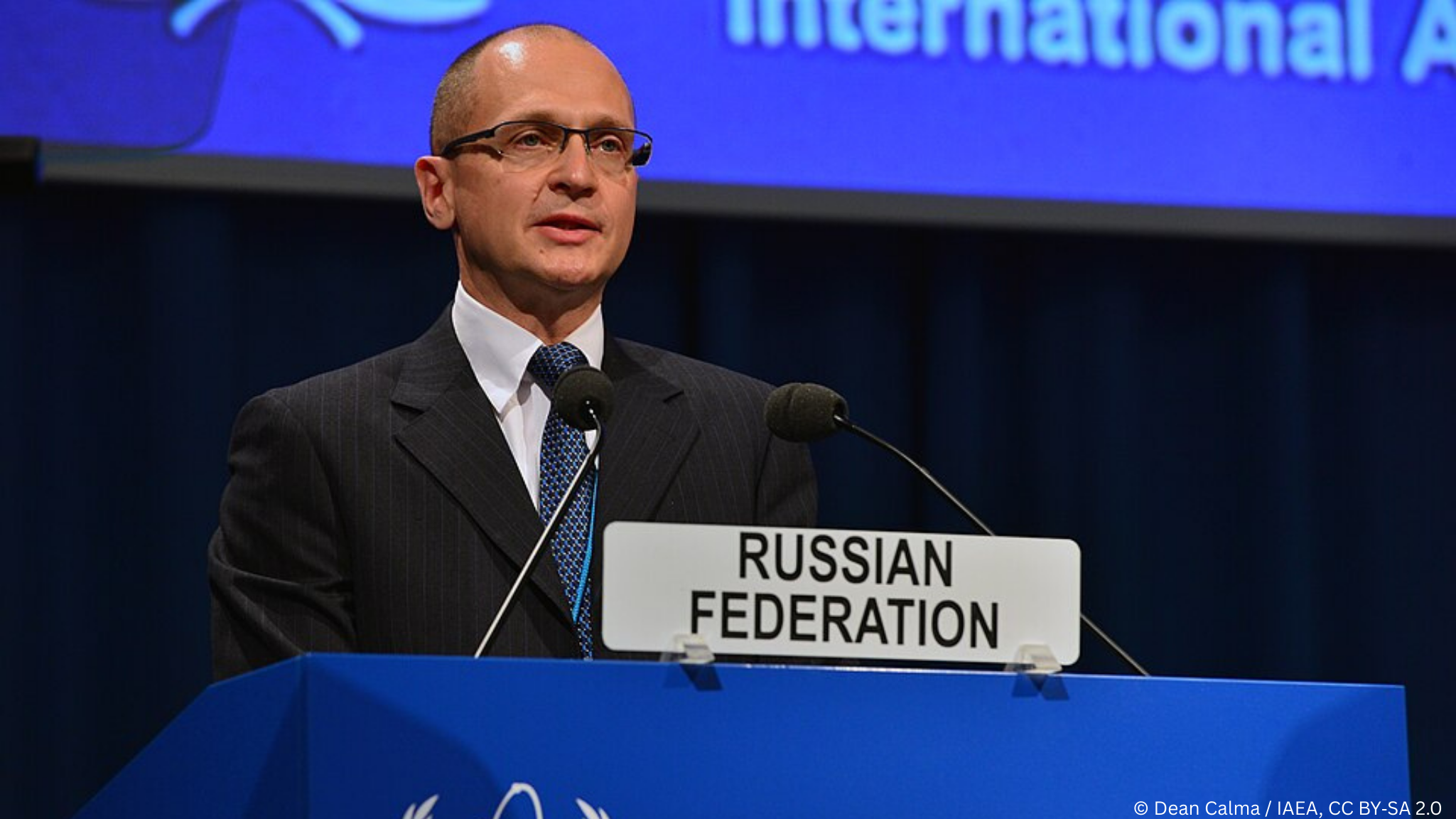
In 2025, the Russian government made significant changes to its oversight of the Georgian regions occupied by Russia. Early in the year, the Chief Curator of the Occupied Regions was replaced within the Russian Presidential Administration. Later, additional structural and personnel adjustments were made. As a result, Sergey Kiriyenko, the First Deputy Head of the Russian Presidential Administration, has since become the most influential official overseeing the occupied regions of Abkhazia and the Tskhinvali region.
Who is Sergey Kiriyenko?
Sergey Kiriyenko became Russia’s youngest Prime Minister at age 36. His rapid ascent began in 1997, when he was appointed First Deputy Minister of Fuel and Energy under Boris Nemtsov. Later that year, he became Minister. On March 23, 1998, President Boris Yeltsin promoted him to First Deputy Prime Minister, and on April 24, Kiriyenko assumed the role of Prime Minister. During his tenure, Russia experienced its first sovereign default, in 1998. During his premiership, on July 25, 1998, Vladimir Putin was appointed head of the Federal Security Service. Putin was introduced to the service’s staff by Kiriyenko.
After stepping down as Prime Minister, Kiriyenko became a member of the State Duma and led the Union of Right Forces electoral bloc from 1999 to 2000. Between 2000 and 2005, he served as the President’s plenipotentiary representative in the Volga Federal District. He then headed the Federal Agency for Atomic Energy from 2005 to 2007, before serving as Director General of Rosatom, the State Atomic Energy Corporation, from 2007 to 2016.
In 2016, Kiriyenko returned to government service as First Deputy Head of the Russian Presidential Administration, reporting to Anton Vaino. Initially, he was responsible for supervising the Kremlin’s domestic policy. Following the onset of Russia’s full-scale invasion of Ukraine in February 2022, his portfolio was broadened to include the administration of regions in Ukraine under Russian occupation.
Curator of the Occupied Regions of Georgia
At the end of January 2025, Kiriyenko made an unanticipated visit to Abkhazia. Shortly thereafter, it was announced that he had been assigned oversight of the Georgian territories occupied by Russia: Abkhazia and the Tskhinvali region.
Kiriyenko was born on July 26, 1962, in Sokhumi. His parents are Vladilen Izraitel and Larisa Kiriyenko. In the 1970s, he relocated with his mother to Sochi, Russia, at which time he adopted her surname. In September 2025, renovation was begun on the family’s former residence on Lakoba Street in Sokhumi. This restoration, funded personally by Kiriyenko, is intended to benefit “the State Orchestra of Folk Instruments in Abkhazia”, to whom he has pledged to transfer the property.
Kiriyenko replaced Deputy Head of the Presidential Administration Dmitry Kozak in the direction of overseeing the occupied regions, who had been curator since 2020 and was dismissed from his position on September 18, 2025. Kozak had held this position since 2020, and is regarded as a long-standing associate of President Vladimir Putin, having been a member of his political team since the outset of his leadership. Notably, Kozak is widely believed to have opposed Russia’s full-scale military intervention in Ukraine.
The position, encompassing the responsibilities of curator for the occupied regions, was established within the Russian Presidential Administration following the 2008 Russo–Georgian war. The first senior official designated as a curator was Tatyana Golikova, who served in this capacity from 2012 to 2013, and who now holds the office of Deputy Prime Minister of Russia. Between 2013 and 2020, oversight of the occupied territories was entrusted to Vladislav Surkov, a prominent political strategist. During his tenure, Surkov made frequent visits to the territories, played an active role in regional political affairs, and often acted as a crisis manager during episodes of political unrest in Abkhazia and the Tskhinvali region.
In 2020, Surkov withdrew from public political life. He was succeeded by Dmitry Kozak, Deputy Head of the Presidential Administration, who, while influential, adopted a largely passive stance regarding the occupied regions. Kozak’s engagement was limited chiefly to meetings with de facto leaders in Moscow, with infrequent, if any, visits to the territories themselves.
Kiriyenko is the first curator to have become extensively involved in the internal affairs of the occupied regions and to maintain a consistent presence through frequent visits. He has demonstrated particular activism in Abkhazia, where he is directly engaged in the execution of Russian-funded projects. In 2025 alone, he visited Abkhazia no fewer than seven times, and the Tskhinvali region on two occasions.
Kiriyenko’s first significant accomplishment in this role was facilitating the victory of the Kremlin’s preferred candidate, Badra Gunba, in the early, internationally unrecognized presidential elections in Abkhazia, held in 2025, on February 15 (first round) and March 1 (second round). Although the Kremlin has intervened in unrecognized elections in these regions in the past, this instance represented the most open and direct form of such involvement to date.
Structural Changes within the Presidential Administration
Following Kiriyenko’s appointment as curator of the occupied regions, the Russian Presidential Administration initiated significant structural reforms. In 2025, Kiriyenko became closely identified with both organizational and personnel changes undertaken in the Administration.
On August 29, 2025, the President of Russia issued Decree No. 607, titled “On Measures to Further Optimize the Structure of the Administration of the President of the Russian Federation.” Pursuant to this decree, the Department for Strategic Partnership and Cooperation was established within the Presidential Administration. This newly formed department is responsible for managing relations with countries in the so-called “near abroad” and select states of the “Global South.”
According to multiple sources, the department will prioritize “humanitarian cooperation” with foreign partners, utilizing instruments of “soft power” to advance Russia’s strategic interests. Kiriyenko has been appointed as the curator of this department. In addition, Kiriyenko oversees Russia’s policy toward Moldova and Armenia, with a mandate to promote Kremlin interests, strengthen pro-Kremlin political forces, and facilitate their ascent to power.
The same decree eliminated both the Department of Interregional and Cultural Relations with Foreign Countries and the Department of Cross-Border Cooperation, each of which had addressed matters concerning the occupied regions for many years.
On October 20, 2025, by presidential order, Igor Maslov, head of the Department of Interregional and Cultural Relations with Foreign Countries, was dismissed. Subsequently, on October 27, President Putin dismissed Alexei Filatov. Both Maslov and Filatov had long been entrusted with responsibilities pertaining to the occupied regions, and were considered among the most experienced officials in this domain.
According to experts, the establishment of the new department is intended to centralize authority within the Presidential Administration under a single coordinator, and to enhance the effectiveness of foreign policy operations.
On October 24, by presidential order, Vadim Titov was appointed as Head of the Department for Strategic Partnership and Cooperation. Titov previously held a position at Rosatom, formerly led by Kiriyenko, and is widely considered a member of Kiriyenko’s professional circle. It is noteworthy that Titov lacks prior experience with the occupied regions.
What will Kiriyenko change?
Kiriyenko holds considerable authority in Abkhazia and the Tskhinvali region. He possesses a thorough understanding of local political dynamics, and maintains a regular presence in the occupied territories, particularly Abkhazia. His visits are typically comprehensive and substantive, reflecting his direct involvement in the implementation of Russian-funded projects, and his oversight of details at all levels.
Kiriyenko’s frequent visits to Abkhazia underscore the Kremlin’s current prioritization of the region, where, in contrast to the Tskhinvali region, there remains notable resistance to Russian policy on select matters. Kiriyenko’s principal objective is to advance Russian interests by mitigating this resistance while averting any escalation of anti-Russian sentiment within the local population.
Following the onset of Russia’s full-scale military aggression against Ukraine in 2022, and the subsequent imposition of Western sanctions, Moscow has increasingly regarded Abkhazia as a key conduit for circumventing these restrictions. In recent years, railway transportation across Abkhazia has expanded, new infrastructure has been constructed at the Ochamchire port utilizing Russian credit, and, for the first time in 32 years, the Sokhumi civilian airport has resumed operations with Russian investment. The resolution of several acute socio-economic and energy challenges has also accelerated due to Kiriyenko’s direct involvement.
Kiriyenko’s influence is evident in the depth of the Kremlin’s involvement in the illegitimate presidential elections held in occupied Abkhazia in February–March 2025, which culminated in the election of the Kremlin’s preferred candidate. The de facto President, Badra Gunba, is widely perceived as Moscow’s choice, with his victory attributed largely to direct Kremlin support and Kiriyenko’s active intervention in the electoral process.
Gunba is directly accountable to Kiriyenko, and is anticipated to make concessions on matters of particular significance to the Kremlin, issues that have previously led to political crises in Abkhazia. These concessions may include permitting Russian citizens to purchase real estate in Abkhazia, fostering a more favorable climate for Russian investors, and transferring control over segments of the energy infrastructure to Russia.
Some within Abkhaz society regard such concessions as tantamount to surrendering “sovereignty” and diminishing “independence.” Nevertheless, for a region that is wholly dependent on Russia, viable alternatives remain scarce.
While previous Russian curators often demanded concessions in a rigid, overt manner, Kiriyenko’s conduct and public communications indicate a shift in the Kremlin’s approach, albeit without altering its strategic objectives. Kiriyenko articulates these goals openly; however, unlike his predecessors, he does so as an “ordinary Sokhumi resident,” rather than as an external Russian official.
Due to his authority and perceived local identity, there is an expectation within the Kremlin that his curatorship will facilitate the swift and relatively unobstructed implementation of Russian policy in the occupied regions.