
On 9 September 2026, Armenian Prime Minister Nikol Pashinyan visited France, where he met with French President Emmanuel Macron at the Élysée Palace.
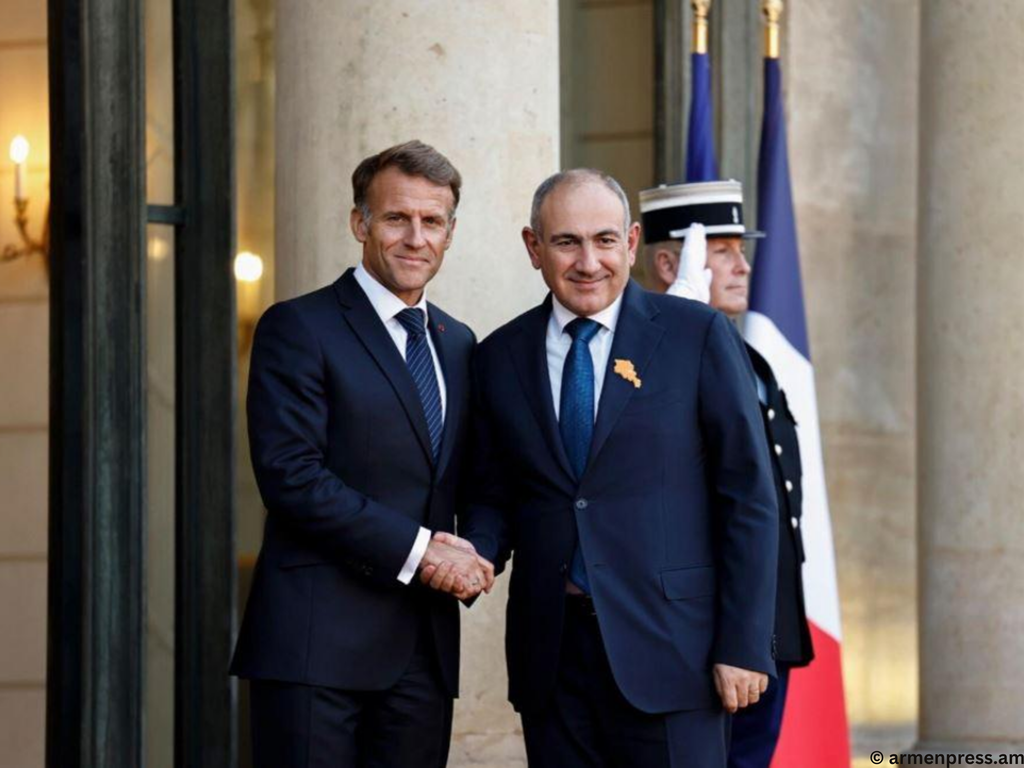
Macron and Pashinyan meet in Paris, 9 September 2026
Macron thanked the Armenian Prime Minister for accepting the invitation to the First International Space Summit, and highlighted ongoing progress in bilateral relations, in line with the declaration on strategic cooperation.
Prime Minister Pashinyan in turn thanked President Macron for the invitation and warm hospitality, and stressed the importance of expanding cooperation with France in the space sector. He noted Armenia’s interest in a more substantive partnership in this field.
The leaders agreed that economic cooperation remains a priority in the strategic partnership, spotlighting Armenia’s ongoing efforts to diversify its economy.
The meeting welcomed progress on the Bargushat Tunnel, which has entered a substantive phase, with both leaders noting the need to begin construction work as soon as possible.
The discussion also addressed regional developments, seeing Macron and Pashinyan underscoring the importance of taking consistent steps to strengthen peace.
On 1 September 2026, Armenian Prime Minister Nikol Pashinyan and Russian President Vladimir Putin met in Bishkek following a session of the Shanghai Cooperation Organisation Summit.
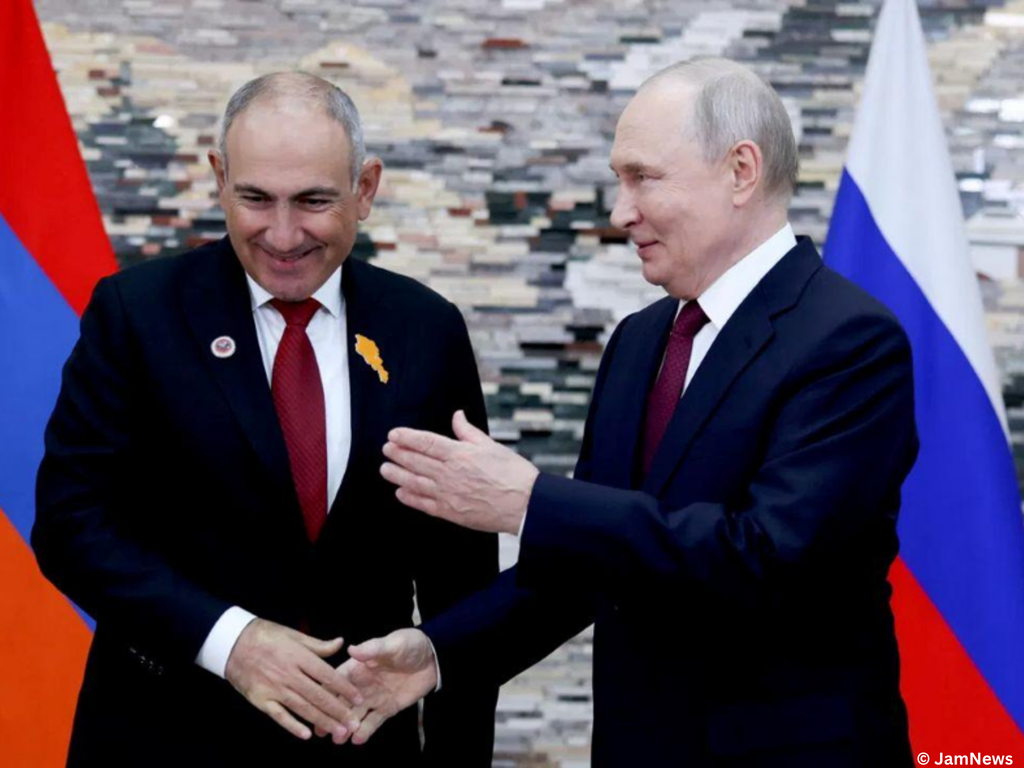
Putin and Pashinyan meet in Dushanbe, 1 September 2026
Tensions between the leaders have grown since their last meeting on 1 April, and since which Armenia has held parliamentary elections where Pashinyan’s party won a majority and created a new government. The Russian President has yet to congratulate Pashinyan on his victory.
At the start of the Bishkek meeting, Putin acknowledged Armenia’s right to pursue EU membership, but noted that this would complicate its membership in the Russian-led Eurasian Economic Union (EAEU).
“The sooner Armenia determines its position on joining the European Union, the better. Moscow needs to understand how to develop relations in the future. Armenia’s adoption of a law initiating the procedure for joining another organisation means that you are announcing your withdrawal from our organisation,” Putin said.
Pashinyan responded that Armenia does not intend to leave the Eurasian Economic Union.
“We highly value our relations with the Russian Federation. We hope that these relations are also important to Russia. I think that Armenia, Russia, and all of us personally, should treat these relations with great care. I want to confirm that I personally, and our government, do treat them with great care. I am confident that you will approach these relations in the same way, and I want to thank you for that,” Pashinyan said.
He said the question of EU membership has not progressed to the point of holding a referendum. Pashinyan explained that Armenia currently has no viable alternative to EU accession, and the issue will only arise when the government can present a choice to the public.
“People should always have the right to choose. So make that choice, and let us close this subject. That is all. The simplest way would be to address the people and ask: what do you want – this or that?” the Russian President said.
After the meeting, Pashinyan posted a video on social media summarising the results of the talks.
He described the meeting as “very good,” and said both sides had agreed to continue their “sincere and constructive dialogue” during his upcoming visit to Moscow, which is expected soon.
“Bilateral relations between Armenia and Russia are extremely important to both countries. […] However, in the new situation and under the new conditions, a need arises to rethink these relations. And I am confident that, as a result of this rethinking, our relations will become better, more constructive, mutually beneficial, and warmer,” Pashinyan said.
Armenia had expected Pashinyan and Putin to face difficult discussions on key issues, though analysts noted that the meeting was unlikely to bring significant change.
A primary topic at the meeting was the possibility of a referendum in Armenia on whether to remain in the Eurasian Economic Union or pursue EU membership. The EAEU includes Russia, Belarus, Armenia, Kazakhstan, and Kyrgyzstan.
Russia and other EAEU member states have been urging Yerevan to hold a referendum, yet Armenian authorities have said they consider it unnecessary at this stage, as Armenia has not applied to join the European Union.
The EAEU has also discussed reviewing Armenia’s status. However, under the union’s charter, only Armenia can decide to leave, and no alternative procedure exists, as Pashinyan has repeatedly pointed out.
On 24 August, the Armenian Prime Minister discussed the possibility of formally applying for EU membership, prompting renewed criticism from Russia.
Moscow described EU membership as a “marathon lasting decades,” and warned that Yerevan would experience “the cost of breaking with Russia and the EAEU here and now.” Russian experts, meanwhile, predicted a “fatal outcome” for Armenia, suggesting the country would have to choose between “Turkification” and a “Ukrainian scenario.”
Another issue discussed at the September 1 meeting between Putin and Pashinyan was the ongoing restrictions on Armenian exports to Russia, which have been in effect since May.
Russia has long been a key export market for Armenia, yet since Moscow imposed restrictions citing product quality, some Armenian products have entered the EU market more actively, where standards are higher.
The meeting also addressed Armenia’s participation in the Collective Security Treaty Organisation (CSTO).
Yerevan has suspended its participation in the organisation for two years in response to the bloc’s inaction. In 2021-2022, when Azerbaijani forces entered Armenian territory, the allies neither intervened nor condemned Baku, citing the lack of a delimited Armenia-Azerbaijan border.
On the eve of the September 1 talks, Russian presidential aide Yuri Ushakov noted that the meeting was occurring “when opposition leaders are being arrested en masse in Armenia.”
Ushakov was referring to the arrest of former Armenian President Robert Kocharyan.
Kocharyan faces charges of abuse of official authority, accepting a large bribe, and money laundering. The court ordered his detention for two months. This is his fourth arrest.
In Armenia, it was fully expected for Putin, who has had friendly relations with Kocharyan, to raise the issue of his release.
During his previous meeting with Pashinyan in April, Putin had expressed hope that Russia’s “friends,” meaning pro-Russian political forces, would be able to participate in Armenia’s elections.
He was likely referring to the party of Russian businessman Samvel Karapetyan, which faces charges on calling for the seizure of power and whose leader is under house arrest, as well as the bloc led by former President Robert Kocharyan.
Both groups participated in the elections but did not secure a parliamentary majority.
On 7 April 2026, Armenian Foreign Minister Ararat Mirzoyan met with Latvian Foreign Minister Baiba Braze in Riga.
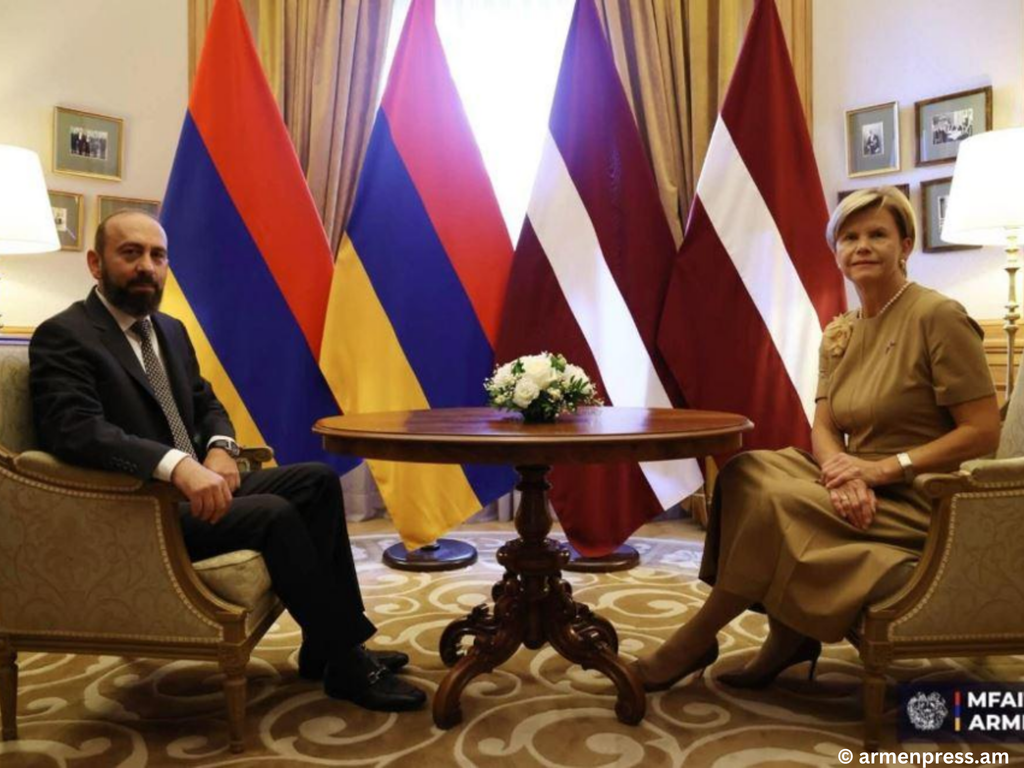
Braze and Mirzoyan meet in Riga, 7 September 2026
The initial meeting was conducted one-on-one, followed by expanded discussions. The parties addressed bilateral relations and regional developments.
Azerbaijan’s Foreign Policy
On 15 September 2026, President Ilham Aliyev of Azerbaijan, while at a meeting with representatives of Muslim religious organisations in Baku, accused European institutions of bias. He also said Azerbaijan would continue strengthening its military capabilities alongside developing the peace process with Armenia.
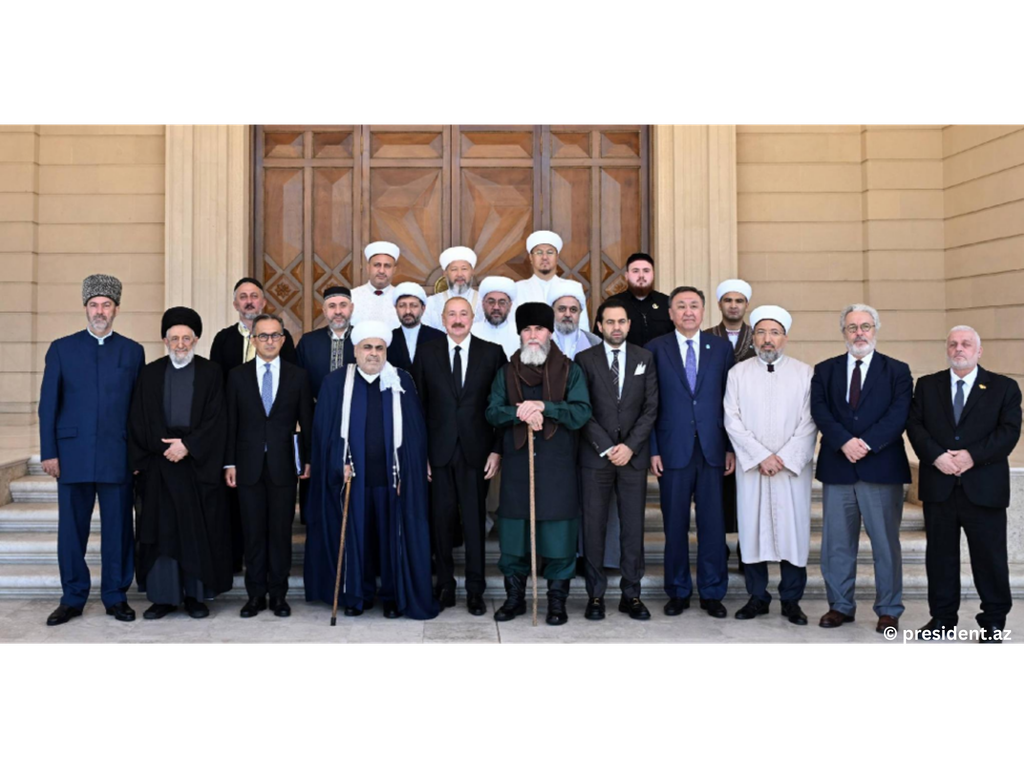
Aliyev meets representatives of Muslim religious organisations in Baku, 15 September 2026
During the September 15 meeting, Aliyev met members and observers of the Council of Heads of Muslim Religious Administrations of the Organisation of Turkic States, co-organisers of the Yahya Bakuvi International Conference, and representatives of the Supreme Religious Council of the Peoples of the Caucasus.
At the meeting, Aliyev accused the Council of Europe and the European Parliament for supporting Armenia yet applying double standards to Azerbaijan. He described the European Parliament as a “nest of corrupt officials.”
“I say this with full responsibility: the European Parliament is a nest of corrupt officials,” Aliyev said.
He claimed that suitcases containing millions of dollars were found in the home of the European Parliament’s Vice-President, but stated that the case concluded without consequences. Aliyev was referring to a female Greek member of parliament.
“How many years have passed since then? Were any measures taken against her? No. Was she held accountable? No. She was released. The European Parliament consists of such Islamophobes, and this must remain a focus of attention,” he said.
Aliyev also linked Azerbaijan’s restoration of full control over Karabakh in September 2023 to the subsequent decision on the credentials of the Azerbaijani delegation, saying the decision responded to Baku’s military operation. PACE is a body of the Council of Europe and, unlike the European Parliament, is not an institution of the European Union.
The report underpinning PACE’s decision presented a broader list of reasons for the refusal to ratify. These included failure to fulfill human rights obligations, reports of political prisoners, the arrests of independent journalists, obstacles created for monitoring, and the failure to invite observers to the presidential election. The document also mentioned the military operation conducted in Karabakh and the departure of the region’s Armenian population.
Aliyev expressed hope that the ongoing peace process with Armenia will last.
He also stated that the past war and extensive destruction would not be forgotten, and that Azerbaijan would remain vigilant on security matters.
The President described military power as a guarantor of the country’s sovereignty and territorial integrity, and said the growing role of force in international relations requires Azerbaijan to continue strengthening its defense capabilities.
The meeting also addressed the expansion of regional conflicts. Aliyev emphasised the need for joint efforts to preserve peace in the Turkic world and the Caucasus, and claimed that an undeclared war is being waged against the Islamic world, identifying Islamophobia as a key component of this.
He stated that solidarity among Muslim countries should be the principal response to this pressure: “Attempts to discredit and smear the Muslim world, equate it with terrorism, and insult our values and the Holy Q’uran – do you think all of this is happening by chance? No. This is a deliberate policy. What can we set against it? Only our unity. The call for unity is not merely a slogan,” Aliyev said.
He noted that Azerbaijan is one of the few Muslim countries participating in European organisations: “Therefore, we know what is happening there. As a member of the Council of Europe, we have encountered this injustice; we encounter it now and will probably encounter it in the future,” he said.
Aliyev also stated that the “smear campaign” against Azerbaijan will continue because, he said, Baku does not yield, openly expresses its position, and protects its national identity and way of life.
“We defend morality. That is precisely why these campaigns are being conducted against us,” the President claimed.
He also noted that religious leaders play a special role in Muslim countries: “The main message, once again, is this: we must all strive for unity. As I have already said, the words of religious figures have special significance for all Muslim countries.”
Aliyev also announced that Baku will host the Organisation of Islamic Cooperation summit next year. He closed by urging religious leaders to promote peace and cooperation in their communities.