
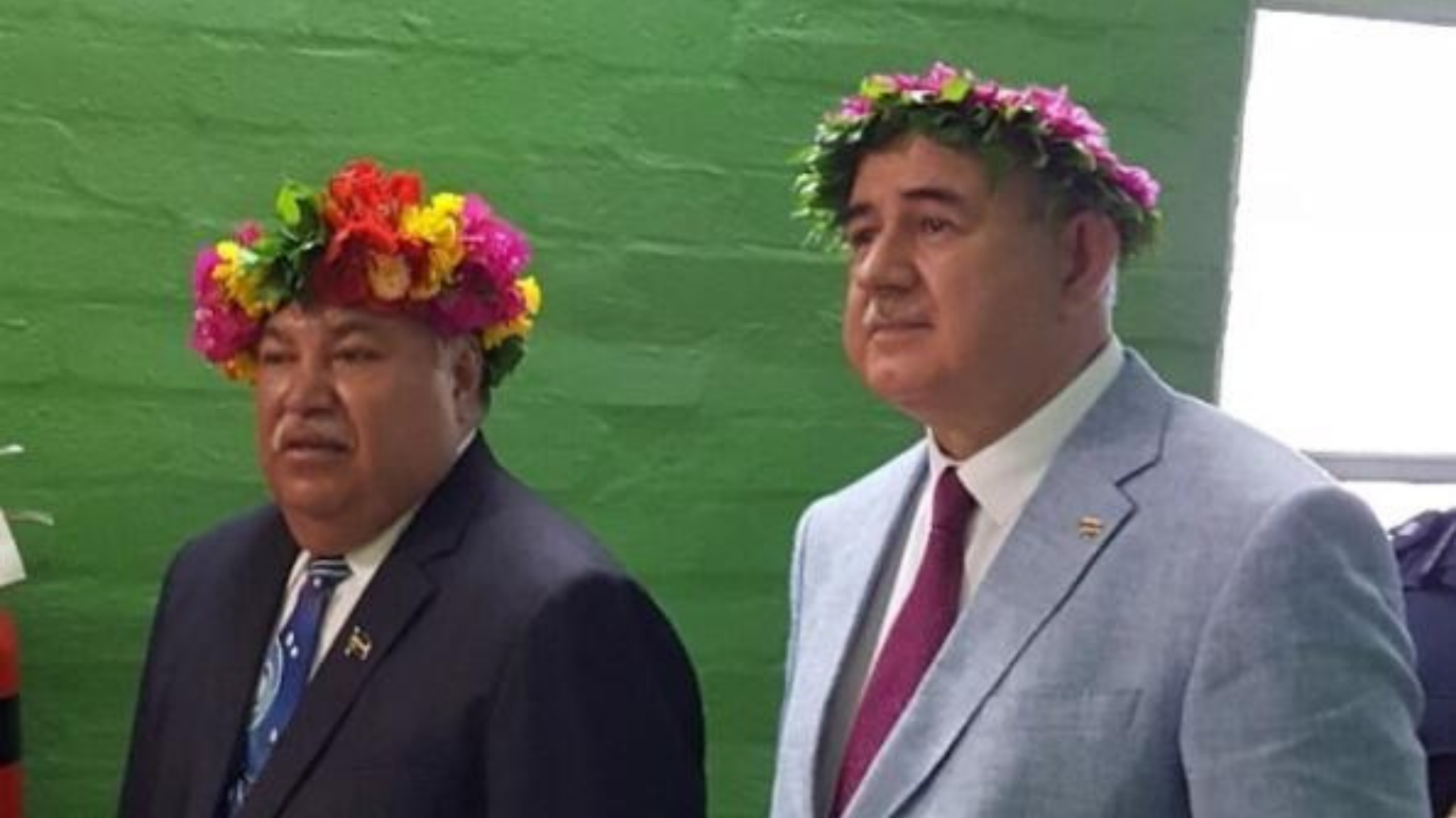
On July 29, 2026, it was announced that the Republic of Naoero (formerly Nauru), an island state located in the Pacific Ocean, had severed diplomatic relations with Georgia’s Russian-occupied Abkhazia and the Tskhinvali region, and had withdrawn its decision to recognise them as independent states. This article explains when and why Naoero recognised the independence of Georgia’s occupied regions, how bilateral relations developed, and why those relations ended.
About Naoero
Naoero is the world’s smallest island state. Its territory covers 21 square kilometres and its population is approximately 12,000. Under a constitutional amendment adopted in May 2026, the country’s name was officially changed back to its original: “Naoero.” The authorities explained the decision as a rejection of the island’s colonial legacy. In June, the United Nations also recognised the country’s new name.
Recognition of Georgia’s Occupied Territories
Shortly after the August 2008 Russia-Georgia war ended, on August 26, Russia recognised the independence of Georgia’s separatist regions, the so-called Republic of Abkhazia and the so-called Republic of South Ossetia (the Tskhinvali region). Russia established complete control over the occupied regions and became the sole guarantor of their security and socioeconomic development.
In accordance with the Kremlin’s foreign-policy objectives, Moscow began lobbying for recognition of the independence of Abkhazia and “South Ossetia.” After 2008, in addition to Russia, four other United Nations member states recognised the independence of the occupied regions: Nicaragua on September 5, 2008; Venezuela on September 10, 2009; Naoero (formerly Nauru) on December 15 and 16, 2009; and Syria on May 29, 2018. There was some uncertainty surrounding the alleged recognition of the occupied regions’ independence by Vanuatu and Tuvalu. Ultimately, in 2013 and 2014, it was announced that these countries had not recognised the independence of Georgia’s occupied regions.
The decisions of three of the above four countries that offered recognition were connected with developments in global politics and their anti-Western policies. In Naoero’s case, the motivation was financial.
Naoero recognised the independence of Abkhazia on December 15, 2009, and that of the Tskhinvali region on December 16, doing so in exchange for money: it is known that Russia provided it with USD 50 million for “urgent social and economic projects.”
Although the political weight of such countries in global politics is minimal, recognition by an independent United Nations member state can nevertheless have significant propagandistic value. The occupied regions regularly highlight that their independence is recognised “by UN member states.” In such cases, the recognising country’s size or political weight is of lesser importance.
Russia’s principal targets are precisely countries like Naoero, which use their status as independent states and their UN membership to obtain certain benefits and, in return, state their preparedness to recognise the independence of such de facto republics as Abkhazia and the Tskhinvali region. As a result of active diplomacy by Georgia and its Western allies, the list of states recognising Georgia’s occupied territories has not expanded since 2018.
How Relations with the Occupied Regions Began and Developed
Following Naoero’s recognition of the occupied regions, a visa-free regime entered into force between the parties. However, because of the geographical distance, reciprocal visits were rare. Only Naoeroan representatives already visiting Russia would travel to Sokhumi and Tskhinvali. Relations between the parties were largely limited to official correspondence, including birthday greetings, and messages marking independence days or other national holidays, addressed to senior officials. The visits and agreements concluded between the parties produced no tangible results.
Relations with Abkhazia
Bilateral visits were rare. Naoero’s representatives were the more active party in this respect. In 2011, Naoeroan representatives visited Abkhazia for the first time to observe the illegitimate presidential election.
In 2015, two delegations from Naoero visited Abkhazia. First, Naoero’s vice president travelled to Abkhazia, followed by the speaker of Naoero’s parliament. A Naoeroan delegation also visited Abkhazia in 2016. On November 12–13, 2017, President Baron Waqa paid a working visit to Abkhazia. He became the first head of state, after the Russian leader, to visit occupied Abkhazia. In 2018, a Naoeroan delegation attended ceremonies marking the tenth anniversary of the recognition of Abkhazia’s independence. No further visits by Naoeroan representatives to Abkhazia were recorded after that.
For its part, the Abkhaz side visited Naoero only once, in 2018. De facto Foreign Minister Daur Kove attended events marking the fiftieth anniversary of Naoero’s independence, and also met the president of the republic. The parties also met several times in Moscow. For example, in 2012, Abkhazia’s so-called ambassador to Russia, Igor Akhba, met the president of Naoero, who was in Moscow on a working visit. The following year, Akhba again met the president and foreign minister of Naoero.
The parties also signed an agreement on friendship and cooperation in 2016, and an agreement on interparliamentary cooperation in 2018. In practice, these agreements were symbolic, and their implementation was never placed on the agenda.
Relations with the Tskhinvali region
A Naoeroan delegation first visited the Tskhinvali region on December 12, 2009, several days before formally recognising its independence. The delegation was headed by the minister of foreign affairs, trade, and finance. In 2010, a Naoeroan delegation participated in ceremonies marking the twentieth anniversary of the Tskhinvali region’s proclamation as a so-called republic. In 2012, the president of Naoero visited the Tskhinvali region to mark its independence day. Naoeroan delegations also visited Tskhinvali for independence-day events in 2016 and 2018.
For its part, in 2018, de facto Foreign Minister Dmitry Medoev travelled to Naoero to attend events marking the fiftieth anniversary of its independence. This was his first official visit to the country. Earlier, in 2017, de facto president Anatoly Bibilov had met the president of Naoero for the first time during a working visit to Moscow.
During Medoev’s first official visit in 2018, the parties signed two agreements: a memorandum of understanding on cooperation in international affairs, and an agreement on visa-free travel.
Severance of Diplomatic Relations
On July 29, 2026, Georgia’s Ministry of Foreign Affairs issued a statement announcing that Naoero had severed diplomatic relations with occupied Abkhazia and the Tskhinvali region. The ministry welcomed “the decision adopted on July 21, 2026, by the executive body of the Republic of Naoero, the Cabinet of Naoero, to terminate diplomatic relations ‘between the Republic of Naoero and the Republic of South Ossetia, also known as the State of Alania,’ and ‘between the Republic of Naoero and the Republic of Abkhazia.’ This decision once again confirms that respect for and observance of the norms of international law constitute the foundation of sound international relations. Georgia expresses its readiness to establish diplomatic relations with the Republic of Naoero and to promote the intensification of bilateral cooperation based on shared interests.”
On July 30, a statement published on the Naoeroan government’s Facebook page announced that Naoero had withdrawn its decision to recognise the occupied regions as independent states and had severed diplomatic relations with them.
On August 5, Georgian Prime Minister Irakli Kobakhidze commented on Naoero’s decision at a government meeting, stating: “The decision of the Republic of Naoero to terminate diplomatic relations with the so-called Republic of Abkhazia and the so-called Republic of South Ossetia once again confirms that respect for and observance of the norms of international law are the foundation of sound international relations.”
Assessments by the Occupied Regions
In the occupied regions, the principal reason cited for Naoero’s decision to withdraw recognition was “external pressure” on the Naoeroan authorities, allegedly involving instruments of political and economic blackmail. Against the background of this diplomatic setback, the occupied regions emphasised that only recognition by Russia, and Moscow’s support, are decisive for them.
On July 29, the de facto Ministry of Foreign Affairs of occupied Abkhazia issued a statement concerning Naoero’s decision: “The Ministry of Foreign Affairs of the Republic of Abkhazia regrets the forced nature of the decision of the Republic of Naoero to terminate diplomatic relations with the Republic of Abkhazia, made under unprecedented and systematic external pressure….The entire arsenal of unacceptable methods of strangulation and coercion was used: from unceremonious political blackmail and brutal diplomatic pressure to outright financial and economic repression and punitive sanctions aimed at forcing the sovereign choice of the Republic of Naoero.”
On July 31, the de facto Ministry of Foreign Affairs of the occupied Tskhinvali region also issued a statement: “This step does not result from the bilateral relations agenda. According to available information, the Government of Naoero was subjected to serious pressure over a prolonged period, including threats. It is evident that Georgia, with the support of Western structures, continues to use every instrument, from political blackmail to economic incentives, in its efforts to continue isolating South Ossetia in the international arena.”
Naoero’s decision was also assessed by former de facto president Eduard Kokoity, the de facto leader of the Tskhinvali region from 2001 to 2011. In his assessment, such a decision indicates that Naoero is “a failed state.” He said: “First of all, we are grateful to Naoero for recognising the Republic of South Ossetia. On the other hand, however, such a step by this country does it no credit. It demonstrates their failure; that they are subject to external influence; and that it was precisely as a result of external influence that the Naoeroan authorities made this decision.”
According to an assessment published in Tskhinvali’s ‘state’ media, “Naoero’s decision could have dealt a blow to the international legitimacy of the Republic of South Ossetia had international law not been trampled over recent decades by the consistent actions of the collective West.” The article argues that Naoero’s recognition in 2009 was likely driven by economic motives, and that, under the influence of a changed international environment, Naoero revised its position, just as Vanuatu and Tuvalu had done previously. It concludes that Naoero’s decision has no significance, just as its decision to recognise had no significance, and that small countries in Oceania and the Caribbean often act as ‘diplomatic mercenaries,’ voting or granting recognition in exchange for assistance.
Assessment of Russia
The Ministry of Foreign Affairs of Russia made a laconic comment on Naoero’s decision late, on August 7, to the state agency “РИА Новости”: “As you know, Russia never interferes in the internal affairs of independent countries. For our part, we note that the motives of such a decision are incomprehensible to the Russian side.” The ministry believes that “the liquidation of diplomatic relations will not help to expand the geography of relations of the island state with the outside world and increase the quality of ties.”
Trading in Sovereignty
Naoero is an independent state in the Pacific Ocean over which Australia exercises significant strategic, financial, and economic influence. Security matters on the island are coordinated with Australia. In September 2024, Australia concluded a security agreement with Naoero. In exchange, Naoero received USD 64 million in direct budget support over a five-year period. Before signing any bilateral agreement concerning maritime security, defence, or policing, Naoero must consult Australia. The agreement also stipulates that Naoero may not conclude agreements concerning ports, air bases, or the banking sector without Australia’s consent. The agreement is intended to prevent the expansion of China’s influence in the Pacific.
Naoero’s foreign-policy decisions can be explained using the term “sovereignty arbitrage,” meaning a country’s use of its status as an independent state to obtain certain benefits. In this respect, Naoero is a good example of a country using its sovereignty to secure economic gains. Small countries such as Naoero can take advantage of their independent-state status and UN membership to offer larger states various ‘services,’ such as citizenship programmes, financial services, diplomatic recognition, and the construction of different types of infrastructure. For various reasons, larger countries may prefer to use the ‘services’ of countries such as Naoero. For example, on January 15, 2024, Naoero, which had been an ally of Taiwan for twenty-two years, severed ties with Taiwan and restored diplomatic relations with China, a move which was followed by the receipt of financial support from China.
In July 2026, the Naoeroan government decided to open a new embassy in Jerusalem, a controversial decision in the context of the Israeli-Palestinian territorial dispute. Such a decision is expected to be followed by financial and economic assistance from Israel.
What Should Be Expected
Naoero’s decision represents reputational damage for Moscow, which has been at the forefront of the policy of recognising occupied Abkhazia and the Tskhinvali region. Although, since 2008, only four UN member states other than Russia have recognised the occupied regions, this gave Sokhumi and Tskhinvali hope that the number of countries offering recognition would increase. Naoero’s decision indicates that Moscow’s global influence has weakened. Following political changes in Syria and Venezuela, the governments of those countries may also adopt similar decisions.