
Armenia’s Foreign Policy
On July 29, 2026, Armenian Prime Minister Nikol Pashinyan announced that he and Russian President Vladimir Putin had reached an understanding on several issues during a telephone call.
Speaking to reporters, Pashinyan also affirmed Armenia’s legitimate right to determine its own course.
“The Republic of Armenia has the legitimate right to pursue its own alternatives. I told the Russian president that we have already announced this path and will continue to follow it, especially now that the people of Armenia have voted in favour of it,” Pashinyan stated.
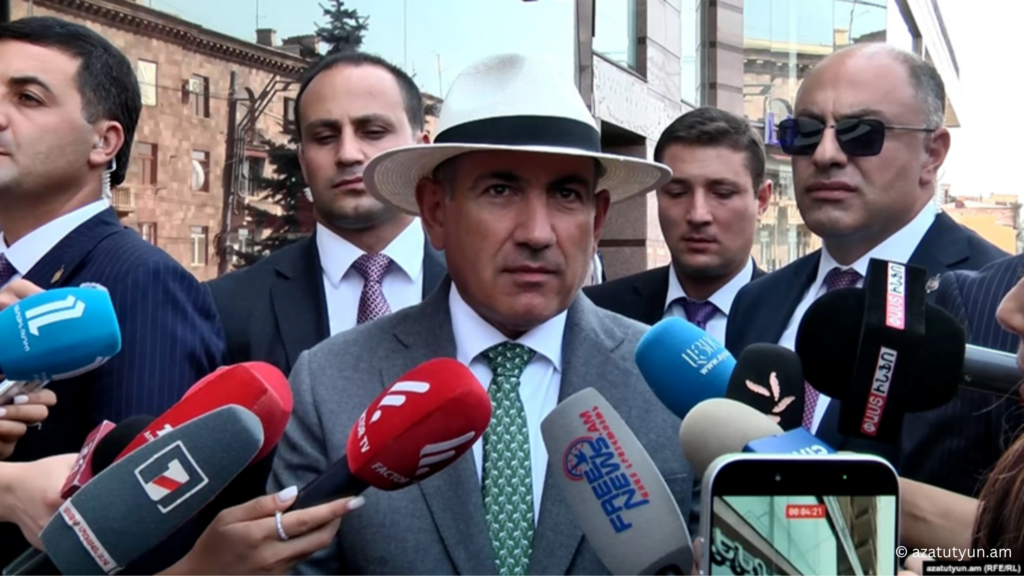
Prime Minister of Armenia Nikol Pashinyan
He stated that he could not foresee Armenia lacking alternatives due to the government’s policies.
“I cannot imagine pursuing policies that would put Armenia in a position where it had no alternatives. Armenia must always have options,” the Armenian prime minister said.
When asked if his conversation with Putin could be labelled as “futile” due to the lack of concrete agreements that came out of it, Pashinyan simply responded, “The dialogue took place, and we spoke at length.”
Pashinyan noted that Russia’s export restrictions impact not only Armenia, but the entire Eurasian Economic Union (EAEU).
“This is a problem for the Eurasian Economic Union. It appears the EAEU is paralysed and no longer functioning. If this issue is not resolved quickly, I predict this will mark the beginning of the end of that Union,” the Armenian prime minister said.
When asked if the Armenian government might withdraw from the EAEU, Pashinyan answered that there are no such plans.
Pashinyan stated that on May 29, in Astana, EAEU member state leaders adopted a joint statement recognising Armenia’s right to hold a referendum on joining the European Union.
“I pointed out to the Russian president that, to hold such a referendum, we would first have to apply for membership in the European Union,” Pashinyan said.
The Normalisation of Turkish-Armenian Relations
On July 28, 2026, Ergüder Toptaş, the mayor of the Turkish border town of Akyaka, told Armenian journalists that he was optimistic about the normalisation of Turkish-Armenian relations.
Toptaş stated that once Armenia and Azerbaijan normalise relations, no further obstacles are expected to stand in the way of reopening the Turkish-Armenian border.
He added that, following instructions from the Turkish president and in coordination with the Ministry of Transport, preparations are underway to reopen border crossings and restore railway infrastructure.
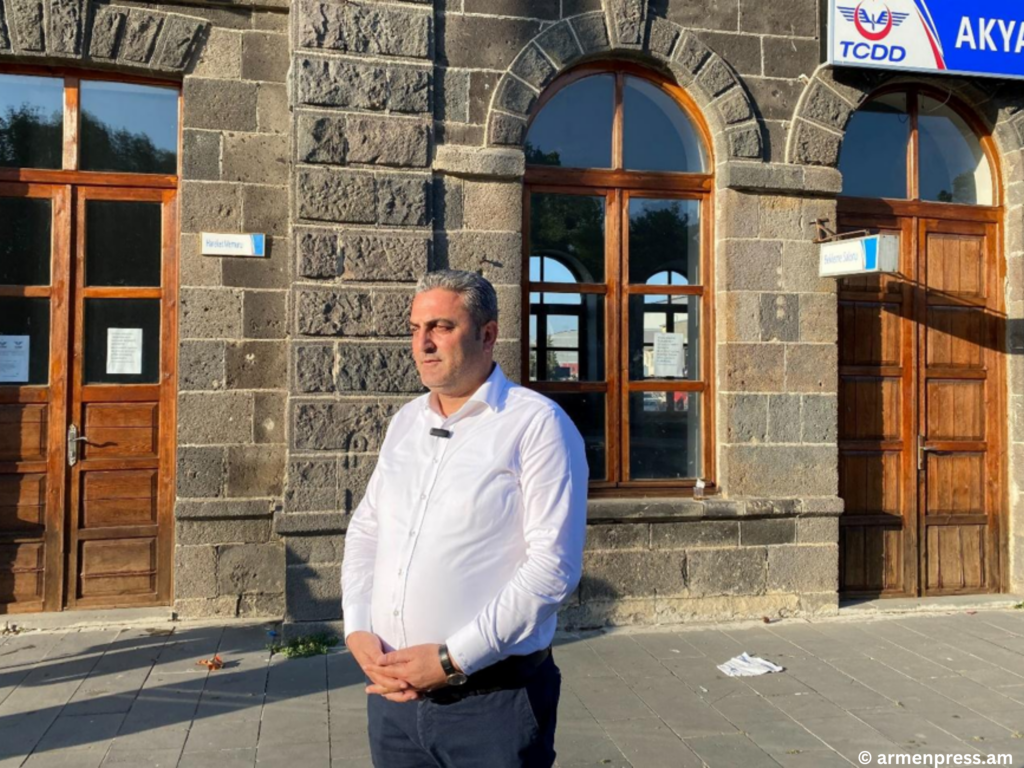
Akyaka Mayor Ergüder Toptaş
In addition to the closed border, which remains the main barrier to railway operations, the infrastructure requires restoration. Toptaş stated that rehabilitation of the Akyaka-Gyumri railway line is underway, and is expected to be completed within two to three months. Public tenders for the required construction have been announced.
“Construction has begun, and work is underway,” Toptaş said, emphasising that these efforts aim to prepare for the reopening of the Turkish-Armenian border.
Preparations also include a tender for constructing a highway between Akyaka and Gyumri.
“The tender for the Akyaka-Gyumri highway has already been announced, and we expect construction to begin soon. This aligns with our governments’ policy of fostering friendly, good-neighbourly relations,” Toptaş said.
According to the mayor, reopening the Turkish-Armenian border would benefit both countries economically, and would create substantial opportunities for cooperation in agriculture and industry.
“When the leaders of Türkiye and Armenia make the necessary policy decisions, we are confident that the entire region will benefit. I believe both countries stand to gain significantly from reopening the border and the economic cooperation it would generate,” Toptaş said. He added that reopening the border would provide Türkiye with an additional route to the Caucasus, while giving Armenia access to the Middle East through Türkiye.
On July 30, 2026, Armenian Prime Minister Nikol Pashinyan announced that the government is considering candidates for Armenia’s new “special representative for normalising Turkish-Armenian relations.” He made this statement during a briefing after a government meeting.
“No decision has been made regarding the special representative. As part of our engagement with Türkiye, we must first determine how to proceed, and within which framework and approach, before making a decision. Consultations are ongoing,” Pashinyan said.
Ruben Rubinyan, Armenia’s former special representative for the normalisation process, has been nominated by the Civil Contract party as its candidate for speaker of the ninth convocation of the National Assembly.
TRIPP
On July 16, 2026, the Armenian government approved a draft law to ratify the Strategic Partnership Framework Agreement between Armenia and the United States on the Trump Route for International Peace and Prosperity (TRIPP) project.
Armenian Foreign Minister Ararat Mirzoyan presented the draft during a government meeting on July 16.
Mirzoyan stated, “With this decision, we are formally beginning the process of ratifying the Strategic Partnership Framework Agreement between Armenia and the United States concerning the TRIPP project. In accordance with established procedures, we will submit the agreement to the Constitutional Court. If the court finds that the obligations it contains are consistent with the Constitution, we will refer the matter to the National Assembly for consideration.”
The foreign minister noted that he and U.S. Secretary of State Marco Rubio had initialled the framework agreement in Yerevan on May 26, 2026. The agreement was subsequently signed in Washington on June 1 and in Yerevan on June 4.
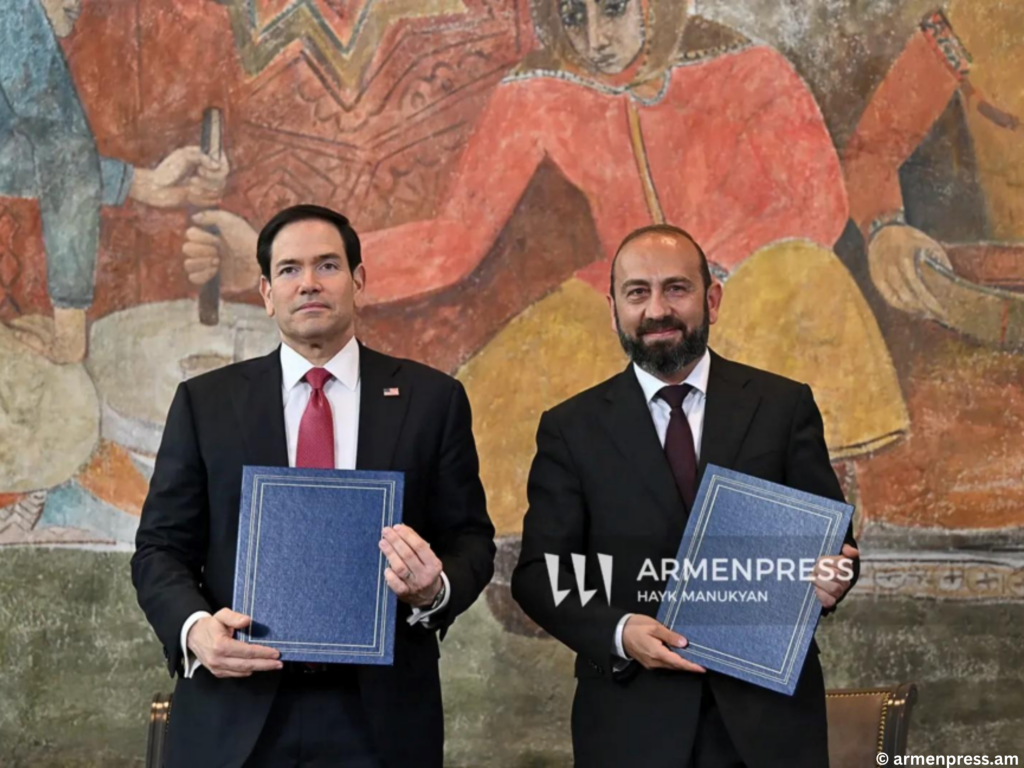
US Secretary of State Marco Rubio and Armenian Foreign Minister Ararat Mirzoyan
“To address any possible questions, I should note that both international practice and Armenian law provide for agreements of this kind to be signed remotely and at different times. This is an accepted practice,” Mirzoyan emphasised.
The Armenian foreign minister stated that the agreement is based on two foundational documents: the August 8, 2025 declaration signed by the Armenian Prime Minister and the President of Azerbaijan, and the TRIPP Implementation Framework signed on January 13, 2026 by the U.S. Secretary of State and the Armenian foreign minister.
“This intergovernmental framework agreement further clarifies the details and areas of cooperation already agreed upon, and is fully consistent with the two documents I mentioned. Why do I emphasize this? Because, following both the August 8 Declaration and the January 13 Implementation Framework, there was speculation that the eventual intergovernmental agreement might contain provisions inconsistent with those documents. As we can see, however, this agreement is not only fully consistent with the publicly announced, formally recorded, approved, and signed principles, but also repeatedly refers to the documents of August 8 and January 13,” Mirzoyan said.
The foreign minister noted that the completion of TRIPP requires two additional documents: a shareholders’ agreement and the charter for the TRIPP Development Company.
The framework agreement seeks to advance peace, stability, and prosperity in the South Caucasus by developing transportation infrastructure and expanding trade.
“The agreement establishes that Armenia and the United States aim to promote peace and stability in the South Caucasus and support the prosperity of its countries and peoples through the development of transportation, transport infrastructure, and regional and global trade. This objective is reiterated throughout the framework agreement,” Mirzoyan said.
The agreement stipulates the establishment of the TRIPP Development Company, which may create special-purpose entities and engage additional partners to implement projects in designated areas of Armenia.
Mirzoyan stated that the process, including the establishment and operation of the TRIPP Development Company, will fully respect Armenia’s sovereignty, jurisdiction, and territorial integrity. The company will be granted land-use and construction rights for 49 years, during which the United States will hold 74 percent of shares and Armenia 26 percent.
After 49 years, the parties may choose to extend cooperation for an additional 50 years, at which time Armenia’s share would increase from 26 percent to 49 percent.
“If the term is extended, the Republic of Armenia will be guaranteed a 49 percent stake in the company. In other words, Armenia’s 26 percent stake will increase to 49 percent. Armenia will not be required to take any additional steps, make further investments, or assume additional obligations to obtain this stake,” Mirzoyan said.
The foreign minister emphasised that Armenia will retain full sovereignty and jurisdiction over the management of its state border, border control, customs administration, and all customs procedures conducted within its territory.
“In accordance with its domestic laws and international agreements, Armenia will remain responsible for security and law enforcement, border control and border security, customs and immigration controls, the transfer of taxes and duties to the state budget, state information systems, and government administrative and oversight functions. As you can see, this list comprehensively addresses all legitimate concerns that may have arisen during the extensive public debate in Armenia, as well as the harmful speculation we have witnessed in recent months,” Mirzoyan emphasised.
He added that certain functions may be organised according to a front-office and back-office model, with private operators potentially responsible for front-office activities.
“These functions may be divided according to the front-office and back-office model, with private operators engaged to perform front-office activities. This practice already exists in Armenia, and its details are also set out in the TRIPP Implementation Framework of January 13,” the foreign minister concluded.
Azerbaijan’s Foreign Policy
On July 21, 2026, German Chancellor Friedrich Merz and Azerbaijani President Ilham Aliyev signed a joint declaration to establish a strategic partnership between Germany and Azerbaijan.
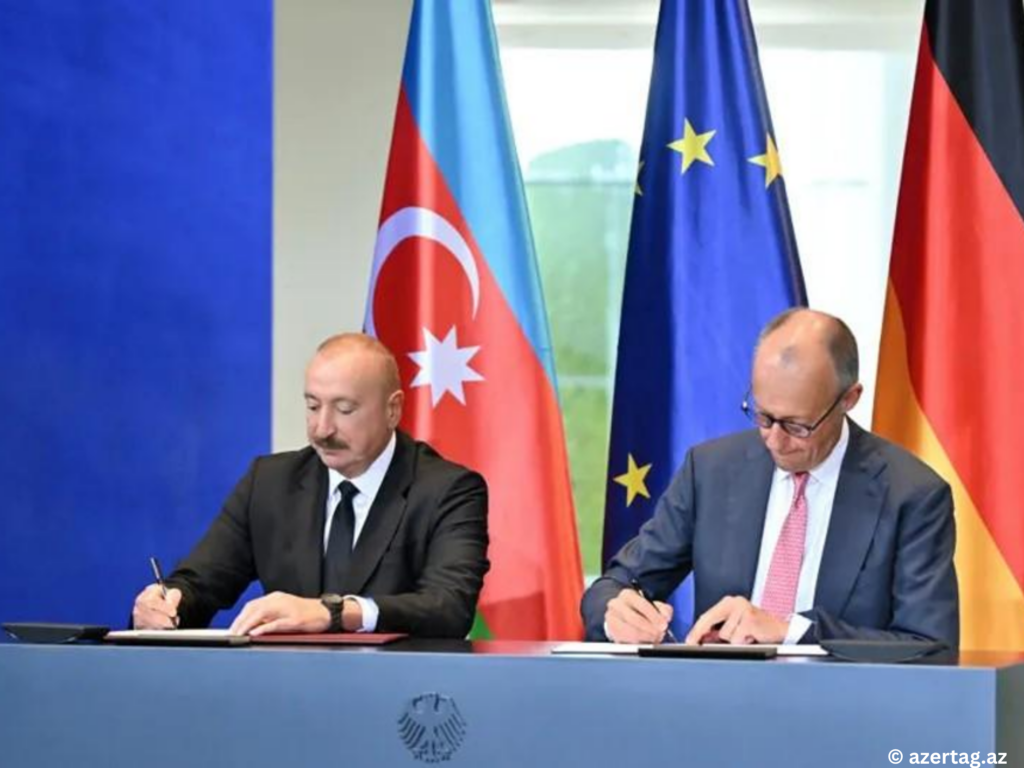
Azerbaijani President Ilham Aliyev and German Chancellor Friedrich Merz
Merz emphasised that greater stability in the South Caucasus would create new opportunities to expand bilateral economic cooperation.
“I am pleased that relations between Germany and Azerbaijan are developing dynamically,” Merz stated during his joint press conference with Aliyev.
Aliyev in turn indicated that Azerbaijan is prepared to increase its natural gas supplies to Germany.
“Traditional supply chains are being disrupted. Because of the suspension of operations at several oil refineries, Russia can no longer supply its traditional customers with the volume of petroleum products they require. I believe that, in light of these circumstances, the ‘green agenda’ may be reassessed, and European banks may provide financing for oil and gas projects. If this happens, Azerbaijan will be able to increase its gas exports to Europe significantly, including to Germany,” Aliyev stated.