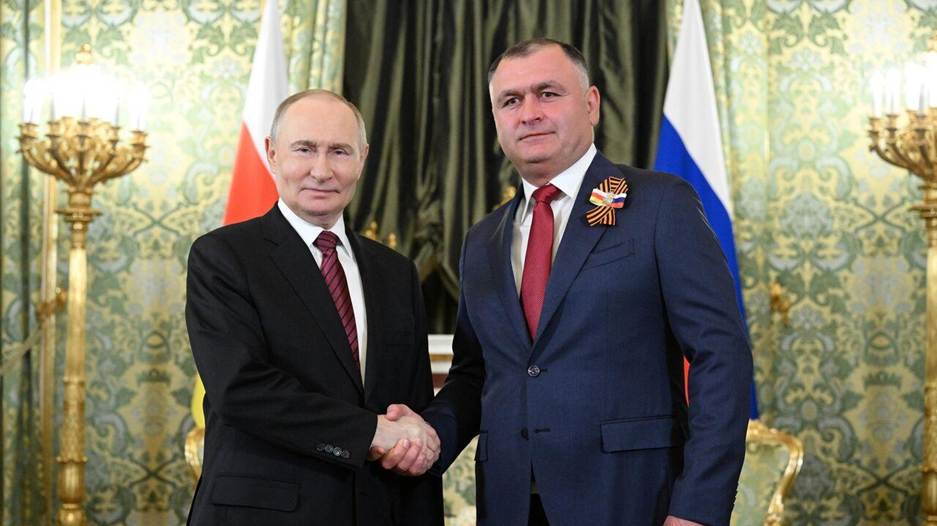
Vladimir Putin and Alan Gagloev, who is wearing the Ribbon of Saint George. Source: Ria.ru
On May 9th, 2026, following the highly anticipated “victory parade” in Moscow, Russian President Vladimir Putin and the so-called president of “South Ossetia” (Georgia’s Tskhinvali region), Alan Gagloev, signed a new comprehensive agreement “on the Deepening of Allied Cooperation.” The “victory parade” turned out to be the least represented celebration of May 9th to date. May 9th is the date which Russia promotes as the day of Nazi Germany’s capitulation and of the USSR’s decisive victory, although Germany actually signed its unconditional surrender on May 8, 1945. Even here, for superior propaganda purposes and in order to distance itself from the democratic world, the USSR decided to mark the day instead on May 9th.
The 2026 “victory parade” was attended by leaders of five countries and de-facto leaders of Abkhazia and so-called South Ossetia. Putin clearly looked forward to that day having more legitimacy, primarily as propaganda material for the Russian population’s internal consumption; a further reason why this new agreement between Putin and “South Ossetia’s” Gagloev was signed. While the de facto government of Georgia’s Russian-occupied territory has already concluded over 100 bilateral agreements with Russia, comprehensively approximating and aligning with it, this new deal could be another formal and legal step towards Russia’s de jure annexation of Georgia’s Tskhinvali region.
The Explanatory Note of the New Agreement
The explanatory note underlines a number of key motivations for the agreement: “ensuring regional peace and stability, pursuing coordinated foreign, defence and security policies, improving socio-economic conditions, developing infrastructure and human potential, harmonising legal regulations, and creating a favourable environment for the free movement of capital, goods, services, and labour between the parties.”
The signatories, Russia and “South Ossetia,” commit themselves to advancing towards a single economic space, improving the welfare and living standards of citizens, and unifying rules and procedures for the borrowing of external credits and making of foreign investments. The agreement also ensures the integration of energy systems, including gas and oil, transport and communications, and expands cooperation in the social, cultural, and labour domains.
“Agreement on the Deepening of Allied Cooperation between the Russian Federation and the Republic of South Ossetia”
Article 1 of the agreement directly reflects the spirit of the explanatory note, and defines a framework in which the document will deepen and further advance bilateral cooperation between Russia and the de-facto government of the occupied Tskhinvali region. This includes the assurance of “peace and stability” in the region, conduct of homogenous and Russia-aligned policies in foreign relations, defence, and security, including further improvement of border-related topics between the parties.
The two commit to harmonise legislation and ensure the development of human resources, free economic and capital movement, services and related fields. According to the agreement, the citizens of Russia and “South Ossetia” can now hold central and local government official positions in the signatory states, which means that Russian citizens are now allowed to work at any level of local and central government in the occupied Tskhinvali region.
It should be noted, however, that Russian citizens and officers have for years been holding multiple high-level administrative and political positions in Tskhinvali. Under the terms of the new agreement, years of service completed within Russian government institutions by ‘South Ossetian’ citizens are now fully credited toward their local records. This change effectively removes the previous legal barriers that restricted Russian citizens from holding official positions within the region. Previously, Russians had to obtain a formal dual citizenship for this purpose.
Articles 3 and 4 further deepen the legal approximation process of Russians in “South Ossetia,” and define that the signatory parties recognise and protect all forms of ownership, and ensure the equal rights of citizens of both parties to obtain, manage, use, and allocate property. The parties will adopt legislation which will ensure equal rights for every type of legal entity, including individual entrepreneurs. Both parties legally recognise each state-issued document issued by the central and local government bodies, including their notarised copies and translations.
The signatories will work to align their labour laws, social safety nets, and pension systems, which includes mutually recognising the employment history and work experience of each other’s citizens. Additionally, Article 7 allows both sides to set up a Joint Commission on Human Rights to help protect and promote basic civil liberties.
Russia and “South Ossetia” agree to build a unified economic space to improve life and financial well-being for their citizens. To do this, they will make their business, civil, and tax laws uniform, transparent, and fair. They will also align their main social and economic goals, transitioning gradually towards a single system for handling international loans and investments, while creating a highly welcoming environment for investors in core industries like infrastructure, energy, and farming.
Additionally, both sides plan to systematically merge their major national infrastructure. This includes integrating their transit grids, communication networks, and energy sectors, such as natural gas pipelines, with specific management rules for these shared networks to be outlined in future agreements. The parties will coordinate their social, educational, and cultural efforts to improve everyday life and strengthen community ties. They commit to opening up broader access to medical services, setting up joint educational and professional training programs across the science and tech fields, and expanding “cultural and athletic exchanges to foster long-term friendship between their peoples.”
Giving the New Agreement a Context
The most important clauses of this agreement lie in the first articles, which give Russian citizens unlimited access to so-called “South Ossetia’s” government positions. The document does not set any limit to which positions Russian citizens can hold, thus giving it a broader understanding that includes not only administrative, but also political roles.
The two signed a Treaty on Friendship, Cooperation, and Mutual Assistance a month after the 2008 Russo-Georgian War. They concluded a Treaty on Alliance and Integration on 18 March 2015. There has been a visa-free movement between Russia and the occupied Tskhinvali Region since 2010. The economic and cultural domains have for many years been completely covered by various bilateral agreements.
It should be noted that the new agreement does not offer new and comprehensive statements regarding the military and security domains of “South Ossetia,” as these fields have already been totally dominated and acquired by Russia. The Russian FSB’s Border Force controls the so-called border crossings and customs services, and Russia’s 4th Military Base of the 58th Army keeps a significant presence and carries out ongoing activities in the occupied region.
The Ossetian military was incorporated into the structures of the 4th Military Base, practically abolishing the “Ossetian army,” once Russia began allowing Ossetians to serve at its military facilities on a contractual basis. There are only a handful of units left that are directly subordinated to the so-called ministry of defence of “South Ossetia,” although the ministry is regularly headed by Russian experienced officers.
The de facto president of “South Ossetia,” Alan Gagloev, along with his predecessor Anatoly Bibilov, has been a keen supporter of “South Ossetia” integrating into the union state with Russia. This agreement, with all previous treaties, can act as a legal precursor to Russia moving towards annexation when it deems this scenario convenient.
Occupied Regions of Georgia in Russia’s Foreign Policy Concept
The new agreement does not appear to be a novelty, as the comprehensive integration of Georgia’s occupied regions has already been among Russia’s formal priorities for years now. Russia has adopted a total of six concepts on the country’s foreign policy since the collapse of the Soviet Union. References to Georgia’s occupied regions first appeared in 2013. The 2013 and 2016 concepts aimed at “state-building” and strengthening the independence of Georgia’s Russian-occupied regions by stating: “assistance to the establishment of the ‘Republic of Abkhazia’ and the ‘Republic of South Ossetia’ as modern democratic states, the strengthening of their international positions, the provision of reliable security and socio-economic recovery, remains among Russia’s priorities.”
Russia shifted its approach to these occupied regions in the 2023 concept, and introduced a focus on the support of integration rather than assisting independent state-building, though the latter has been of a predominantly formal nature throughout the years. The occupied Tskhinvali region has already gradually approximated and integrated its economic and security domains with Russia through multiple bilateral agreements, particularly post-2008 Russo-Georgian War.
Reaction from the Georgian Government
So far, none of the Georgian government bodies, including the Ministry of Foreign Affairs, have issued an official statement regarding the new deal between Russia and Georgia’s breakaway separatist region. The Minister of Foreign Affairs of Georgia, Maka Botchorishvili, briefly commented on the issue in her address delivered in Chisinau, Moldova, at the 135th Session of the Committee of Ministers of the Council of Europe on May 15, stating: “Russia continues to disregard its international obligations and is taking further steps towards the annexation of Georgia’s regions.”