
Armenia’s Foreign Policy
On May 4, 2026, Yerevan hosted the eighth European Political Community summit, gathering over 40 heads of state and government from Europe and beyond under the motto “Building the Future: Unity and Stability in Europe.” It was the first time a non-European country participated, with Mark Carney, the Prime Minister of Canada, attending as a guest.
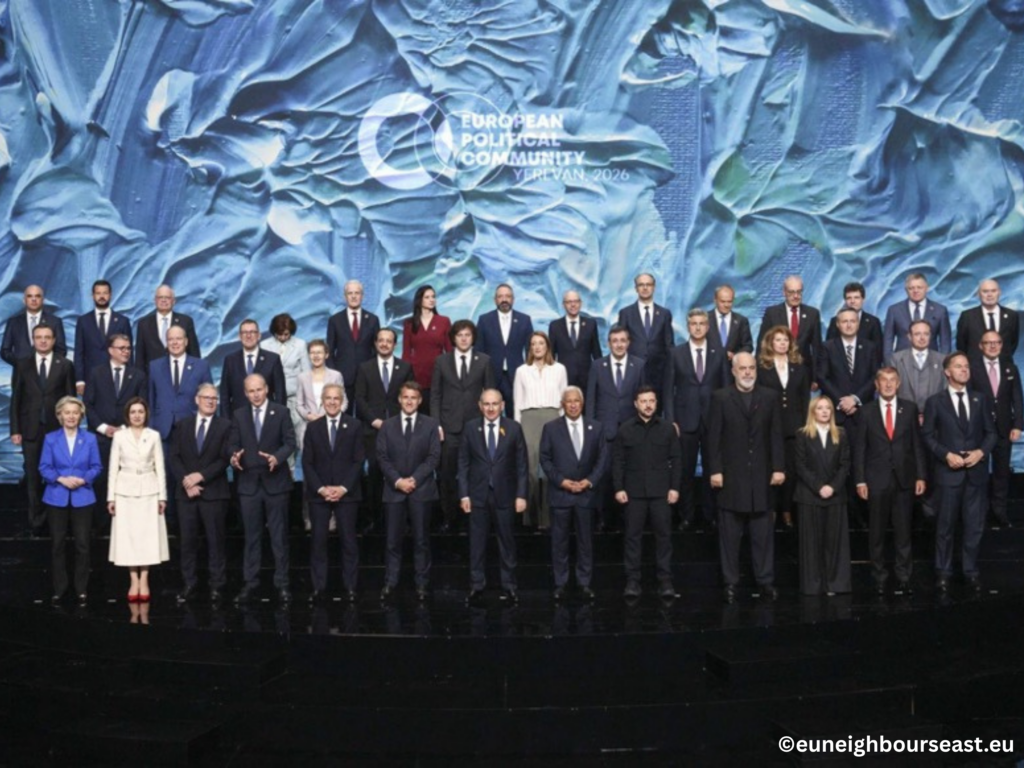
Participants of the European Political Community Meeting in Yerevan, May 4, 2026
The leaders explored opportunities to deepen cooperation and coordinate efforts to strengthen democratic stability, improve connectivity, and enhance economic and energy security.
The summit was co-chaired by the President of the European Council, Antonio Costa, and the Prime Minister of the Republic of Armenia, Nikol Pashinyan.
President Costa underlined the historic significance of the summit: “This is a historic event, because the European Political Community is meeting here for the first time in the South Caucasus, and because it has placed Armenia at the heart of Europe, where it belongs, given its long and rich history.”
He also noted that the day began with a videoconference address by Ilham Aliyev. “This means that this summit will forever be remembered as a peace summit in the Caucasus, made possible by courageous political choices and relentless diplomatic efforts,” Costa said.
President Costa emphasized the EU’s readiness to work with Armenia and the wider region to promote peace and stability, grounded in sustainable democratic institutions and strong economic ties among neighboring countries.
Volodymyr Zelenskyy was in attendance at the summit in Yerevan. Costa affirmed that supporting Ukraine remains “a top priority for the European Political Community,” and delivered two key messages to Zelenskyy: “First, the EU will stand by Ukraine for as long as it takes to achieve a sustainable, just and lasting peace, with full respect for Ukraine’s territorial integrity. Secondly, we must advance Ukraine’s accession process and, to this end, we must open the first cluster of negotiations as soon as possible.”
On May 5, 2026, the Belarusian Foreign Ministry summoned the Chargé d’Affaires of Armenia and delivered a note of protest.
The Belarusian Foreign Ministry issued the following statement:
“A strong protest was expressed to the Armenian diplomat Artur Sarkissian regarding the recent unfriendly actions of the Armenian side, and a corresponding note was handed over.”
The Foreign Ministry did not provide further details. The note followed Minsk’s strong criticism of Armenian Parliament Speaker Alen Simonyan, who referred to Belarus as a “governorship” of Russia.
In addition, official Minsk separated the “Armenian people” from the Armenian government.
Armenian Prime Minister Nikol Pashinyan publicly rejected President Vladimir Putin’s proposal to hold a referendum on Armenia’s membership in the European Union and its future relations with Russia.
“Until the need arises, we will not raise such an issue,” Pashinyan said on May 11, 2026, adding that a referendum on the issue would only be held if there was an “objective need.”
Pashinyan reiterated that Armenia would consider such a decision when “the time is right,” and stated that Yerevan does not need to leave the Eurasian Economic Union now or in the near future.
“There is simply no objective need to leave the Eurasian Economic Union,” Pashinyan told reporters at a briefing in Yerevan.
On May 10, President Vladimir Putin stated that “it is none of his business,” but added that “it would be logical” for the Armenian authorities to hold a referendum on joining the European Union and future relations with Russia.
He added that Armenia should decide promptly whether to join the European Union or remain in the Eurasian Economic Union.
“We would draw the appropriate conclusions and go through a soft, intelligent, and mutually beneficial divorce,” Putin told reporters.
On May 11, Pashinyan responded to Putin’s remark about “divorce,” saying: “I also do not agree with the term ‘divorce.’”
The Prime Minister recalled that during one of his speeches in the National Assembly, he stated, “We sometimes confuse interstate relations with marriage, and I do not agree with that formulation.”
Pashinyan confirmed he will not attend the Eurasian Union summit scheduled for May 2026 in Astana.
Normalization of Armenian-Turkish Relations
Türkiye and Armenia signed a memorandum of understanding on May 4, 2026, to jointly restore the ancient Ani Bridge. This initiative was welcomed as a positive step toward strengthening bilateral relations.
The agreement was announced after a meeting in Yerevan between Armenian Prime Minister Nikol Pashinyan and Turkish Vice President Cevdet Yılmaz during the 8th Summit of the European Political Community.
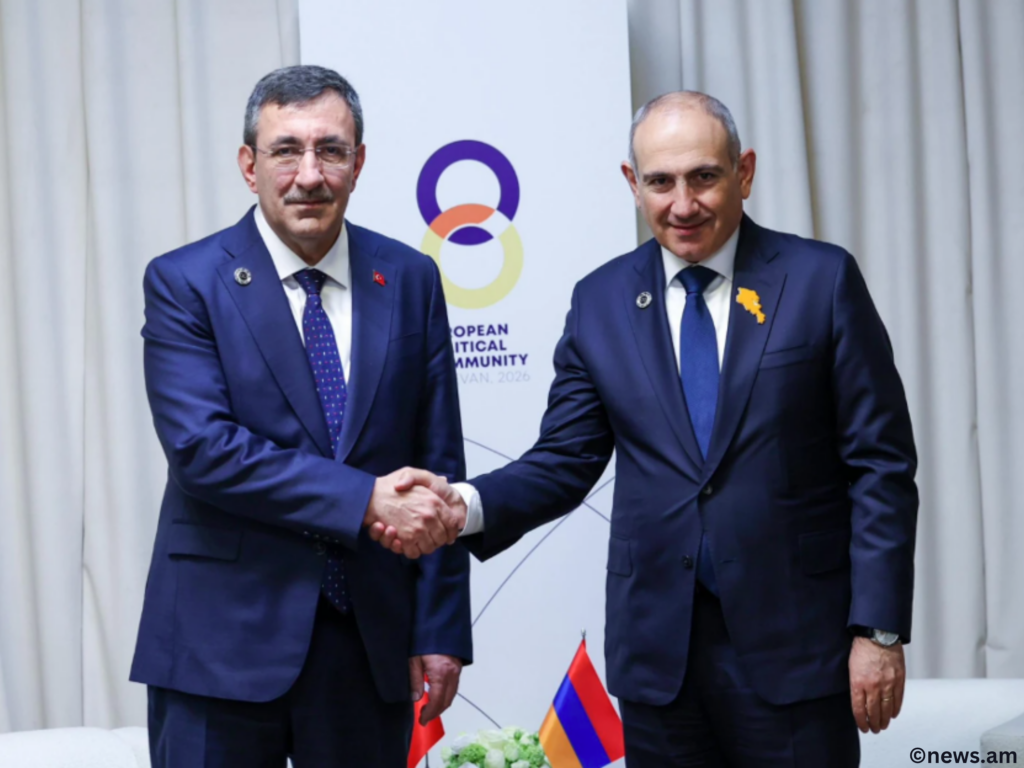
Meeting between Cevdet Yılmaz and Nikol Pashinyan in Yerevan on May 4, 2026
Serdar Kılıç, Türkiye’s Special Representative, and Ruben Rubinyan, Armenia’s Representative, signed the document. The restoration project will focus on the historic Ani Bridge on the Armenian-Turkish border.
Armenia’s Domestic Policy
In Armenia, political groups spent hundreds of thousands of dollars on advertising across Meta platforms, including on Facebook and Instagram, in the months leading up to the elections.
According to local publication Factor TV, more than $309,000 was spent on political advertising on Meta platforms between February 8 and May 8, 2026.
The publication reports that about two-thirds of the advertising expenditures were linked to the Strong Armenia party, which is affiliated with Russian billionaire Samvel Karapetyan. The party and its affiliated pages spent $210,322 on Meta platforms over the three months.
Factor TV’s analysis of Meta’s Ad Library data detailed the distribution of political advertising expenses during the three-month period:
Strong Armenia and its affiliated pages, including Youth Structure/Strong Armenia, Samvel Karapetyan, and Your Way, held the top four positions among Meta’s 10 largest advertisers.
The Your Way page is associated with a movement formed by Karapetyan’s supporters in June 2025, after his arrest. Its name refers to a statement Karapetyan made during tensions between the authorities and the Armenian Church.
At that time, Karapetyan stated that if political forces could not resolve the situation, his supporters would intervene “in their own way.” Authorities viewed this as a call to seize power, leading to his arrest. He is currently under house arrest and remains active in political affairs.
During the three-month period, Strong Armenia and its affiliated pages placed 168 advertisements on Meta, spending a total of $210,322.
The ruling Civil Contract party ranked second, spending $47,882 on 146 advertisements. Its affiliated pages included C News, Civic, Tigran Avinyan, and Youth Structure/Civil Contract.
Former Armenian President Robert Kocharyan’s page ranked third, spending $27,958 on 86 advertisements.
Former Ombudsman Arman Tatoyan and his party, Wings of Unity, ranked fourth. Between February and May, they placed 54 advertisements and spent $15,043.
Foreign Policy of Azerbaijan
The Milli Mejlis of the Republic of Azerbaijan terminated relations with the European Parliament on May 1, 2026. The procedure to withdraw from Euronest is also to begin.
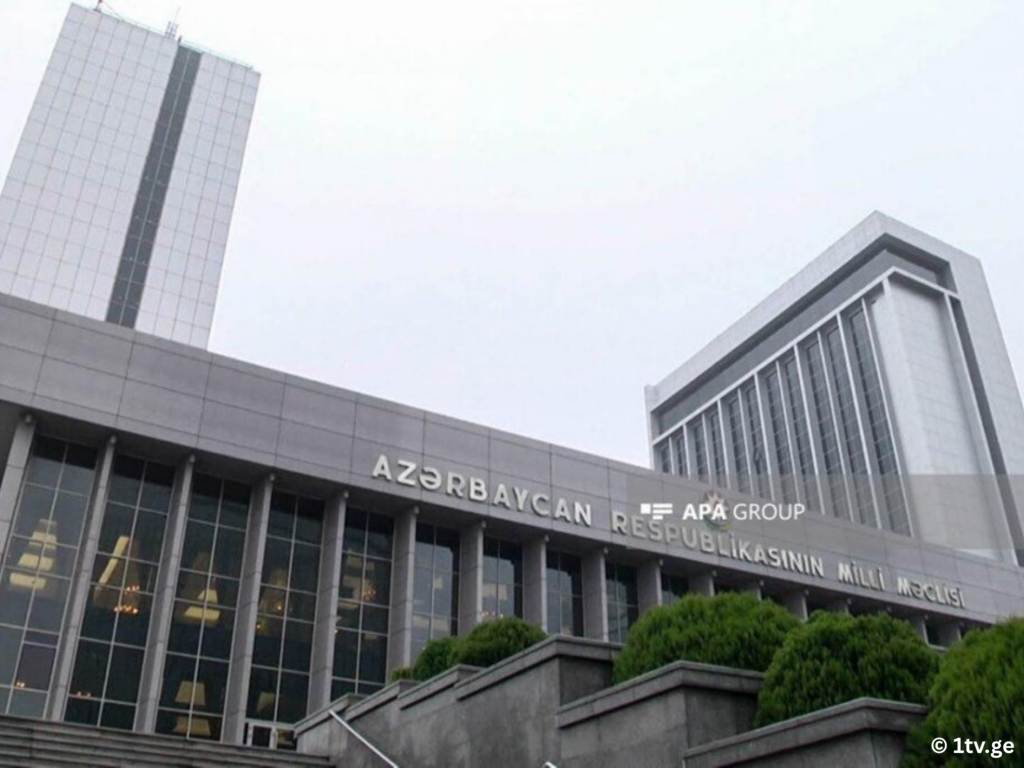
Milli Majlis of the Republic of Azerbaijan
The Milli Majlis of the Republic of Azerbaijan manages relations with foreign parliaments and international parliamentary organizations to support peace, security, and sustainable development. It promotes open and constructive dialogue grounded in parliamentary values and shared interests.
However, its statement on the termination of relations contends that the European Parliament’s position is destructive, contradicts these principles, and poses a significant obstacle to further cooperation.
“The essence of the European Parliament’s activities is a categorical rejection of the norms and principles of international law and the concept of justice. This institution consistently ignores the 30-year occupation of our lands by Armenia, the destruction of hundreds of cities and villages, historical, religious, and cultural monuments, ethnic cleansing, and the human rights of more than a million refugees and internally displaced persons.
“The platforms intended for cooperation with the European Parliament—the EU-Azerbaijan Parliamentary Cooperation Committee and the Euronest Parliamentary Assembly—have become instruments of pressure, blackmail, and gross interference in the internal affairs of our country,” the statement issued by the Milli Majlis of Azerbaijan states.
On the same day, the EU Ambassador to Azerbaijan, Mariana Kuyunjic, was summoned to the Ministry of Foreign Affairs.
According to the Azerbaijani Ministry of Foreign Affairs, the meeting strongly condemned what it described as groundless and biased provisions in the European Parliament’s April 30 resolution. A note of protest was delivered to the EU.