
Introduction
On 27 April 2026, Russian Defence Minister Andrey Belousov visited Russia’s 999th Airbase in Kant, Kyrgyzstan. Belousov’s appearance at the airbase was not a routine engagement. On the same day, he held a meeting with Iranian Deputy Defence Minister Reza Talaei-Nik, with whom he discussed the ongoing US-Iran armed conflict. It should be noted that Kyrgyzstan is separated from Afghanistan only by Tajikistan; Afghanistan, in turn, shares a significant land border with Iran.
To this day, Tajikistan hosts Russia’s FSB Border Service, which focuses on the Afghan frontier. Since the collapse of the Soviet Union, Russia has consistently asserted its interests in Kyrgyzstan and Tajikistan. Although maintained in technically modest quantities, the Russian Armed Forces have sustained their presence in the region under various legal frames, primarily through the Collective Security Treaty Organisation (CSTO). Russia’s influence in Kyrgyzstan has faced several significant political upheavals since its initial deployment.
Kyrgyzstan’s former President, Almazbek Atambayev, stated during his incumbency that, “Kyrgyzstan must rely solely on its own forces in the future. This also concerns the Russian base… [my predecessor] removed the American base and left the Russian one.” Atambayev was evidently pointing towards the eventual removal of the Russian military presence by claiming he had already significantly reduced the base’s terms of deployment. In response, a chief editor of a prominent Russian media outlet asserted that the decision to remove Russian military facilities would not be Atambayev’s to make, suggesting that such a move would jeopardise his prospects for a further presidential term.
In 2015, Atambayev refused to wear a Russian symbol of particular significance: the Ribbon of Saint George (Гео́ргиевская лента). This emblem is widely promoted by the Russian Federation, and is worn by Russian and pro-Russian officials alike. It has also become a primary attribute of Russian soldiers in Ukraine, alongside the “Z” symbol. However, Atambayev was arrested on alleged corruption charges shortly after completing his term in 2017. Commenting on the situation, the Russian President’s Press Secretary, Dmitry Peskov, stated: “Russia has no intention of intervening in the situation in Kyrgyzstan,” maintaining that Russia’s only interest in the country was security and stability. Atambayev fled to Spain in 2023, and has lived in exile since. In 2025, the Kyrgyz court sentenced him to eleven years in prison in absentia.
Military Cooperation
On 15 May 1992, Kyrgyzstan became a founding member of the Collective Security Treaty Organisation (CSTO). Established as Moscow’s alternative to NATO, the CSTO mirrors the NATO Charter’s Article 5 by obliging member states to provide mutual military assistance. Under this framework, an attack on one member state is considered an attack on all. Beyond this mutual defence clause, the signatory governments agreed to operational cooperation and formal consultations in the event of emerging security threats.
Russia and Kyrgyzstan subsequently signed a Treaty on Friendship, Cooperation, and Mutual Assistance on 10 June 1992. Through this treaty, Russia sought to solidify bilateral ties with former Soviet republics, using the document as a framework for future engagement. This was particularly evident in the military domain, where Russia intended to inherit and further develop the existing Soviet military infrastructure and presence. On 5 July 1993, the two nations signed an agreement on Defence and the Military Domain, which established initial working principles and priority directions, including the exchange of military technology and cooperation on border protection.
In 1999, the parties signed an agreement on military-technical cooperation: a standard instrument utilised by Russia to supply arms and equipment to signatory states. Through such agreements, Russia aims to position itself as the dominant supplier, ensuring that the partner state becomes reliant on Russian expertise, facilities, and technology for the repair and replenishment of military stockpiles, and creating a long-term dependency on Russian production and services. This trajectory continued in 2000 with the adoption of a further agreement on Friendship, Alliance, and Partnership, which was designed to deepen bilateral relations. It was followed, in 2002, by a subsequent agreement specifically addressing cooperation in the security domain.
The Russian Federation has consistently justified the intensification of its military ties and presence in Central Asian states by citing threats of international terrorism and religious extremism; positioning itself as the primary guarantor of regional stability and development. However, the operational efficacy of the CSTO was brought into question when the organisation failed to respond to Kyrgyzstan’s formal request for assistance during domestic armed clashes.
The organisation maintained that its mandate was restricted to interventions involving external aggression by a third-party state. Nevertheless, this stance stood in direct contradiction to Moscow’s previous assertions regarding the CSTO’s role in managing both regional and internal security challenges. Consequently, the perceived effectiveness and credibility of the CSTO framework have significantly diminished.
While the various agreements signed between the 1990s and 2002 addressed issues concerning Russian military facilities, personnel, and equipment, none formally established a military base in the manner Russia had already institutionalised in other post-Soviet states. The first treaty specifically designed for this purpose was signed in 2003, which formally introduced a Russian airbase in the city of Kant, east of Bishkek. However, the 999th Airbase had already been operational at that site, though under a different designation, for over sixty years.
Russian military analysts have frequently highlighted the chronic underfunding of Russian military installations in Kyrgyzstan. During the first two years following the official commencement of operations at the Kant airbase, Russia expended 300 million roubles (approximately $10.5 million), with roughly 130 million roubles ($4.5 million) allocated annually for maintenance. Analysts noted a stark disparity compared to the United States, which spent $163 million in 2004 alone on the operational costs of its own facility in the country.
The runway of the Kant Airbase is incapable of receiving large aircraft. During his visit to Kyrgyzstan in 2006, Russia’s then-Defence Minister Sergey Ivanov’s plane had to land at the Manas airport in Bishkek, which, at the time, was hosting the US military base. This, despite the purpose of Ivanov’s visit being to inspect the Kant Airbase.
Russian Military Facilities
Russia’s Joint Military Base in Kyrgyzstan
On January 29, 2017, an agreement Russia and Kyrgyzstan had signed on the establishment of a joint Russian military base on the territory of Kyrgyzstan entered into force. This was a part of the ongoing reform of the Russian Armed Forces launched after the 2008 Russo-Georgian War. The unification of all military facilities in Kyrgyzstan addressed optimisation and structural changes, rather than the creation of a new military base. The Joint Military Base combined all of the existing Russian military facilities and territories under a unified command.
The new agreement inherited the provisions of previous treaties, regulating topics of Russian military personnel, equipment, buildings, etc. The agreement was signed in 2012 and was to last a duration of 15 years, with automatic continuation for 5-year periods. The Joint Military Base combines four military facilities already present in Kyrgyzstan: the 999th Airbase in Kant; the 954th Anti-Submarine Weapons Test Base of the Russian Navy in Karakol; the 338th Communications Site in Kara-Balta; the 1st Autonomous Seismic Facility, and the 17th Radio-Seismic Laboratory in Djalal-Abad.
The 999th Airbase
The 999th Airbase (the Kant Airbase – military unit #20022) was conceived in 2003, based on an agreement signed between Russia and Kyrgyzstan. The agreement “on the status and conditions of the presence of a Russian aviation base on the territory of the Kyrgyz Republic” defined the purpose of the airbase by stating that, during its presence, it would ensure the sovereignty and security of both Kyrgyzstan and the Russian Federation. The operational activities of the airbase were based on previous relevant bilateral agreements, primarily “on the joint planning and execution of activities on operational preparation” from 2002.
The history of the airbase dates back to 1941, when the Soviet government moved the Odessa military Aviation School of Pilots from Ukraine to Kyrgyzstan. This was due to the USSR’s entry into World War II, which made the security and operation of the school in its current location implausible. The school was renamed multiple times, finally adopting the designation “Military Institute of the Armed Force of the Kyrgyz Republic.” The main facility of the school was built in Bishkek (then Frunze), however, the airfield south of the city of Kant was also incorporated, and has hosted the 999th Airbase since 2003.
The Kant Airbase subordinates to the 14th Guards Air Force and Air Defence Army, which in turn is part of the Central Military District of the Russian Federation. When the facility was transformed into the military aviation school, it started training pilots of Russia and its allies. The base houses different variants of SU-25 attack role jet aircraft, training aircraft, and heavy MI-8 helicopters for the support and search and rescue missions. The highest number of jet aircraft at its peak has never exceeded 12, including training jets.
The president of the Russian Federation, Vladimir Putin, awarded the Kant Airbase the “Guards” honorary status, formally suggesting that the unit had shown exceptional courage and bravery during the armed conflict. Russian media articles on the topic did not mention a specific conflict, however, considering Russia’s full-scale war in Ukraine and the exceptionally high number of jets and helicopters the Russian army has lost in recent years, it can be assumed that Kant Airbase too has experienced significant casualties in the Russia-Ukraine war.
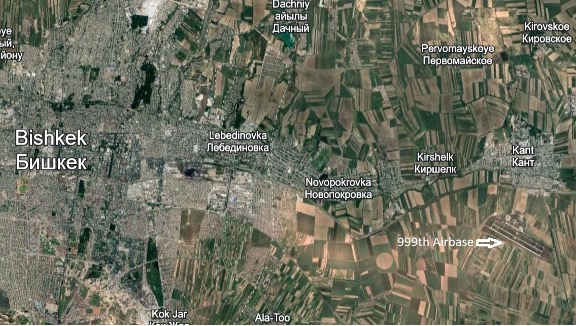
Location of the Kant Airbase. East of Kyrgyzstan’s capital Bishkek, south of the city of Kant. Source: Google Earth
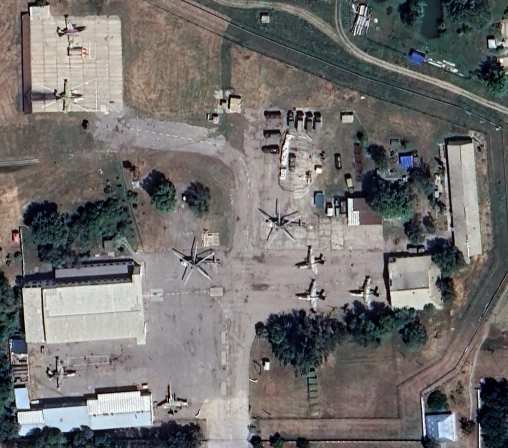
Russian military aircraft parked at Kant Airbase. The most recent open-source satellite images likely date from 2023. Source: Google Earth
The 954th Test Base “Koy-Sary”
The Koy-Sary base (military unit #87366) is located north-west of the city of Karakol, and occupies part of the eastern shore of Lake Issyk-Kul. Like Kant Airbase, the history of the Koy-Sary naval test base dates back to 1943, when the Soviet government evacuated the military facility from the proximity of the Eastern Front to Central Asia. The facility produced naval torpedoes in Dagestan, northern Caucasus, and was transformed into a test centre in 1955, where the Soviet army conducted various military experiments and weapon tests, primarily with torpedoes and naval mines.
The lake itself creates near-perfect conditions for various tests to be conducted. The water is similar to sea-water; it does not freeze during winter, allowing the Russian military to carry out activities throughout the year; the depth is enough to conduct deep-water experiments; and the location is remote enough to ensure that third countries will not intercept Russia’s confidential test operations in the area. The Russian ministry of defence also claims they ensure there are no leaks or pollution to damage the environment. Several Russian media articles claim the test site positively impacts the local economy. Apart from Russia paying an annual lease for the land to the Kyrgyz government, locals are allowed to work on the base, who, according to several sources, receive Russian pay-grade salaries. However, locals have implied that they rarely benefit from the Russia-Kyrgyzstan deal.
This part of Kyrgyzstan also hosted another Soviet military site, which has been abandoned since the collapse of the Soviet Union. The mining village of Kadji-Say was built in 1947 for the mining of coal and uranium. While the site was a Soviet top-secret location and was deliberately erased from the maps for security reasons, it has been accessible to the public since the 1990s. Local villagers have complained that the uranium shafts were not properly sealed and that radioactive water sometimes leaks into Lake Issyk-Kul after heavy rains. However, this has not deterred local residents from establishing hospitality businesses along the village coastline, nor does it prevent Russian tourists from visiting the area to enjoy the lakeshore.
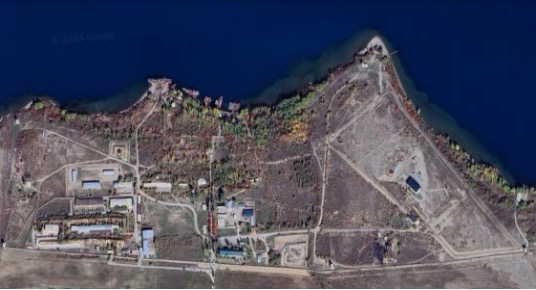
954th Test Base “Koy-Sary” at Lake Issyk-Kul. Source: Google Earth
The 338th Communications Facility “Marevo”
The Russian communications facility, also known as “Station Prometheus,” in Kyrgyzstan represents a strategically positioned component of Moscow’s long-range naval communications architecture. Located in the Chuy Region, the site benefits from conditions favourable to very low frequency (VLF) transmission, including terrain and groundwater characteristics that improve signal propagation. These capabilities enablecommunication with submarines operating at extended distances, including in the Pacific and Indian oceans.
The facility operates under a bilateral Russia–Kyrgyzstan agreement signed in 1997, which regulates the lease and operational status of Russian naval infrastructure on Kyrgyz territory. Rather than relying primarily on direct financial payments, the arrangement has historically been structured around military-technical cooperation, including training, equipment transfers, and defence support mechanisms.
At the core of the installation is a large-scale antenna system consisting of multiple interconnected “Zenit” umbrella antennas supported by high-rise lattice masts exceeding 300 meters in height. The complex incorporates hardened support infrastructure, automated load-management systems, and extensive grounding networks designed to maintain operational continuity under adverse environmental conditions. Constructed during the Soviet period, the facility continues to provide Russia with specialized long-range communications capability, linked to strategic naval operations.
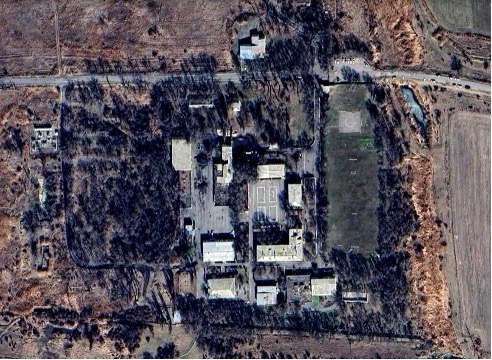
338th Communications Facility. Source: Google Earth
The 1st Autonomous Seismic Facility and 17th Radio-Seismic Laboratory
The 1st Autonomous Seismic facility operates under the 1994 agreement between Russia and Kyrgyzstan on Russian military facilities. It is partof a united automatized system of seismic control of the Seismic Service of the Ministry of Defence of the Russian Federation. According to the official description, the station serves as a detection system for nuclear tests and explosions in and beyond the region. Under the bilateral agreement, rather than paying a lease, Russia has committed to sharing seismic and geological data obtained by the 1st Autonomous Seismic Facility with the Kyrgyz government.