The Armed Forces of the Russian Federation have been undergoing another wave of major reforms in parallel with the full-scale war in Ukraine. The latest changes in structure included the reintroduction of two new military districts – Moscow and Leningrad. Though these two have been created in 2024, it is important to note that the Russian Empire had the military districts under similar designation. The Moscow and Petersburg (renamed to Leningrad during the Soviet Union) Military Districts of the Russian Empire were founded in 1864 and remained throughout the Russian Soviet Federative Socialist Republic and the Soviet Union, until their dissolution and unification into a single Western Military district of the Russian Federation in 2010.
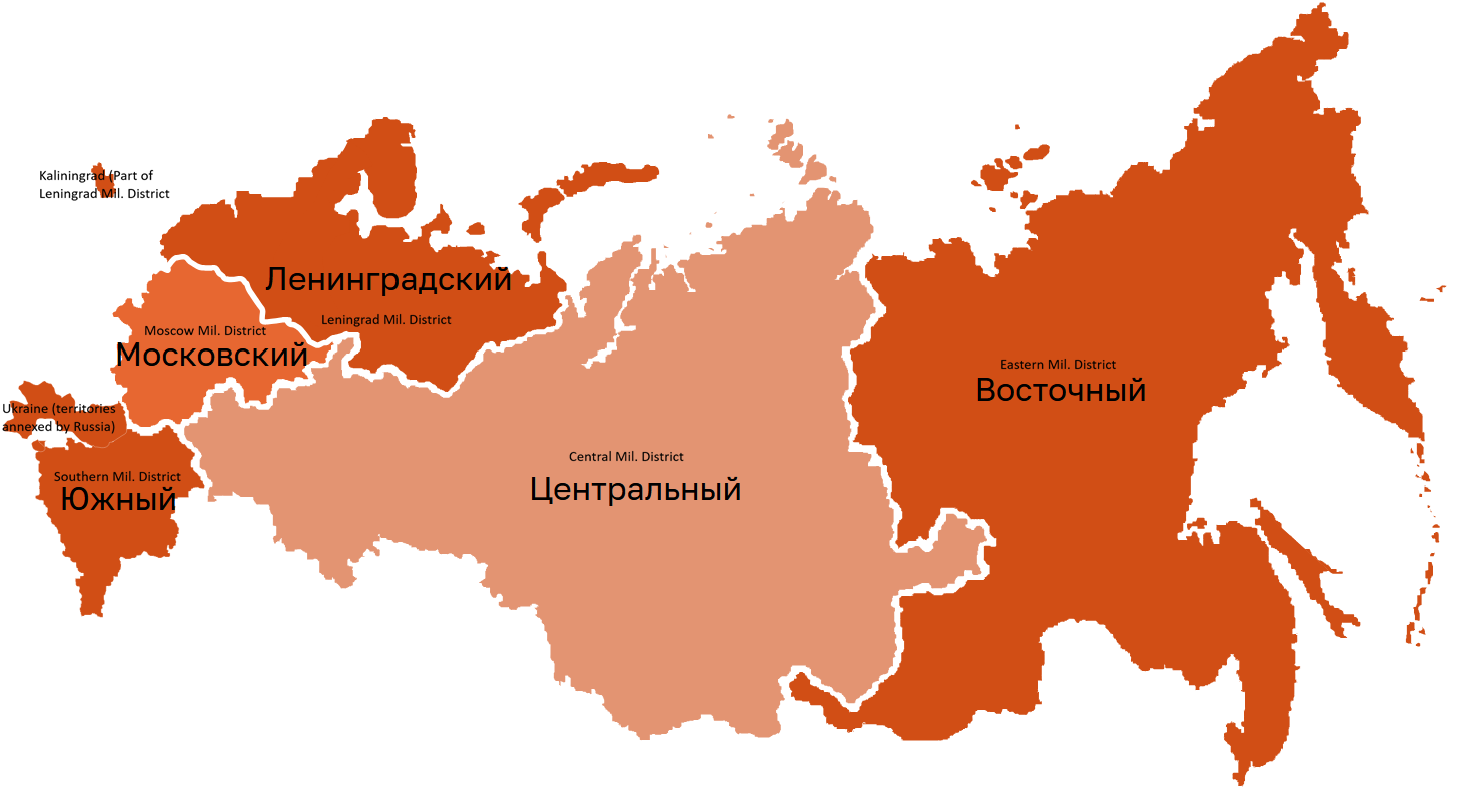
Presently, the Russian Armed Forces incorporate five military districts: Moscow, Leningrad, Central, Eastern, and Southern. The Southern Military District has been expanded to include Ukrainian territories occupied by Russia. Crimea was annexed in 2014. Russia formally annexed Ukraine’s Luhansk, Donetsk, Zaporizhzhia, and Kherson oblasts in late 2022, subsequently incorporating them into its Southern Military District.
Moscow Military District
Moscow Military District was created on February 26, 2024, replacing the Western Military District that was operational between 2010-2024. The district covers the Kursk, Bryansk, Belgorod, and Smolensk oblasts of the Russian Federation and borders Ukraine and Belarus. Commander – Sergey Kuzovlev (Since 2024). Sergey Kuzovlev also commands Russian Grouping of Forces “West”, participating in the full-scale war in Ukraine.
Structure
- 1st Tank Army
- 20th Combined-Arms Army
- 98th Airborne Division
- 106th Airborne Division
- 16th Separate Brigade
- Separate Rocket Brigade; Brigades of radiological, chemical, and biological defense; electronic warfare; and railway.
Leningrad Military District
Leningrad Military District, along with Moscow Military District, was created in 2024 as a co-successor of the Western Military District. Leningrad Military District borders Latvia, Estonia, and Finland. Commander – Evgeni Nikiforov (Since 2024). Nikiforov also commands “Northern” Grouping of Russian Forces, participating in the full-scale war in Ukraine.
Structure
- 11th Army Corps
- 14th Army Corps
- 44th Army Corps
- 6th Combined-Arms Army
- 76th Airborne Division
- 45th Separate Brigade
- 2nd Separate Brigade
- Separate Rocket Brigade; Brigades of radiological, chemical, and biological defense; electronic warfare; and railway.
Central Military District
Central Military District was created in 2010 replacing Siberian and Volga-Ural Military Districts. The district borders Kazakhstan. Commander – Valeriy Solodchuk (Since 2025). Solodchuk also commands “Center” Grouping of Russian Forces, participating in the full-scale war in Ukraine.
Structure
- 2nd Combined-Arms Army
- 25th Combined Arms Army
- 41st Combined-Arms Army
- 90th Tank Division
- 104th Airborne-Assault Division
- 201st Military Base in Tajikistan
- 3rd Separate Brigade
- 238th Brigade
- 12th Separate Engineering Brigade
- Separate brigades of radiological, chemical, and biological defense; electronic warfare; and railway.
Southern Military District
The Southern Military District is the most significant military-administrative formation of the Armed Forces of the Russian Federation. Although it covers the smallest territory among the military districts, it has been at the forefront in terms of combat experience and participation in armed conflicts since the collapse of the Soviet Union. Commander – Sergei Medvedev (Since 2025). He also serves as commander of the “Southern” Grouping of Russian Forces, engaged in combat operations in Ukraine.
Structure
- 3rd Combined Arms Army (Created in 2024 – Luhansk);
- 8th Combined Arms Army;
- 18th Combined Arms Army (Created in 2023 – Crimea);
- 49th Combined Arms Army;
- 7th Military Base in occupied Abkhazia;
- 51st Combined Arms Army (Created in 2024 – Donetsk);
- 58th Combined Arms Army;
- 4th Military Base in the occupied Tskhinvali region;
- 102nd Military Base in Armenia;
- 7th Airborne Division (Part of Russia’s Airborne Forces);
- 10th Separate Brigade;
- 22nd Separate Brigade;
- 346th Separate Brigade;
- Separate brigades of command: communications; radiological, chemical, and biological defense; electronic warfare; and railway.
Eastern Military District
The Eastern Military District was created in 2010 and replaced the Far Eastern Military District. It also incorporated several formations of the Siberian and Transbaikal (USSR) Military Districts. The district borders China and Mongolia. Commander – Andrei Ivanaev (Since 2024). Ivanaev also serves as commander of the “Eastern” Grouping of Russian Forces, engaged in combat operations in Ukraine.
Structure
- 5th Combined-Arms Army
- 29th Combined-Arms Army
- 35th Combined-Arms Army
- 36th Combined-Arms Army
- 68th Army Corps
- 11th Separate Airborne-Assault Brigade
- 83rd Separate Airborne-Assault Brigade
- 14th Separate Brigade
- 16th Separate Brigade
- 17th Separate Brigade
- Other separate brigades of various purposes.