
Occupied Abkhazia
Staff Exercises of the So-called Abkhazian Armed Forces
In February 2026, staff exercises were conducted within the so-called armed forces of Abkhazia. Similar activities had already taken place in January. The stated objective of these drills was to improve coordination among all branches of the so-called armed forces and to centralize operational command and control. According to the de facto Ministry of Defense, the exercises were intended to prepare for the repulsion of potential threats. Notably, all de facto armed formations operating in occupied Abkhazia are subordinated to the so-called armed forces. The exercises were led by the de facto Minister of Defense, Vladimir Anua, and the de facto Chief of the General Staff, Russian officer Vladimir Savchenko.
In late February, Savchenko concluded and summarized the staff exercises which, according to him, were conducted in accordance with the “plan” of the so-called armed forces of Abkhazia. He also emphasized that particular attention had been given to combat and mobilization readiness. However, it should be noted that in January–February 2026, the de facto Ministry of Defense did not release any information or footage regarding live-fire drills or field combat exercises, which it usually does. Savchenko also awarded Abkhaz servicemen who won a sprint competition.
Abkhaz Officers in the Rusdram Theater
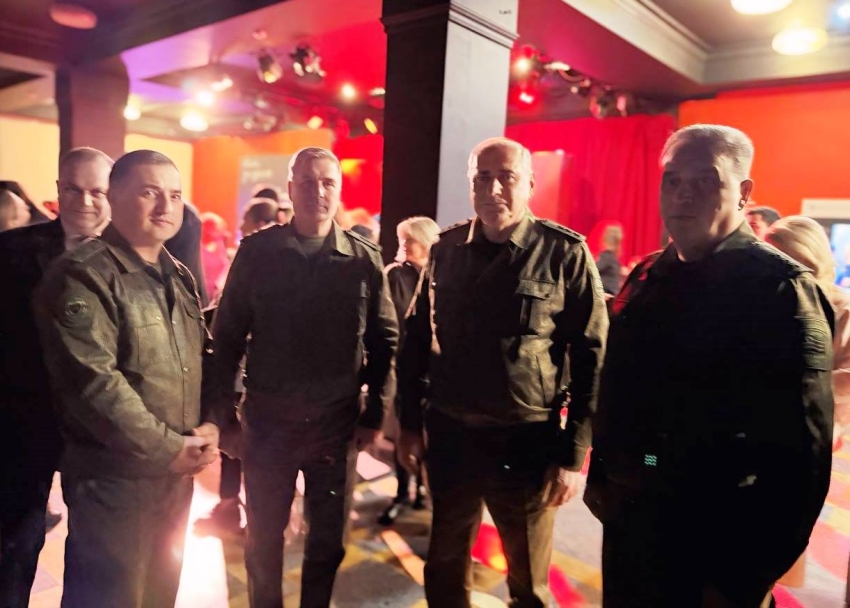
In the middle: Russian officer Vladimir Savchenko and de facto Defense Minister Vladimir Anua. Source: apsny.land
On February 25, representatives of the de facto Ministry of Defense attended a performance at the Fazil Iskander Russian State Drama Theater in Sokhumi (also known as “Rusdram”). The event was also attended by cadets of the Sukhumi Military School (“SVOKU”). In its assessment of the performance, the de facto Ministry of Defense stated: “This performance conveys that true strength lies not in physical capabilities, but in resilience of spirit and a kind heart.”
UAV Crashes on Abkhazian Territory
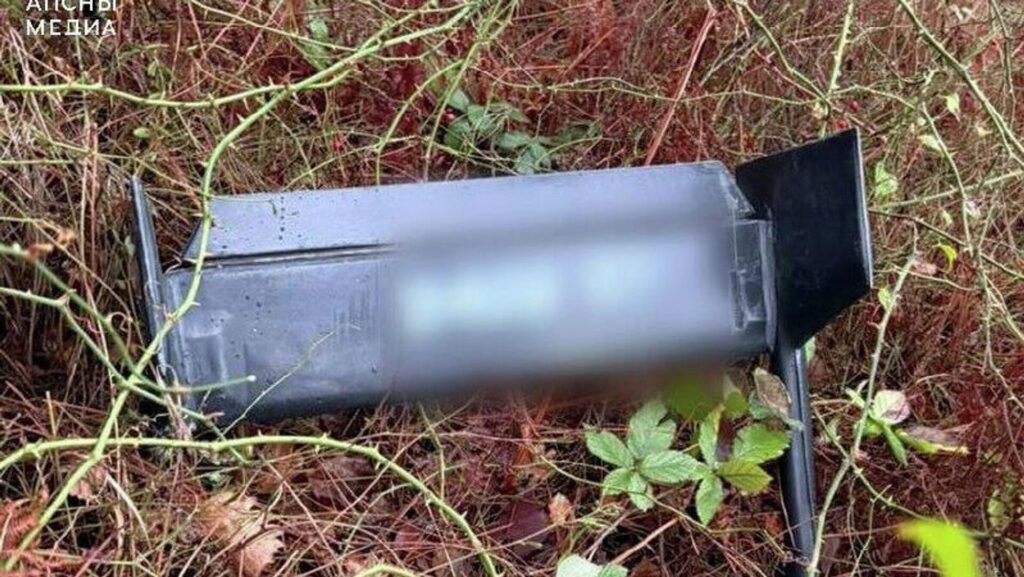
UAV Debris in the vicinity of Gagra. Source: apsnypress
On 23 February, Abkhazian media outlet Apsnypress reported that a combat unmanned aerial vehicle (UAV) had crashed and exploded approximately six kilometers from the city of Gagra. The incident occurred northeast of Gagra, in the vicinity of Mount Mamdzyshkha. The incident took place at a time when the Russian city of Sochi was reportedly being targeted by Ukrainian UAVs. Sochi’s airspace had been closed, and operations at Sochi Airport were suspended. It is highly likely that the drone fell into the territory of Abkhazia after Russia attempted to jam UAVs over its own territory using electronic warfare systems. As a result of Russian counter-drone measures, the Ukrainian combat UAVs reportedly deviated from their intended course, with one of them ultimately crashing in the Gagra area.
On 24 February, Sputnik reported that another unmanned aerial vehicle had been shot down in Abkhazia, in the area of Gantiadi. The de facto Ministry of Defense stated that any violation of Abkhazia’s airspace would be effectively prevented by the so-called air defense and electronic warfare units of Abkhazia. It is important to note, however, that Ukrainian UAVs entered Abkhaz territory only after Russian air defense forces employed electronic warfare methods against them over Russia’s own territory, suppressing their GPS functions. These UAVs were not shot down by the so-called Abkhaz air defense.
Amendments in Deployment Locations of Russia’s 7th Military Base
The de facto Parliament of Abkhazia ratified amendments to the 2010 agreement between occupied Abkhazia and the Russian Federation “On the Russian military base.” As a result, a former sanatorium building located in Sukhumi was removed from the list of formal deployment sites of Russia’s 7th Military Base. In practice, Russia has deployed the 7th Military Base on locations not originally foreseen by the agreement, and the list of sites specified in the document has, to a certain extent, held a largely formal character.
The principal agreements concluded between Russia and the regions of Georgia occupied by the Russian Federation, the 7th Military Base, and the so-called armed forces of Abkhazia, are scrutinized in the following publications: The Primary Agreements between Russia and the Russian-Occupied Regions of Georgia: A Brief Overview; Russia’s 7th Military Base in Occupied Abkhazia: What We Should Know; Armed Forces and Security Sector of Occupied Abkhazia.
The Occupied Tskhinvali Region
February 2026 was particularly intensive in terms of military exercises in the occupied Tskhinvali region, with combat training activities conducted throughout the month. At the end of January, the de facto Minister of Defense of occupied Tskhinvali, Russian officer Yuri Yarovitsky, inspected the vehicle fleet and equipment storage facilities of the so-called armed forces. In early February, the de facto Ministry of Defense identified the proper storage and maintenance of newly transferred military transport vehicles and weaponry received from Russia as a priority. Yarovitsky conducted another inspection of the vehicle fleet on 13 February.
On February 3, Tskhinvali celebrated the 17th anniversary of the establishment of Russia’s 4th Military Base. The event was attended by the de facto military and political elite of the occupied Tskhinvali region. On February 6, Yarovitsky outlined the priorities for 2026, including deepening relations with Russia, increasing the intensity of combat and mobilization training, improving military infrastructure, and related activities.
Combat Exercises
Source: alaniamil.org
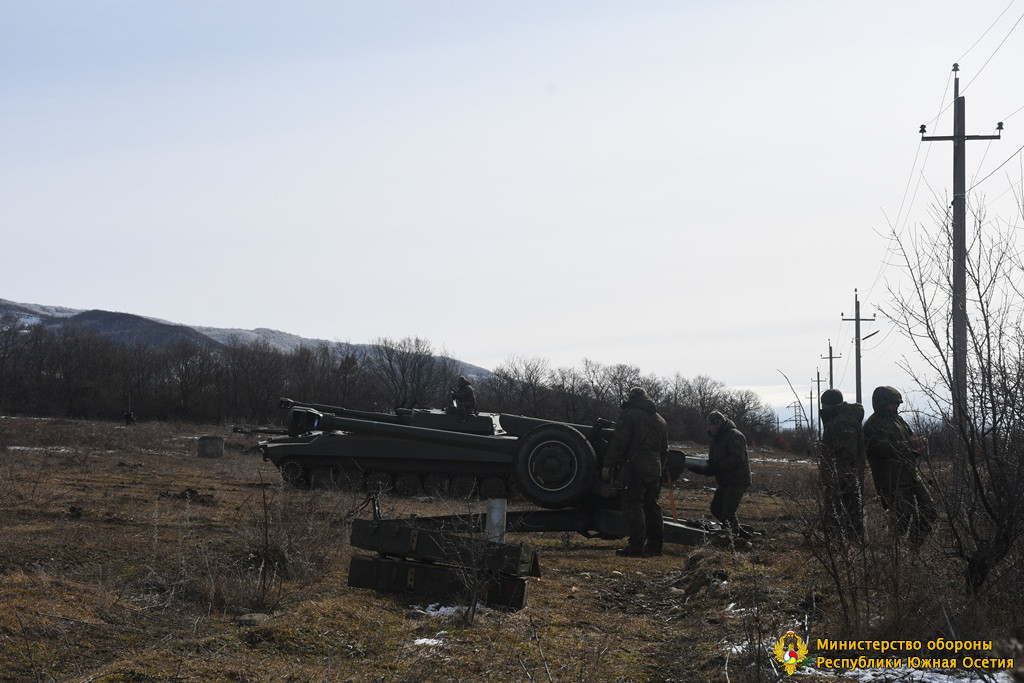
February began with artillery exercises in occupied Tskhinvali. According to the de facto Ministry of Defense, the drills were conducted “in accordance with the exercise plan” at a shooting range, and involved the use of self-propelled and towed artillery systems and mortars. Photographs released by the de facto ministry show a Soviet-made 82 mm mortar and a Soviet-produced 122 mm D-30 howitzer.
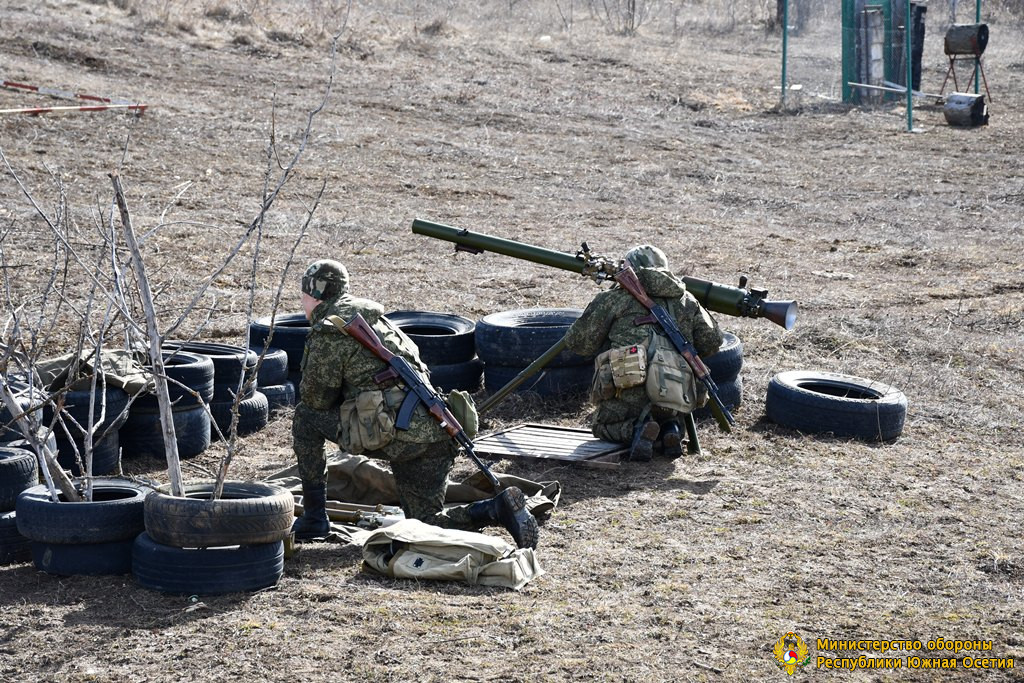
By February 11, the exercises had expanded to include the use of both small arms, artillery, and armored vehicles. Images released by the de facto Ministry of Defense depict self-propelled and towed howitzers, mortars, a BTR armored personnel carrier, and a BMP-3 infantry fighting vehicle. Yuri Yarovitsky personally attended the exercises on February 16. According to the de facto ministry, particular attention was given to the pace and quality of adoption of the new weaponry supplied by the Russian Federation, as well as to personnel familiarization with these systems. Artillery training remained a priority, involving both heavy artillery and SPG-9 grenade launchers.
Source: alaniamil.org
On February 24, the exercises focused on technical support and logistics. Assigned military personnel were tasked with preparing the technical infrastructure for combat drills scheduled for April. Activities included the maintenance and servicing of military vehicles, equipment, and weapons, ensuring their operational readiness, as well as other related support tasks. In its press release, the de facto Ministry of Defense noted that the event was being conducted “according to plan and schedule.”
On February 25, the live-fire exercises resumed. The Ossetian troops practiced identifying enemy positions and command posts using quadcopter UAVs (DJI Mavic 3 and Mavic 2), followed by directing artillery fire against the detected targets. Infantry units were also involved in these activities. On February 27, the focus shifted to infantry training, including rifle drills. At the end of the month, during a simulated exercise, the Ossetian special purpose battalion was brought to combat readiness.
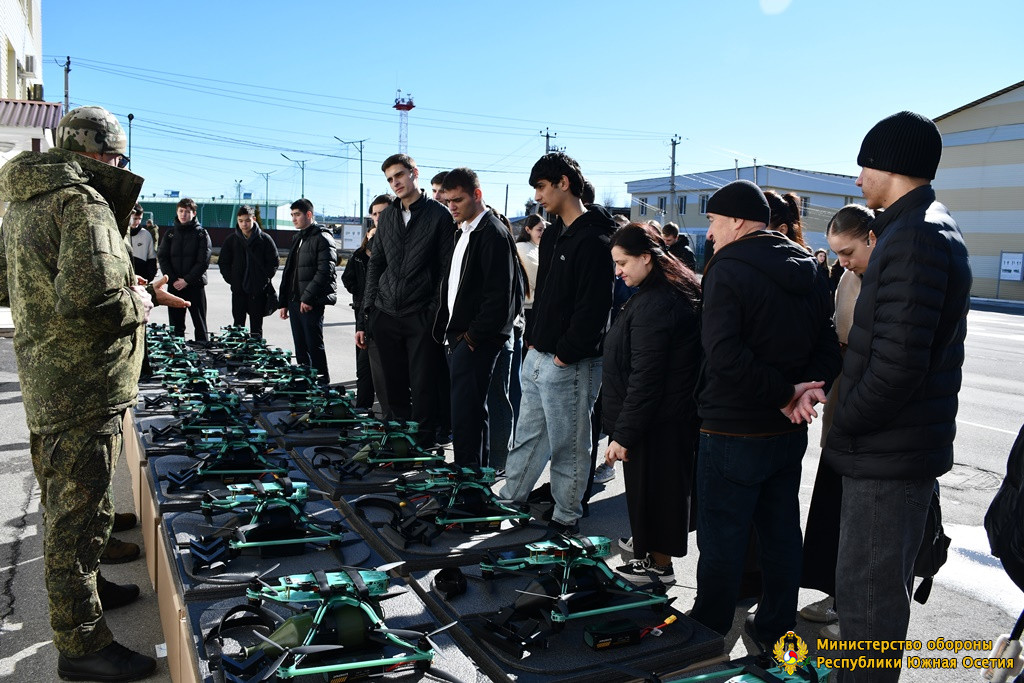
New FPV Drones Provided to Tskhinvali by Russia
Source: alaniamil.org
In February, the de facto President Alan Gagloev handed drones gifted by Russia to the so-called armed forces of “South Ossetia.” Gagloev invited school students on a school trip to view the approximately 20 FPV drones and other equipment previously transferred from Russia.
Based on the available information and released images, the FPV drones in question are operated via fiber-optic cable. This type of system first emerged in the context of the Russia–Ukraine war in early 2024, and, by 2026, has become increasingly widespread on the battlefield.
Unlike drones controlled via radio signal, fiber-optic drones transmit control commands and video through a physical fiber-optic line connecting the drone to its ground station. Because the communication link does not rely on radio frequencies, these drones are largely resistant to electronic warfare (EW) measures such as jamming or signal interception. As a result, disrupting them with conventional EW systems is unattainable.