
The independence of the Russian-occupied Georgian regions of Abkhazia and the Tskhinvali region (formerly the autonomous region of South Ossetia) has been recognized by five United Nations member states. After the 2008 Russo-Georgian War, Russia was the first to accept Abkhazia’s independence, followed by Nicaragua, Venezuela, Nauru, and Syria. In recent years, Abkhazia has developed particularly close relations with Syria and Nicaragua. In addition to regular visits from the de facto foreign minister, the so-called “ambassadors” in these countries actively participate in local events to establish and expand international connections.
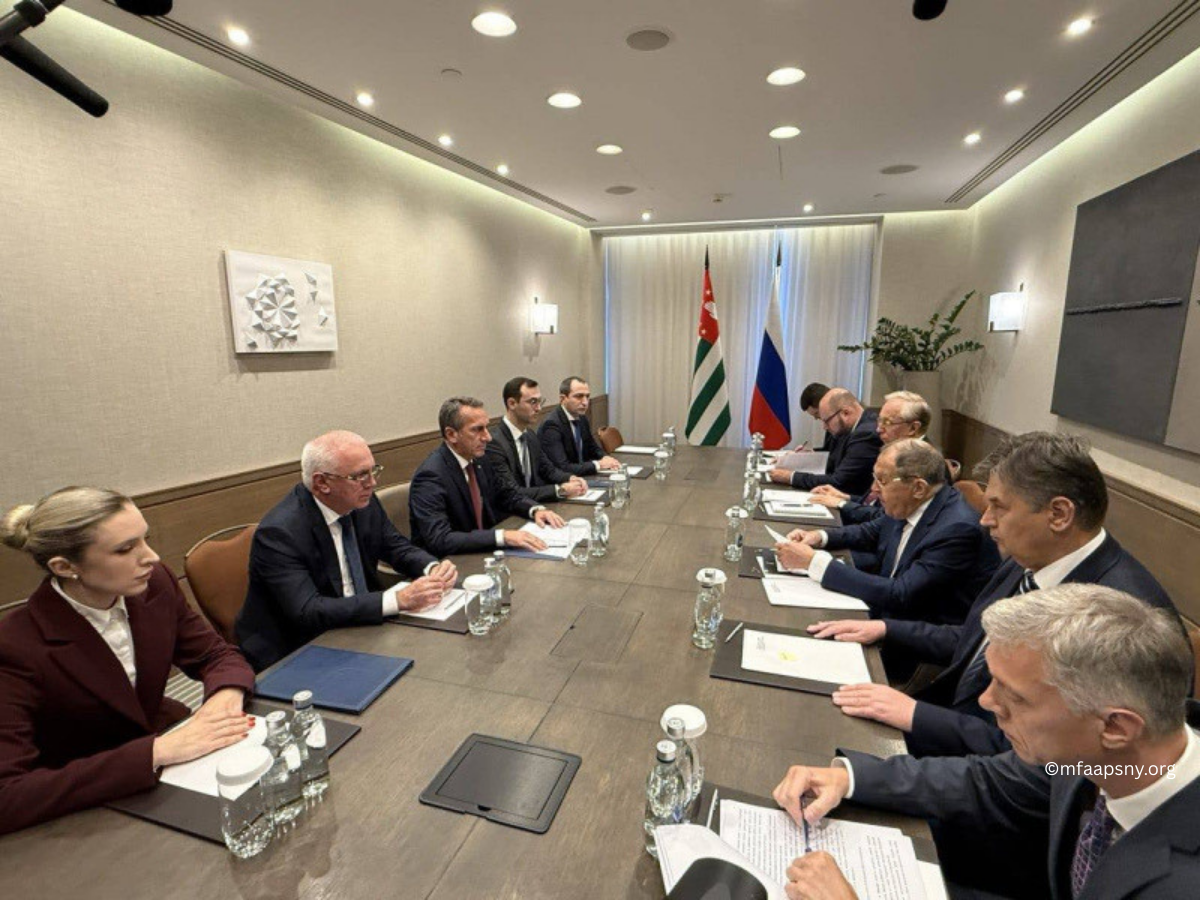
The foreign policy of occupied Abkhazia remains entirely reliant on Russia’s political, diplomatic, and logistical support. A formal legal framework regulates foreign policy cooperation between Moscow and de facto authorities in occupied Abkhazia. On October 1, 2025, in Sochi, Russian Foreign Minister Sergei Lavrov and the de facto Foreign Minister of Abkhazia, Oleg Bartsits, signed the Plan of Consultations between the Ministry of Foreign Affairs of Abkhazia and the Ministry of Foreign Affairs of the Russian Federation for 2026-2027. A comparable agreement was concluded in 2023. Previously, on October 3, 2023, Lavrov and the then de facto Foreign Minister Inal Ardzinba signed the Plan of Consultations between Diplomatic Agencies for 2024-2025.
The consultation plan includes discussions on current issues in bilateral relations, the development of a bilateral legal and contractual framework, the exchange of information regarding the foreign policy activities of both parties, the organization of joint scientific and practical seminars, conferences and round tables, and support for cultural and sporting events.
In recent years, Abkhazian diplomatic efforts have primarily focused on Latin America, the Middle East, and Southeast Asia. Moscow and Sokhumi assert that, following Venezuela and Nicaragua’s recognition of Abkhazia’s independence, another country, particularly from Latin America, could recognize Abkhazia’s independence from Georgia. Moscow continues to support Sokhumi in broadening its international relations in this context.
This article provides a concise overview of recent “foreign policy” activities conducted by the de facto authorities in occupied Abkhazia.
UN Member States Recognizing the Independence of Abkhazia
The de facto government of occupied Abkhazia maintains its most intensive diplomatic relations with Syria and Nicaragua, engages in comparatively fewer interactions with Venezuela, and sustains largely formal relations with Nauru, primarily due to geographical distance and the country’s limited size.
There has been growing concern in Sokhumi about political developments in Syria and Venezuela, as changes in leadership in these countries could lead to the withdrawal of recognition of their independence.
Syria recognized Abkhazia’s independence on May 29, 2018. Since that time, visits to Syria have primarily involved representatives of the de facto Abkhaz government. After the overthrow of the Assad regime in December 2024, de facto Foreign Minister Oleg Bartsits conducted two visits to Syria in 2025. Sokhumi’s concerns regarding a potential reassessment of bilateral relations by Syria in 2025 proved unfounded. The new Syrian government, given its ongoing relationship with Russia, has demonstrated little urgency to reverse the previous administration’s recognition of Abkhazia.
Meanwhile, Western countries have remained the principal supporters of Georgia’s policy of non-recognition. However, relations between Georgia and these Western states have deteriorated significantly under the “Georgian Dream” government in recent years. As a result, Tbilisi’s efforts to advocate for non-recognition among Western countries have become increasingly complex.
The pressure exerted by the United States on the Venezuelan government, and the detention of Venezuelan President Nicolás Maduro as a result of a U.S. military operation on January 3, 2025, were viewed negatively in Abkhazia. There is well-founded concern in Abkhazia that, if Washington’s influence in Venezuela increases, there is a high probability that Caracas will reconsider its decision to recognize Abkhazia.
Nicaragua remains a primary focus of Abkhazian “diplomatic” efforts, with anniversaries of the Sandinista Revolution offering opportunities for official visits. Supported by Russia, Abkhazian de facto leaders periodically travel to Nicaragua and seek to strengthen relations with other Latin American states. Nevertheless, the United States’ growing influence over regional countries aligned with Russia presents further obstacles to Abkhazian “diplomatic” initiatives.
Post-Soviet Countries
Among the post-Soviet states, occupied Abkhazia maintains relations with Belarus alone. A significant development in bilateral ties occurred in September 2022, when Belarusian President Alexander Lukashenko visited Abkhazia, followed by the reception of Abkhaz de facto President Aslan Bzhania in Minsk in February 2023. These high-level visits led to expectations that Belarus might recognize the independence of occupied Abkhazia. However, no further advancement in Belarus-Abkhazia relations was observed in 2024 and 2025. Recent developments in Belarus-Georgia relations, including bilateral meetings and public statements, indicate that Minsk can currently withstand Russian pressure. Belarus does not appear inclined to recognize the occupied regions and is instead seeking to maintain amicable relations with Georgia.
The Middle East
Within the region, Abkhazia demonstrates significant activity in its engagement with Turkey. Although Turkey does not recognize Abkhazia’s independence, and refrains from official meetings with representatives of the de facto government, the presence of a substantial Abkhazian diaspora in Turkey enables the Abkhazian side to visit the country and organize meetings on Turkish territory, particularly in areas inhabited by descendants of Abkhazian emigrants.
Recent observations indicate increased engagement between Iranian representatives and the occupied regions. Notably, in 2025, the 22nd session of the International Business Cooperation Council of the Chamber of Commerce and Industry of the Caspian Region Countries (“Business Caspian”) convened in Tehran on October 20-21. For the first time, with Russian support, representatives from occupied Abkhazia participated in an event on Iranian territory. Additionally, the 2024 visit of an Iranian representative to the Tskhinvali region suggests potential shifts in Tehran’s policy toward Georgia’s occupied regions.
Although Iran is unlikely to recognize Abkhazia’s independence at this stage, it is apparent that previous restrictions on contact with representatives of the occupied regions have been lifted. This development may be associated with the expanding military cooperation between Tehran and Moscow through Russia’s military aggression against Ukraine.
Southeast Asia
In Southeast Asia, the main target of Abkhazian “diplomacy” is China. Abkhazian interests in China are promoted by the so-called Honorary Consul of Abkhazia in China, Ge Zhili, who periodically visits Abkhazia. China does not officially recognize Abkhazia’s independence; however, representatives of the occupied region can participate in certain economic events. For example, in 2025, a delegation from the so-called Chamber of Commerce and Industry of occupied Abkhazia participated in the international exhibition Food2China Expo 2025, held in Guangzhou, China. The likelihood of China recognizing Abkhazia’s independence remains very low, but it has not imposed restrictions on economic relations with Abkhazia.
In 2025, the first instance of activity by occupied Abkhazia toward South Korea was recorded. On September 23, the Abkhazian-Korean Cultural Center was opened in Seoul, with the opening ceremony reportedly held at the Korean National Assembly. However, the South Korean government does not currently recognize the operation of the center, and continues to support Georgia’s territorial integrity. This development may also be linked to political changes in South Korea following the inauguration of President Lee Jae Myung in 2025, who has expressed support for pursuing more pragmatic relations with China and Russia.
Europe
Abkhazia’s engagement in Europe remains limited, and relies primarily on individual efforts. In this context, Vito Grittani, the so-called Ambassador Extraordinary and Plenipotentiary of the de facto Ministry of Foreign Affairs in Italy, has been notably active, using personal connections to advance relations. Grittani serves as a lobbyist for occupied Abkhazia in Italy, where a “representation” has operated since 2016. He frequently visits Abkhazia, including as an “observer” at illegitimate elections, and organizes events. Through his network, Grittani seeks to build relationships with Italian city officials, with contacts in Trieste in 2025 being particularly significant. Grittani last met with de facto Foreign Minister Oleg Bartsits on November 14, 2025, when Bartsits awarded him the Medal of Merit for “strengthening the positive image of the Republic of Abkhazia in Italy.”
In Germany, Hibla Amichba, who is ethnically Abkhaz, and Wolfgang Matzke, are active as self-described representatives of Abkhazia. The German government does not recognize their status, and they act as private individuals. Amichba and Matzke serve as the leading lobbyists for occupied Abkhazia in Germany, regularly organizing events. Matzke often leverages his personal connections to arrange events for the so-called Chamber of Commerce and Industry of occupied Abkhazia in Potsdam, where he promotes Abkhazia’s economic potential. Amichba frequently attends events organized by the “Eurasian Society,” which advances Russian interests.
Africa
Africa remains unengaged by Abkhazian “diplomacy,” despite longstanding hopes in Abkhazia that ties between some African countries and Russia might lead to recognition of Abkhazia’s independence. This status has not changed in recent years. In 2025, Isaac Kumesina was appointed as the so-called Ambassador Extraordinary and Plenipotentiary of the de facto Ministry of Foreign Affairs of Abkhazia to build relationships in Africa. Based primarily in Ghana, Kumesina represents and advances the interests of the occupied region in African countries.
Key Challenges Facing Abkhazia’s “Foreign Policy”
Since 2018, when Syria recognized the independence of occupied Abkhazia, the recognition policy has remained essentially unchanged, primarily due to the diplomatic efforts of Georgia’s partner countries. In 2025, for the first time, the possibility arose that UN member states that had recognized Abkhazia’s independence might withdraw their recognition. Ongoing political changes in Syria and Venezuela prompted this development. Although no such decisions have been made to date, the weakening of Russian influence in these countries may prompt a reassessment of recognition.