
Armenia’s Foreign Policy
- On December 2, 2025, Armenia and the European Union formalized a new strategic partnership agenda. The agreement was signed in Brussels after the sixth meeting of the Armenia-EU Partnership Council by Armenian Foreign Minister Ararat Mirzoyan and the European Union’s High Representative for Foreign Affairs and Security Policy, Kaja Kallas.
The document, known among the parties as the “New Agenda,” comprises over 70 pages and delineates their political commitments.
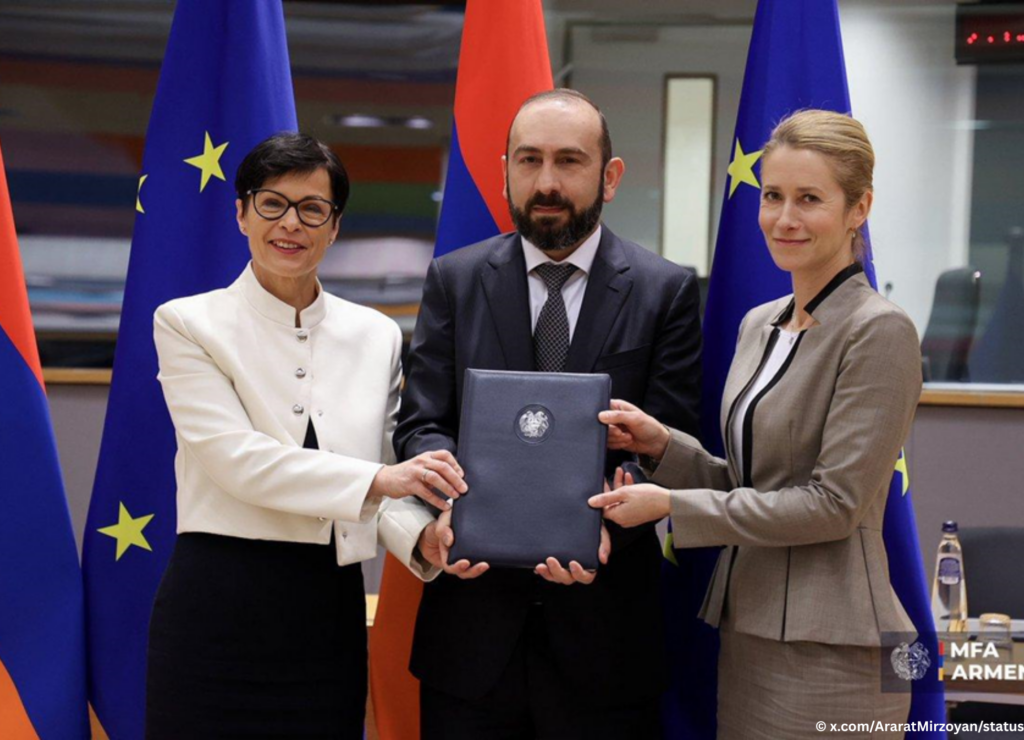
Armenian Foreign Minister Ararat Mirzoyan announced the adoption of the new strategic agenda for the Armenia-EU partnership, stating that it complements the Comprehensive and Enhanced Partnership Agreement and elevates bilateral relations to a strategic level. During the press conference following the signing, he emphasized that the Armenia-EU partnership is entering a new, more ambitious stage.
Mirzoyan further stated that the strategic partnership with the EU “is not the limit of Armenia’s ambitions,” noting that the Armenian parliament has already approved a draft law initiating the EU accession process. The first Armenia-EU summit is scheduled for May 2026.
EU High Representative for Foreign Affairs and Security Policy Kaja Kallas emphasized that the new agenda encompasses cooperation across diverse areas, including the economy, security and defense, visa liberalization, and additional sectors.
Kallas also announced the allocation of €15 million to support Armenia’s resilience. These funds will be directed toward initiatives such as enhancing demining skills, supplying equipment, and countering hybrid threats and disinformation campaigns originating from Russia and its allies.
“You are not alone in facing these challenges; we are ready to help you actively,” Kallas stated.
- Armenia has sought assistance from the European Union to address hybrid threats and malign influence in advance of the 2026 parliamentary elections, according to EU High Representative for Foreign Affairs and Security Policy Kaja Kallas, Armenpress reported.
Kallas stated, “The elections in Armenia are approaching, and the question is what assistance we can provide. They have asked us for help in combating malign influence. We have provided similar support to Moldova.”
Kallas noted that Armenia faces challenges in the information domain, but also benefits from the European Union’s support in addressing them.
- On December 9, 2025, Armenian Prime Minister Nikol Pashinyan visited Germany, where he and German Chancellor Friedrich Merz signed a declaration establishing a strategic agenda for bilateral relations.
The declaration acknowledges the long-standing friendly relations between the parties, and reaffirms their commitment to deepening bilateral cooperation. It emphasizes Armenia’s intention to enhance its relationship with the European Union, and highlights the significance of ongoing political dialogue, security assistance, and cooperation frameworks to address cyber threats. Additionally, the parties welcomed progress toward the normalization of relations between Azerbaijan and Armenia.
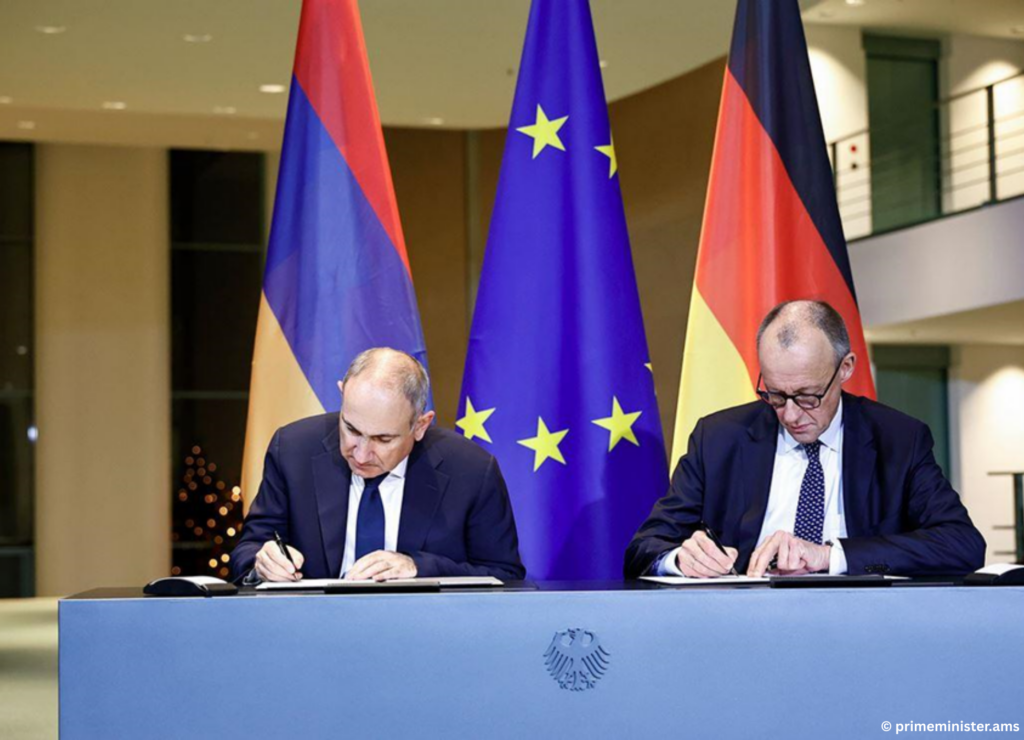
The declaration states that Armenia and Germany will collaborate in economic development, culture, education, science, technology, and innovation, as well as security and defense.
- At the National Assembly on December 15, 2025, Armenian Economy Minister Gevorg Papoyan warned that hybrid attacks against Armenia are likely. He stated, “They can put our democracy at risk, and certain circles controlling billions of dollars may try to influence the elections through fake news or voter fraud.”
“Some countries do not want Armenia to hold free, democratic elections, or to have a government chosen by its people. It is every nation’s sovereign right to protect its interests, and so it is only natural that we defend our democracy and state from such threats.”
When asked whether Russia is waging a hybrid war against Armenia or the European Union, Papoyan responded: “I did not name any specific country or region. Anyone, be it a former official, an oligarch from abroad, or any other actor who tries to influence Armenia’s elections—through fraud, bribery, fake news, or undermining democracy—must be countered. It is not only a right, but an obligation to defend democracy. To do so effectively, one must have the necessary resources and knowledge, and must act decisively at the right moment.”
When asked whether Armenia requires support from the EU in this context, Papoyan responded: “ I believe that the EU countries’ experience with democracy, shaped by their history and past successes, can be leveraged to protect them against various forms of hybrid attack. Democracy is when the people elect the government they want, and the people’s vote is not rigged. The power that receives the most votes in the elections is truly elected by the people —where bribes are not distributed, people are not intimidated, and they are not put on lists or deliberately sent to the elections—such elections are characteristic of democracy.”
In response to reports concerning the development of a Moldovan scenario in which certain parties might be excluded from participating in the elections, Papoyan stated: “I don’t know what scenario this is; I can’t comment, because I don’t know what the Moldovan scenario is.”
When asked about successful European experiences, the minister replied: “Well, if they created democracy and have continued to preserve it, this suggests they possess knowledge and mechanisms that enable democracy to protect itself. For example, when democracy in Germany failed to preserve itself, Hitler came to power.”
Armenia’s Internal Relations
- On December 4, 2025, Archbishop Arshak Khachaturian of the Armenian Apostolic Church, who has allegedly been implicated in a sex scandal within the Armenian Church, was arrested on drug-related charges.
Arsen Babayan, attorney for Arshak Khachaturian, reports that Khachaturian is accused of planting drugs in 2018 on an activist who had criticized Armenian Patriarch Garegin II, allegedly to undermine the activist’s credibility.
“A criminal case was initiated within the framework of a preliminary investigation under Articles 1 and 4 of Part 2 of Article 393 of the Criminal Code of the Republic of Armenia, which refers to illegal drug trafficking committed by a group of persons by prior agreement and in a public place,” the Investigative Committee of Armenia said.
In October 2025, an intimate video allegedly depicting Arshak Khachaturian was circulated on Armenian social networks. Authorities subsequently opened an investigation into the invasion of privacy. Khachaturian, a vocal critic of Pashinyan, called the reports “unworthy slander.”
Foreign Policy of Azerbaijan
- On December 4, 2025, during the OSCE Ministerial Council meeting in Vienna, Azerbaijani Foreign Minister Jeyhun Bayramov met with Turkish Foreign Minister Hakan Fidan.
The parties discussed security, as well as economic and trade relations, with particular emphasis on cooperation in the energy and transportation sectors.
- On December 8, 2025, Abbas Araghchi, the Foreign Minister of the Islamic Republic of Iran, visited Baku and met with Azerbaijani President Ilham Aliyev and Foreign Minister Jeyhun Bayramov.
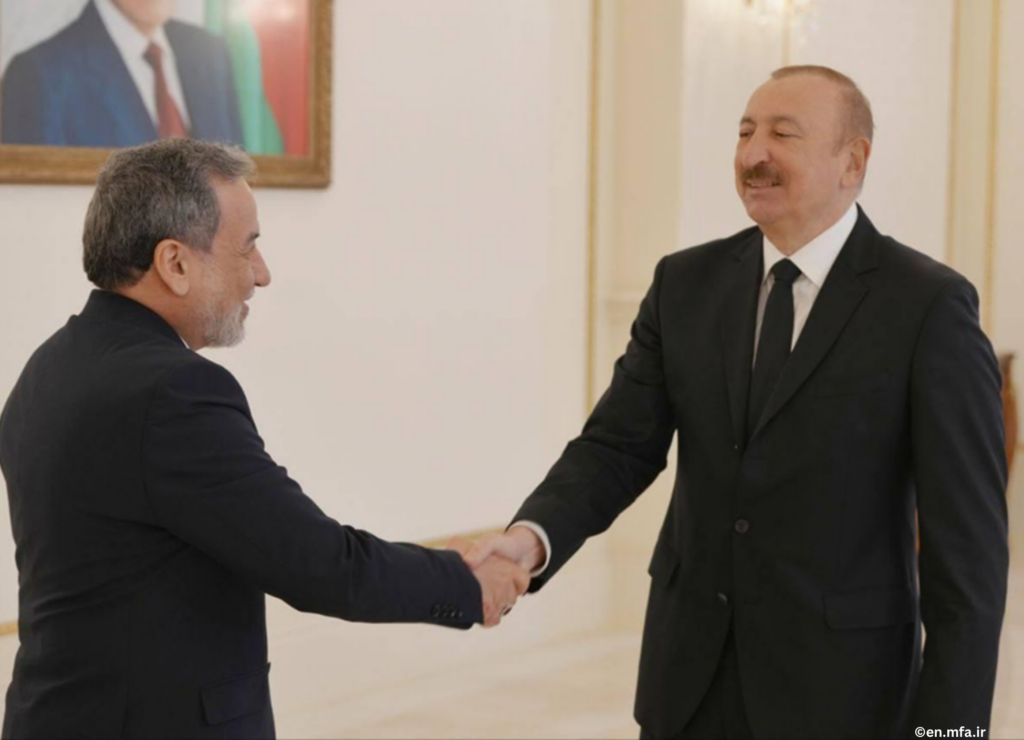
The meetings focused on bilateral relations and recent developments in the South Caucasus region.
According to Iranian media, the Iranian delegation emphasized the significance of the 3+3 format, which comprises Russia, Iran, Turkey, Azerbaijan, Armenia, and Georgia. The next 3+3 meeting is scheduled to take place in Baku, although the date has yet to be announced.
Normalization of Armenian-Azerbaijani Relations
- Armenian Economy Minister Gevorg Papoyan informed journalists in parliament that rail shipments of wheat to Armenia through Azerbaijan are ongoing.
In response to a question about wheat supplies to Armenia via Azerbaijan, Papoyan stated: “Supplies are continuing, and new batches are currently on their way.”
The minister did not specify the countries of origin for the wheat, and stated, “When the cargo arrives, I will publish data on the volume. I cannot say more at this stage.”
On November 6, 2025, a shipment of approximately 1,000 tons of Russian wheat was transported by rail from the Russian Federation to Armenia, transiting through Azerbaijan. On November 8, a similar shipment of 1,000 tons of Kazakh wheat also entered Armenia via Azerbaijan.
Previously, Azerbaijani President Ilham Aliyev had lifted all restrictions on cargo transit through Azerbaijan to Armenia. In response, Armenian Prime Minister Nikol Pashinyan welcomed the decision and stated that Armenia had also lifted all restrictions on the transportation of goods through its territory to Azerbaijan.
Normalization of Turkish-Armenian Relations
- Bloomberg reported that Turkey is considering reopening its border with Armenia within the next six months.
Following the report, Bloomberg contacted the Armenian and Turkish Foreign Ministries for official comment, but did not receive a response.