

On December 7, 2025, reports emerged indicating that the construction of a transit and logistics hub, also known as a cargo terminal, at the so-called “Enguri checkpoint” in the Gali district of Russian-occupied Abkhazia had reached its final stages. While Abkhazian and Georgian media had periodically reported on new infrastructure developments at the Enguri Bridge, the Abkhazian side issued its first public statement on the matter only on December 7. It came as a surprise to the general public. The General Director of the transit and logistics company, Astamur Akhsalba, confirmed the construction of new infrastructure at the so-called checkpoint in an interview. Despite this confirmation, significant ambiguity persists, and several questions regarding the project remain unresolved.
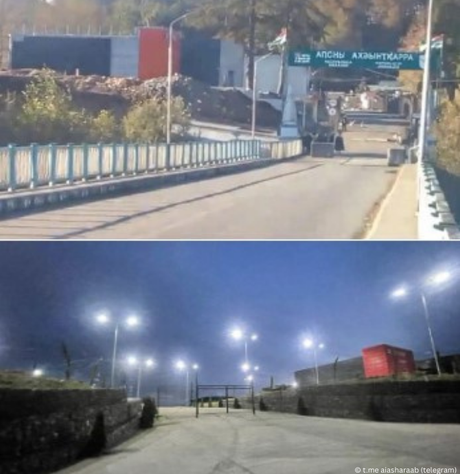
Image of a cargo terminal circulated on Abkhazian Telegram channels in October 2025
What was built?
On December 7, 2025, Astamur Akhsalba, General Director of the transit and logistics company, announced in an interview with Russian state media outlet Sputnik that construction of a joint Abkhazian-Russian transit hub in the Gali region is nearly finished. He claimed that the project is 80% complete, and the cargo terminal is currently being outfitted. Akhsalba explained that new equipment, including scanners, X-ray machines, and inspection pits, will be installed at the terminal to ensure thorough security checks for all cargo passing through the hub. He also stated that, in the initial stage, Abkhazia is projected to earn annual revenues of 300-600 million rubles from transit services.
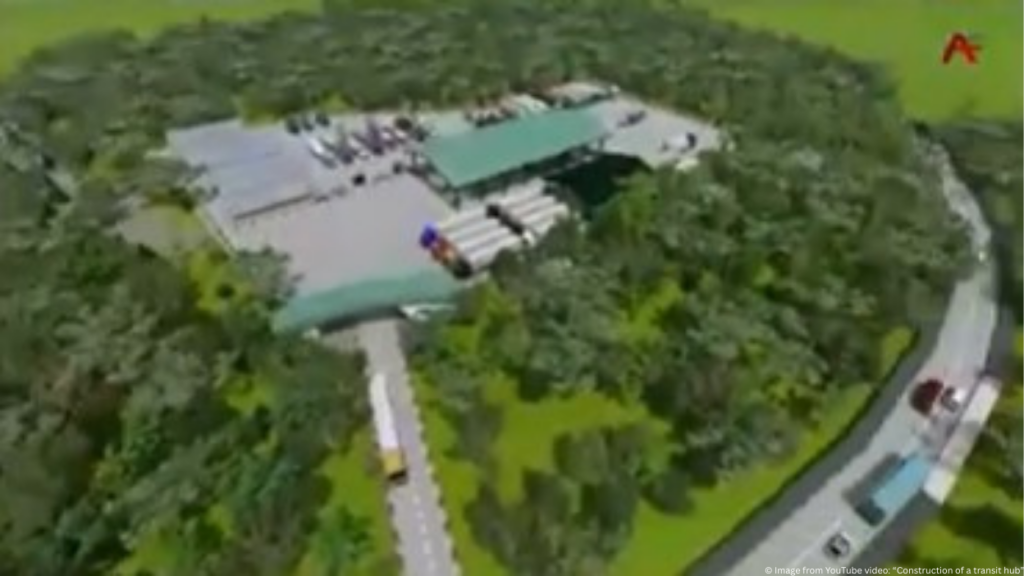
Model of a cargo terminal, image from an Abkhazian television report
Akhsalba stated that the project’s implementation is tied to a 2010-2011 agreement between Russia and Abkhazia’s customs services, which allows for transit shipments. In October 2010, Moscow and Sokhumi signed a cooperation and mutual assistance agreement on customs matters. This agreement aims to simplify the movement of goods and vehicles, enable mutual recognition of customs documents, seals, and stamps, and establish specialized customs offices on each other’s territory.
Who will use the transit route?
According to Akhsalba, the new cargo terminal is expected to serve as an alternative to the Larsi border checkpoint, the only road route connecting Russia and Georgia, which is often closed due to bad weather, and which is also prone to traffic jams. He further claimed that the terminal will facilitate cargo movement between Russia and third countries, including Iran, India, and Azerbaijan. Akhsalba placed particular emphasis on Iran.
Notably, on October 20-21, 2025, the 22nd session of the International Business Cooperation Council of the Chambers of Commerce and Industry of the Caspian Region countries (Business Caspian) took place in Tehran, and marked the first participation of representatives from occupied Abkhazia. Delegates from the so-called Chamber of Commerce and Industry of occupied Abkhazia met with leaders of the Tehran Chamber of Commerce, Industry, Mines, and Agriculture, and with the Iran-Russia Joint Chamber of Commerce. The Abkhazian delegation also held discussions with Iranian entrepreneurs and members of the Russia-Iran Business Council.
How will the transit corridor work?
As transport infrastructure in occupied Abkhazia is underdeveloped and unable to handle large cargo volumes, the transit scheme is expected to depend on both road and rail networks. Specifically, trucks will likely cross the Enguri Bridge, located on the occupation line, and be inspected at the transit and logistics hub at the so-called Enguri checkpoint. Most of these trucks are expected to deliver cargo to the container terminal near the port of Ochamchire, where goods will be transferred to railway wagons for onward shipment to Russia. The railway in occupied Abkhazia has long been active in cargo transport. In 2024, Abkhazian Railway revenues reached 586 million rubles, a sixfold increase compared to 2019. During the first 11 months of 2025, the railway transported over 1 million tons of cargo, primarily coal.
This mechanism is also expected to function in reverse. Cargo from Russia would transit through occupied Abkhazia by rail and road, cross the occupation line, and continue through Georgia to third countries. In some instances, cargo may also reach the port of Ochamchire by sea.
Akhsalba also remarked that test shipments have already taken place, both toward Russia and, in the opposite direction, toward Iran.
A central component of the transit corridor is the new infrastructure near the port of Ochamchire. In early 2025, Russia completed the construction of an intermodal container terminal about half a kilometer from the port. The terminal is designed to enable fast cargo delivery between Russia and third countries, supporting both exports and imports. The terminal measures 250 meters in length and 500 meters in width, covering an area of 1.5 hectares. It is connected to three railway lines totaling 550 meters, with platforms built for unloading cargo from rail wagons. The facility can accommodate up to 1,200 containers simultaneously.
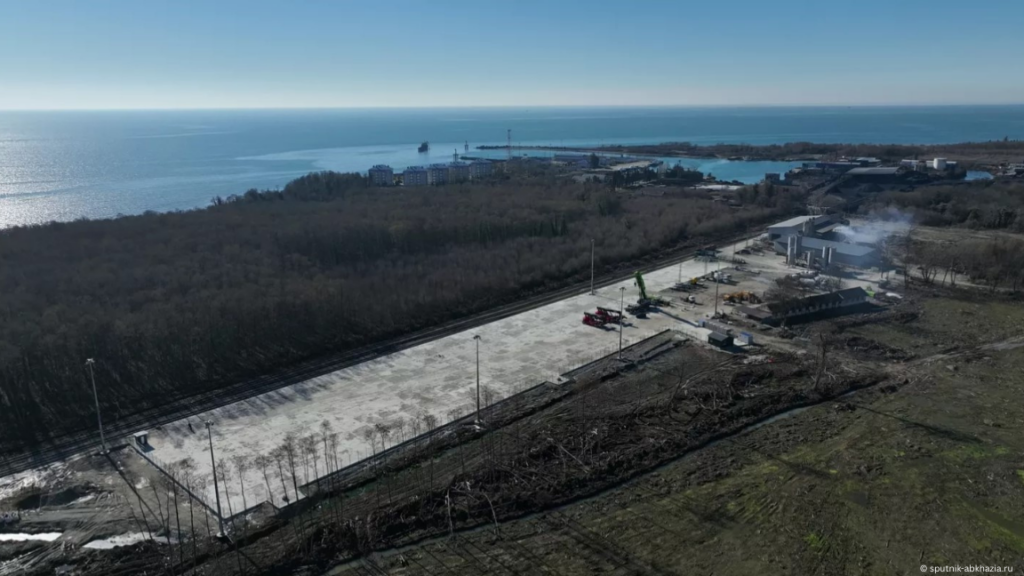
Container terminal in Ochamchire. Source: sputnik-abkhazia.ru
In July 2025, a new platform was completed at the eastern berth of the Ochamchire port. The so-called Abkhaz Maritime Administration stated that the platform is designated for large-scale mechanization equipment. Additionally, a cargo crane was installed to support the efficient handling and transport of sea containers.
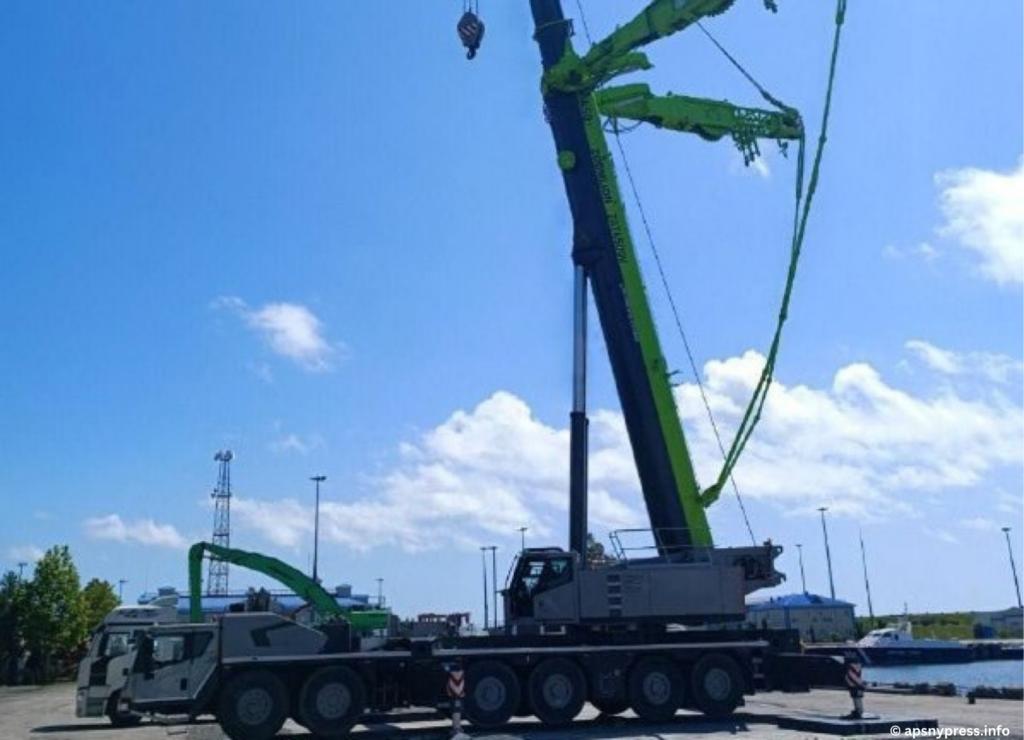
New platform at the port of Ochamchire. Source: apsnypress.info
Akhsalba stated that Abkhazia will serve solely as a transit corridor, providing logistical services for transit operations. Drivers with Georgian citizenship and vehicles bearing Georgian license plates will not be allowed to pass through Abkhazia. In such circumstances, cargo must be transferred to other vehicles permitted in the occupied region. Akhsalba suggested that this situation could change only if Tbilisi and Sokhumi reach agreements on key issues, such as Tbilisi’s commitment to the non-use of force. He also emphasized that goods produced in Georgia will not be transited through Abkhazia.
Who implemented the project?
Akhsalba explained that the idea for the project had been under consideration for several years. It gained increased significance for Russia following the launch of its so-called “special military operation” (Russia’s military aggression against Ukraine) in February 2022. Nevertheless, the project remained out of the public spotlight because of the challenging geopolitical climate.
Senior Russian officials have also openly expressed interest in Abkhazia’s transit potential. For instance, on May 12, 2023, Sergey Katyrin, President of the Russian Chamber of Commerce and Industry, told Russian media that railway transit should be incorporated into the Silk Road route connecting China, Iran, Azerbaijan and Georgia, passing through Abkhazia.
Restoring the railway route appears unlikely in the near future, but work on alternative transit and transport options is ongoing. Akhsalba noted that the container terminal in Ochamchire was built with Russian state funding, while the cargo terminal relied on private investments from Abkhaz and Russian entrepreneurs.
Akhsalba also named Andrei Belyaninov as a key supporter of the project. Belyaninov was Head of the Federal Customs Service of Russia from 2006 to 2016, and served as President of the Eurasian Development Bank from 2017 to 2020. Since 2025, he has served as Secretary General of the World Peoples Assembly, an international union of non-governmental organizations. Akhsalba leads the Abkhaz representation within the Assembly. Earlier in his career, Belyaninov worked in the First Main Directorate (foreign intelligence) of the Soviet State Security Committee (KGB). In the late 1980s, he was stationed at the Soviet Embassy in the German Democratic Republic, where, according to Russian media, he reportedly met Vladimir Putin.
What do people in Abkhazia think?
In October, before Akhsalba’s statement, critical voices on Abkhazian social media reported that construction of a cargo terminal at the so-called Enguri checkpoint had been completed. Telegram channel users questioned the purpose of opening a terminal that could facilitate contact with Georgians, who are officially considered adversaries. Some suggested the terminal’s primary function would be to boost checkpoint throughput. In contrast, pro-government channels argued that the terminal would “increase the territory’s attractiveness for international cooperation” and mark “an important step toward the region’s integration into the global economic process.”
Representatives of the de facto authorities have not issued official statements regarding the construction of the cargo terminal. Consequently, most discussion has occurred on social media. Online, Abkhazian users have questioned what fees might be imposed, what tangible benefits Abkhazia could gain, whether local road infrastructure can handle increased traffic, and how cargo will be inspected. Doubts were also expressed that Georgia and Russia would benefit from transit through Abkhazia, as the transit corridor would mainly carry sanctioned goods. Although economic relations with Georgia are approached cautiously in the occupied region, limited interaction does occur with the de facto authorities’ formal approval. For instance, following Russia’s invasion of Ukraine and subsequent sanctions, the de facto President of Abkhazia, Aslan Bzhania, issued a decree on March 31, 2023, simplifying the movement of certain goods between occupied Abkhazia and Georgian-controlled territory. The decree lists items such as crop seedlings, seeds, live poultry, pet food, agricultural machinery, equipment for agricultural production and processing, motor vehicles, auto parts, and automobile oils that may cross the so-called Enguri checkpoint under a streamlined procedure.
Tbilisi’s response
Following Sputnik’s dissemination, on 7 December 2025, of information about the development of new infrastructure at the so-called Enguri checkpoint, the Georgian government offered its first official response on 10 December, delivered by Prime Minister Irakli Kobakhidze. In addressing a journalist’s inquiry, Kobakhidze emphasized Georgia’s non-involvement in the infrastructural developments, reiterated the state’s non-recognition of the so-called border, and characterized related discourse as speculative. He further contextualized the situation by referencing a prior agreement* concluded during a previous administration, which facilitated Russia’s accession to the World Trade Organization. This agreement stipulated the establishment of a mechanism for the transit of goods, mediated by Switzerland; however, Kobakhidze noted that this process has remained dormant, with no substantive steps undertaken by the current government. He underscored the absence of any official activity or engagement regarding the matter, reaffirming that any future developments would be duly communicated.
*The 2011 World Trade Organization agreement between Russia and Georgia provided for the establishment of a complex and modern system for tracking and auditing cargo, with international trade monitoring to be carried out by a private Swiss company. The agreement envisaged the creation of three trade corridors, two of which would pass through occupied Abkhazia and the Tskhinvali region. However, the agreement was never implemented.
Obstructing factors
The facilitation of transit through the occupied territory of Abkhazia is contingent upon the explicit consent of the Georgian Dream government. Official pronouncements from Georgian Dream representatives consistently assert that “the Georgian side is not involved in the process.” Notwithstanding this publicly stated position, significant questions persist regarding the mechanisms by which the Russian Federation was able to finance and execute infrastructural projects, most notably the construction of a cargo terminal, in the absence of prior coordination or agreement with Tbilisi.
In the event that Tbilisi was to provide consent, a range of logistical and legal challenges would require careful consideration. Central among these is the potential need to amend or repeal the current Law on Occupied Territories, which imposes stringent restrictions on entry into the occupied regions and on economic operations, including rail and international road transportation.
Moreover, Akhsalba’s interview omits discussion of several salient issues, including the prospective regulatory framework governing transit through Abkhazia, oversight mechanisms for customs procedures and cargo clearance, protocols for the physical inspection of goods, and the structure of taxes or fees to be levied by the de facto authorities.
Conclusion
The construction of the cargo terminal and its possible launch raises doubts that the terminal could become a transit and logistics point between Russia and the territory controlled by the central government of Georgia.Within the prevailing geopolitical context, the project may also afford Russia a mechanism to circumvent international sanctions and reconfigure established cargo routes.