
Introduction
Russia assumed complete de jure control over the defence and security of occupied Abkhazia following the 2008 Russo-Georgian War. On 17 February 2010, Dmitry Medvedev, the then-President of the Russian Federation, and Abkhazian de facto President Sergey Bagapsh, signed an agreement “On the Russian Joint Military Base.”
Unlike in the occupied Tskhinvali region, the Abkhazian “army” was not fully integrated into the Russian Armed Forces; however, a Joint Military Group was established based on an agreement signed on 21 November 2015 that entered into force in 2016.
This article examines issues related to Abkhazia’s defence and security sector, including the so-called defence ministry, other key law-enforcement bodies, major bilateral agreements, and the role of Russia’s 7th Military Base as the region’s ultimate security guarantor.
Main Conclusions:
- The “armed forces” of occupied Abkhazia are not solely restricted to the de facto defence ministry. They include every “government body” whose personnel are permitted to carry service weapons.
- Every element of the so-called armed forces is subordinate to the de facto General Staff during wartime, which has frequently been led by high-ranking ethnic Russian military officers.
- Unlike the occupied Tskhinvali region, Abkhazian separatists did not support the full integration of the “armed forces” into the Russian Army. They also rely on unconventional guerrilla warfare methods.
- Russia created a legal basis for its military domination in the occupied territory by concluding bilateral agreements with the de facto government of Abkhazia.
- Assessments by Russian officers regarding the so-called military units of occupied Abkhazia and the Tskhinvali region are consistent. From Russia’s perspective, occupied Abkhazia should not maintain its own army; rather, its military units should be incorporated into the Russian Armed Forces.
- Immediately following the start of Russia’s full-scale invasion of Ukraine, a significant part of the military units and equipment of the Russian Army based in occupied Abkhazia were deployed to the frontline. This development caused concerns within Abkhazian political and civilian circles regarding security and the state of the “Abkhazian army.”
- Russia has been deploying the armed forces based in the occupied territories of Georgia into international conflicts since 2014.
Main Agreements Concluded between Occupied Abkhazia and the Russian Federation in the Defence Domain
The agreement “On Friendship, Cooperation, and Mutual Assistance” between “the Republic of Abkhazia” and the Russian Federation, on 17 September 2008, defined the general principles of their cooperation in the defence domain. The parties assumed responsibility for providing military assistance to each other in the event of an assault. These provisions created a legal basis for the permanent deployment of the Russian Armed Forces on the territory of occupied Abkhazia. Furthermore, according to Article 5 of this agreement, the parties committed to concluding separate agreements in the defence domain.
Based on the 17 September 2008 agreement, the parties signed the agreement “On the Russian Military Base” on the territory of “the Republic of Abkhazia” on 17 February 2010. This agreement, which is similar to the one concluded between the Russian Federation and the occupied Tskhinvali region, addresses the legal status of the military personnel, equipment, vehicles, and real estate of the Russian Armed Forces deployed in occupied Abkhazia.
On 24 November 2014, Russia and “the Republic of Abkhazia” concluded an agreement “On Alliance and Strategic Partnership.” The parties agreed to deepen relations in various fields, including through the establishment of a mutual defence domain. This mutual defence domain was specified in Article 5 of the agreement, according to which the Russian Federation and Abkhazia were obligated to create a joint military group for repelling military aggression.
Based on the agreement “On Alliance and Strategic Partnership,” the Russian Federation and “the Republic of Abkhazia” concluded the agreement “On the Creation of a Joint Military Group.” Two separate infantry battalions, an artillery battalion, an aviation group, and a special purpose unit were designated to join the Joint Military Group from the Abkhazian side.
Structure of the Armed Forces of the So-Called Republic of Abkhazia
The “Abkhazian army” is a mixed paramilitary formation created on a partially-professional basis. It includes active service members (soldiers) and, in order to increase its numbers, relies on a compulsory reserve, which in turn is formed by the “citizens” of occupied Abkhazia. The “Law on Reserve” of Abkhazia obligates its “citizens” to enlist for the reserve. The reserve constitutes a part of the armed forces and is subordinate to the General Staff of the de facto defence ministry.
The “armed forces” of Abkhazia are not solely restricted by the de facto defence ministry, but include every “government body” whose personnel are permitted to carry service weapons (firearms). These bodies are: military units of the so-called defence ministry; armed units of the so-called Ministry of Internal Affairs; units of the so-called State Security Service; special units of the so-called State Protection Service; special units of the Agency for Government Communications; and the so-called Immigration Service of the Republic of Abkhazia.
The so-called “Law on Defence” of “the Republic of Abkhazia” defines the organizational structure of the “armed forces” of Abkhazia, according to which the Commander-in-Chief of the armed forces is the “President” of Abkhazia. The so-called defence minister governs the “armed forces” through the ministry and the General Staff. The “law” further underlines that the main body for the operational command of the “defence ministry” is the General Staff, which has frequently been led by high-ranking ethnic Russian officers of the Russian Armed Forces.
The so-called “Law on Defence” states that those elements of the “armed forces” belonging to different government bodies are, during peacetime, subordinate to the de facto defence minister, who governs and leads them through the General Staff. Furthermore, the General Staff carries out the coordination of interagency exercises and joint activities, even during peacetime.
The De facto Defence Ministry
The structure of the de facto defence ministry is based on the post-Soviet model and comprises three major branches: operational planning, human resources, and logistics. Administrative and operational functions are fully delegated to the General Staff.
The de facto defence ministry is led by a minister who has five deputies: a first deputy; a deputy-chief of the General Staff; a deputy-state secretary; a deputy in charge of “material-technical assurance;” and a deputy in charge of the “preparation of preserve units and formations.”
The de facto Minister is responsible for overall oversight and, considering the political nature of this position, directs general policymaking and international co-operation. The deputies are responsible for logistics, human resources, the social insurance of personnel, and also, partially, for combat readiness. The chief of the General Staff is responsible for the operational command and planning of the “armed forces.”
Based on various sources, the central apparatus of the de facto defence ministry incorporates six departments: the Human Resources Department; the Combat Training Command Department; the Logistics and Armament Department; the Finance Department; the Military Intelligence and Counter-Intelligence Department; and the International Co-operation Department. It is worth noting that the de facto defence ministry does not operate a separate military police unit.
The de facto government of occupied Abkhazia has divided its ground forces into three districts: the Central Military District (based in Sokhumi); the Western Military District (based in Bichvinta/Pitsunda); and the Eastern Military District (based in Ochamchire). Although data on the “Abkhazian armed forces” is usually inflated in Russian open-source materials, the majority of these sources state that the overall size of the so-called armed forces does not exceed 2,200 service members, excluding the reserve.
Apart from the ground forces, the de facto defence ministry incorporates a navy and air force. The navy, like the ground forces, is deployed across three divisions: the First Division in Sokhumi, the Second Division in Bichvinta (Pitsunda), and the Third Division in Ochamchire. Reliable and updated information on the “Abkhazian navy” is scarce. Although data published before 2010 suggested it included approximately 700 service members, this number is likely inflated. The effective ground, naval, and air defence of occupied Abkhazia is ultimately ensured by the Russian Armed Forces.
The Military Reserve, and Illegal (Unregistered) Weapons among the Abkhazian Population
According to Abkhazian “legislation,” the reserve constitutes one of the most important elements of the Abkhazian “armed forces.” The functions of the reserve are regulated by the so-called laws “on Defence” and “on Reserve.”
The reservists in occupied Abkhazia previously had the right to retain automatic (battle) rifles at home; however, subsequent amendments to the “law” stripped them of this right, obligating them to submit their rifles to special locations. In the event of mobilisation, they would be able to retrieve their rifles using assigned special cards; nonetheless, it has been suggested that the majority of reservists have not submitted their automatic rifles.
The so-called “Law on Weapons” entered into force in occupied Abkhazia on 1 March 2021. The issue of illegal arms trafficking, which originated during the war in Abkhazia, remains unresolved to this date. The “law,” adopted in 2020, was the first formal attempt to regulate this issue, with Abkhazian “government officials” justifying the decision by citing increased crime rates.
Thousands of automatic (battle) rifles and other weapons that entered the territory from Russia during and after the war remained within the Abkhazian population. The separatist government has not undertaken effective legal or operative measures for the confiscation or control of illegal arms. The so-called “Law on Weapons” sets forth formal rules related to firearms that are very similar to regulations in Russia, however, this does not affect the reality of unregistered illegal firearms held among the civilian population.
There are also indications that the confiscation and control of illegal firearms was deliberately delayed by the Abkhazian political elite. Specifically, the Abkhazian separatists, unlike their “South Ossetian” counterparts, opposed the full integration of the Abkhazian military into the Russian Armed Forces, retained their own “army,” and began relying on unconventional guerrilla warfare methods, given that the “Abkhazian army” is small and ineffective. This is further substantiated by Abkhazia’s mixed “armed forces” system, which primarily relies on the reserve and volunteers to fill its numbers.
The “State Security Service” of Abkhazia
The so-called State Security Service was founded in occupied Abkhazia in December 1992. According to the so-called “Law on State Security Bodies” the head of the “State Security Service” is appointed by the de facto president of Abkhazia. The armed military units of the “State Security Service” are part of the “armed forces” of Abkhazia, and are subordinate to the General Staff of the de facto defence ministry in combat exercises and battle operations during both peacetime and wartime. The “Special-Purpose Centre” is also a component of the “State Security Service.”
The “Special-Purpose Centre” was created in occupied Abkhazia in 1998, and the first person to head the centre was the ethnic Russian Aleksandr Solopov. In October 2022, instructors from the “Special-Purpose Centre” visited the Russian-occupied Donetsk region of Ukraine to train Abkhazian mercenaries fighting for Russia. Furthermore, an ex-chief of the centre, Raul Kharabua, has been participating in the Russo-Ukrainian War since 2022.
The “State Security Service” has also been led by ex-de facto presidents of occupied Abkhazia – Raul Khajimba and Aslan Bzhania. As of 2025, the institution is being led by Dmitry Dbar – the son of ex-de facto Chief of General Staff, Sergei Dbar.
The “Ministry of Internal Affairs” of Abkhazia
The so-called Ministry of Internal Affairs consists of a central apparatus and eight territorial units. The central apparatus incorporates the Joint Centre for Information and Co-ordination of the Russian Federation and “the Republic of Abkhazia.”
The agreement “On the Joint Center for Information and Co-ordination” was signed on 18 May 2017 in Sochi, Russia. Reactions to the centre’s creation have not been homogenous in occupied Abkhazia. Nine out of thirty-four members of the “parliament” voted against ratification of the document, while two MPs were absent. Opponents of the joint centre’s establishment stated that, by creating this body, the “government had taken a step against the independence of Abkhazia”. On the contrary, supporters of the centre argued that its activities would not include active investigative measures, but would enhance the fight against crime.
Armed formations, comprising employees of the so-called Ministry of Internal Affairs, are part of the “armed forces” of Abkhazia, and are subordinate to the General Staff of the de facto defence ministry during wartime.
The “Agency for Government Communications”
The “Agency for Government Communications” was created in 1999, with its main responsibilities being to ensure communications and special means of information transfer between the so-called state bodies. The Agency is also equipped with the power to protect “state secrets,” encrypt information using cryptographic and technical means, and ensure the security of “presidential communications.” The employees of the Agency are provided with service firearms and appear to be a part of the “armed forces.”
The “State Immigration Service”
The so-called State Immigration Service was created in 2009, although it only became operational in 2011. The “State Immigration Service” is a paramilitary organisation, and its armed units are subordinate to the General Staff of the de facto defence ministry. The Service implements government policies in the field of immigration, and monitors the activities of foreign natural and legal entities to ensure they comply with local “legislation” during their presence on the occupied territory.
The Border Guard of the Federal Security Service of the Russian Federation (FSB)
The Border Guard Service of the Federal Security Service of the Russian Federation (FSB) has been in charge of the borders of occupied Abkhazia since 30 April 2009. The 160-kilometre-long land and over 200 kilometres of maritime borders are under its direct control. The FSB’s Border Guard is also part of the defence structure of occupied Abkhazia, as its employees undergo combat training on Abkhazian territory. Furthermore, the Border Guard of Abkhazia’s “State Security Service” is also involved in controlling the so-called borders, operating alongside the FSB Border Guard.
Russian 7th Military Base
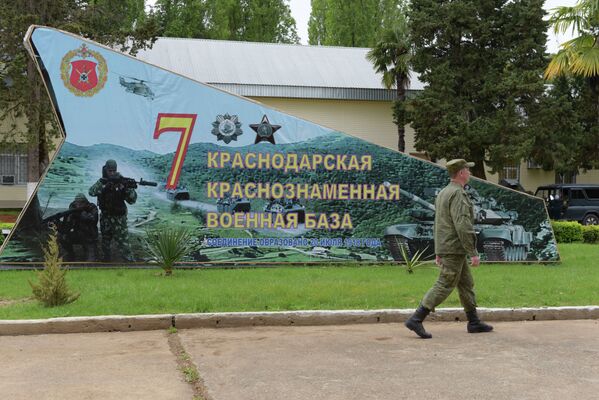
The then-President of the Russian Federation, Dmitry Medvedev, and de facto President of Abkhazia, Sergei Bagapsh, signed the agreement “On the Russian Military Base” on 17 February 2010, in Moscow, Russia. Based on this agreement, the 7th Military Base of the Russian Armed Forces was established on the territory of occupied Abkhazia. The agreement was concluded for a period of 49 years, with the possibility of extensions.
The 7th Military Base, located in occupied Abkhazia, is part of the 49th Army of the Southern Military District of the Russian Federation. Its main functions include ensuring Abkhazia’s security and protecting Russia’s interests in the South Caucasus. According to various sources, the 7th Military Base employed between 3,500 and 4,500 Russian servicemen until February 2022, however, Russia’s full-scale invasion of Ukraine significantly altered this situation.
The agreement anticipates the further development of Russia’s military infrastructure in the South Caucasus and the Black Sea region. Although the agreement was originally scheduled for conclusion in 2009, this only became feasible during Bagapsh’s second de facto presidential term. The agreement strengthens the military alliance between the parties. According to experts, Sergei Bagapsh, in demanding these types of relations, opposed Russia’s sole military dominance in occupied Abkhazia. Bagapsh also intended for all of the Russian base’s military facilities to be incorporated into Abkhazian military infrastructure, therefore ensuring a high level of co-operation and joint combat exercises between Russian and Abkhazian servicemen.
Based on the 2010 agreement, the following military formations and infrastructure became part of the Russian military base: the former “peace corps” of the Russian Federation deployed in the Gudauta region, the Bombora military base, the military range and naval access point located in Ochamchire, and the joint Russian-Abkhazian military garrisons located in the Kodori Gorge and at the Enguri Hydro-electric Power Plant. The military ranges in Gudauta, the Nagvalou village of Ochamchire, and Molkin in Krasnodar Oblast have all been used for military exercises.
The servicemen of the 7th Military Base of Russia have been participating in the war initiated by Russia in Ukraine through its satellites, the self-proclaimed People’s Republics of Donetsk and Luhansk, since the end of 2013. By 2014, it had already been confirmed that military equipment and servicemen from the 7th Military Base were being provided to separatist forces in Ukraine, including Main Battle Tanks (T-72, T-72M, T-72BM). As such, the Russian military forces deployed in the occupied parts of Georgia have been utilised in international conflicts since as early as 2014.
In 2022, shortly after the beginning of the full-scale invasion, Russia started deploying a significant portion of its equipment and servicemen from the occupied territories of Georgia to Ukraine. The military personnel of the 4th Military Base of Russia, located in the occupied Tskhinvali region, also joined the war. These developments raised concerns within Abkhazian political and civilian circles about security and the future of the “Abkhazian army.” Prior to this, it had been widely assumed that the Russian forces stationed in Abkhazia possessed sufficient capacity to deter any potential military action from Georgia.
In May 2025, the de facto Abkhazian defence minister Vladimir Anua, and Russian Defence Minister Andrey Belousov, signed a new agreement, according to which the parties would further enhance and deepen their co-operation and partnership in the defence domain. Pursuant to this agreement, the 7th Military Base will have its own general education secondary school, where the children of Russian servicemen will study alongside locals. The construction of this school was already underway in April 2025.
Military Education – Sokhumi Higher Combined-Arms Command School (СВОКУ)
The Sokhumi Higher Combined-Arms Command School, which operates under the de facto defence ministry of occupied Abkhazia, was established on 31 October 2000. This is the only military higher educational facility for officers that offers the “citizens” of Abkhazia certificates in both the higher civilian and middle-military categories.
The civilian education component includes courses on “Staff Management,” and students are awarded a “Manager” diploma. The military education includes “Management of Infantry Units” and “Management of Artillery Units.” These military programmes last four years, and graduates are awarded the rank of “Lieutenant,” after which they may consequently undertake internships as platoon commanders.
The military education available in occupied Abkhazia is restricted to this single educational facility. Servicemen seeking further education are urged to enroll in programmes at various military schools in the Russian Federation. All high-ranking ethnic Abkhazian officers are graduates of elite Russian military schools.
Thoughts on the “Abkhazian Army” in Russia
The formal establishment of the Russian military base in occupied Abkhazia meant only one thing: Russia would no longer have to operate in Abkhazia’s military domain through unconventional methods. The evidence confirms that the Russian Federation armed, organised, and trained the separatists, and maintained their operational command prior to, during, and after the war in Abkhazia.
Unlike in the occupied Tskhinvali region, ethnic Abkhazians are appointed de facto defence ministers in Abkhazia; however, this role is largely of a symbolic and formal nature. Both bilateral agreements and factual reality indicate that the Russian 7th Military Base is the dominant factor in ensuring Abkhazia’s defence, while the local “armed forces” are subordinate to the so-called General Staff.
Since 1992, apart from two separate occasions, the General Staff of the de facto defence ministry has been led by experienced ethnic Russian officers. The exceptions were Sergei Dbar, an ethnic Abkhazian high-ranking career officer of the Soviet Army, and an ethnic Kabardian, Sultan Sosnaliev. Sosnaliev, also an experienced Soviet officer, joined the war in Abkhazia as a commander of the military wing of the Confederation of Mountain Peoples of the Caucasus, and soon became the military commander of the Abkhazian separatists.
In April 2019, the first joint military exercises were held with the participation of the Abkhazian military under the supervision of Russian officers. The Russian officers highlighted the poor performance of the Abkhazian servicemen, stating that they were completely incapable of waging a war. According to the officers, problematic issues included a lack of discipline and the need to restructure/reorganise the Abkhazian defence system. In the same year, the agreement on the modernisation of the “Abkhazian army” was signed, with the process to be funded by Russia.
A similar situation occurred in the occupied Tskhinvali region in 2010, when the then-de facto defence minister, ethnic Russian Valery Yakhnovets publicly highlighted the Ossetian military’s poor performance. He stated that the Ossetians possessed no theoretical knowledge and would be unable to defend their territory – a function that had to be carried out by Russia. The media outlet Ekho Kavkaza also reported with similar assessments.
According to the ex-Chief of the Main Directorate of the International Military Co-operation of the Russian Federation, Leonid Ivashov: “Abkhazia’s rearmament is a pointless measure that will bring no benefit. This issue requires a radical approach – units consisting of local military personnel must be created within the ranks of the Russian Army. Currently, the Abkhazian armed forces are not combat-ready, and are predominantly a paramilitary formation rather than a regular army.”
The assessments from Russian officers and officials regarding the Abkhazian and “South Ossetian” separatist military formations are consistent. While the so-called Ossetian army was effectively abolished, Russia’s agreement, concluded with Abkhazia in 2016, anticipated the incorporation of a separate Abkhazian military formation into the ranks of the Russian Army, with the remainder of the “Abkhazian army” left with territorial defence and reserve functions.