
The digest covers China’s political, diplomatic, economic and other activities in the South Caucasus region and relations between China and the South Caucasus countries. It relies on a wide variety of sources, including the Chinese media. It is worth noting that the Chinese media is controlled by the Chinese Communist Party (according to the World Press Freedom Index, China is nearly at the bottom of the list and ranks 178nd out of 180 countries).
China-Armenia strategic partnership
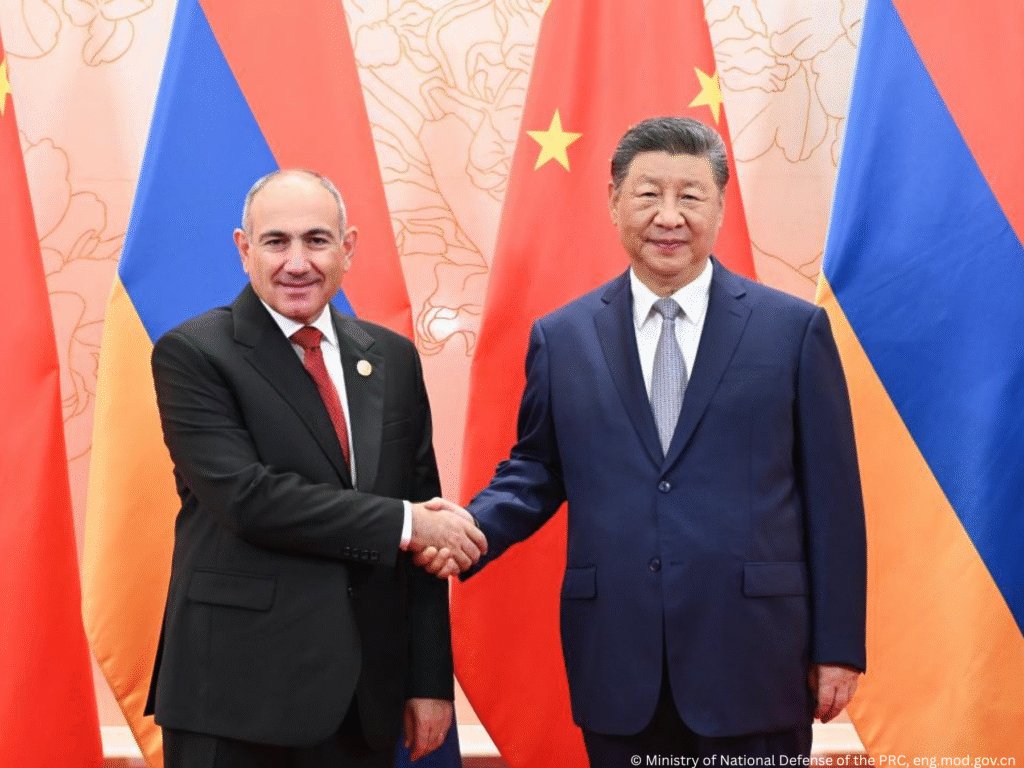
A meeting between Nikol Pashinyan and Xi Jinping. Source: Xinhua/Xie Huanchi/Ministry of National Defense of the People’s Republic of China
On August 31, the CCP leader Xi Jinping and Armenian Prime Minister Nikol Pashinyan announced the establishment of a strategic partnership between the two countries during their meeting in Tianjin, China, ahead of the Shanghai Cooperation Organization Summit 2025.
Later, the text of the China-Armenia strategic partnership agreement was published.
“The Parties respect the development paths chosen by the other side in accordance with national characteristics and independent decision-making in bilateral relations policy,” the agreements stated.
The Armenian side expressed support for “the one-China principle, recognizing that there is but one China in the world and Taiwan is an inalienable part of China’s territory and that the Government of the People’s Republic of China is the sole legal government representing the whole of China.” Armenia “firmly opposes any form of ’Taiwan independence‘ and supports the efforts being made by China towards the national reunification”.
The Chinese side confirmed its “firm support for the political independence, sovereignty, territorial integrity and inviolability of borders of the Republic of Armenia”. China also expressed support for the peace agenda proposed by the Armenian side and welcomed Yerevan’s “Crossroads of Peace” initiative.
The Parties expressed their readiness to strengthen high-level political dialogue, to convene regular political consultations between the Ministries of Foreign Affairs of the two countries “and to expand communication between central and local authorities, as well as between political parties for the purpose of exchanging experience and strengthening collaboration”.
The two sides noted that they attached “great importance” to the further cooperation between the legislative bodies of the two countries and emphasised “the importance of parliamentary diplomacy in fostering bilateral political dialogue”.
They also stressed the need to further develop communication mechanisms between the governments of Armenia and China to exchange views on development and security issues.
The two governments expressed readiness to strengthen cooperation and exchange in the legal and judicial spheres, “based on equality, mutual benefit and mutual respect”.
In the statement, they expressed their readiness to strengthen law enforcement and security cooperation, “to exert joint efforts toward countering terrorism, separatism, extremism, cybercrime and other types of transnational crimes”.
Armenia welcomed the participation of Chinese companies in the infrastructure projects in Armenia.
They also expressed their willingness to strengthen exchanges and cooperation with “the aim of expanding the trade and investment potential in such areas as infrastructure, information technologies, renewable energy sources, agriculture, industry, etc”, as well as their readiness to further increase mutual investments to strengthen cooperation in such areas as industry, information and telecommunications, agriculture, energy, and others.
According to the statement, Armenia and China are interested in promoting cooperation in the fields of science and technology, education and language exchanges.
The two sides emphasised “the importance of cooperation” in the fields of information technology, innovation and artificial intelligence, and expressed their readiness to promote the establishment of incubation centres, science and technology parks, innovation centres and joint research centres, with Armenia’s “Engineering City” and “Academic City” projects as possible platforms for cooperation.
They also expressed their readiness to deepen cooperation in health, employment, social security, sports and youth and strengthen exchanges in fields including film, media and think tanks.
Armenia and China also expressed interest in the exchange of experience in fields including cybersecurity and combating hybrid threats.
The statement said that the Parties stayed committed to defending the UN-centred international system.
“The Parties stand ready to continue to strengthen cooperation within the framework of the UN, support each other in playing a greater role in international and regional affairs, join hands in promoting an equal and orderly multipolar world and a mutually beneficial and inclusive economic globalization and jointly promote the building of a new type of international relations and a community with a shared future for humanity,” the agreement noted.
The Armenian side welcomed the Global Development Initiative, the Global Security Initiative and the Global Civilisation Initiative promoted by the Chinese leadership.
Both governments agreed to strengthen policy coordination as well as the synergy between development plans within the framework of the Belt and Road Initiative (BRI), and bring their Belt and Road cooperation “to a new stage of high-quality development, for the benefit of the two countries and their peoples. Armenia, as one of the first countries to participate in Belt and Road cooperation, stands ready to work with China to actively promote the implementation of relevant cooperation projects under the BRI and the ’Crossroads of Peace‘ initiative and ensure the safe and successful progress of these projects”.
The Chinese side welcomed the Armenian side’s desire to strengthen cooperation with the Shanghai Cooperation Organization (SCO), and pledged support to Armenia in improving its legal status in the SCO.
The Armenian side expressed support for the fundamental principles of the SCO, such as “mutual respect for sovereignty, independence and territorial integrity, non-violation of national borders, mutual non-aggression, non-interference in internal affairs and non-use of force or threat of its use in international relations.”
The Chinese side welcomed Armenia’s membership in the Asian Infrastructure Investment Bank (AIIB).
On September 1, Armenian Prime Minister Nikol Pashinyan participated in the SCO+ format meeting of the Shanghai Cooperation Organization Summit in Tianjin, China, and delivered a speech.
He noted that with the support of the President of the United States Donald Trump they had adopted a Declaration of Peace with the President of Azerbaijan, and initialed the Agreement on Peace and Interstate Relations between Armenia and Azerbaijan.
He also expressed his belief that the concept of the Global Governance Initiative put forward by Xi Jinping was “appreciable, especially in the context of the importance of preserving and strengthening the multiplex system based on the UN Charter and its core principles,” saying that the Armenian side supported Xi Jinping’s initiative.
Nikol Pashinyan, together with his wife Anna Hakobyan, also attended a parade in Beijing marking the 80th anniversary of the end of World War II.
On September 6, Armenia’s state news agency Armenpress and China’s Xinhua News Agency signed a new cooperation agreement, aiming to expand cooperation, enhance the process of news exchange and contribute to closer ties between the two peoples.
The Armenian side emphasised that in accordance with the agreement, the two agencies would engage in the exchange of materials and photographs, undertake professional exchange visits, maintain regular communication on areas of mutual interest, and extend reciprocal support in the preparation of media content.
The cooperation between Armenpress and Xinhua was first established in 2009.
Armenia and China strengthen high-tech collaboration
On August 22, Armenia’s Minister of High-Tech Industry Mkhitar Hayrapetyan met with China’s Ambassador to Armenia Li Xinwei, discussing science, innovation and technology, with particular attention to space technologies, cybersecurity, digitalisation and the technology industry. Hayrapetyan expressed confidence that the Chinese side would contribute to the expansion of cooperation in the field of high technologies. The two sides highlighted the importance of high-level mutual visits and opportunities to expand cooperation within the framework of international organisations.
- On August 25, the Chinese Embassy in Armenia solemnly marked the victory “of the Chinese and Soviet armies over Japanese aggression in World War II”.
Chinese Ambassador Li addressed the guests: “The world is undergoing profound global changes and stands at a historic turning point. The direction of our future depends on the choices we make today and our ability to make the right choices depends on how accurately we understand history. The purpose of today’s gathering is to learn from history and build a common future”.
He told the Armenian attendees: “You once fought shoulder to shoulder with us for world peace and today we must work together to build a community with a shared future for mankind.”
- On September 2, the Ministry of Education, Science, Culture and Sports of Armenia and the Ministry of Culture and Tourism of China signed a cultural cooperation program for 2026-2029.
The two sides discussed the possibilities of organising joint cultural days, implementing joint programs within the framework of international organisations and initiatives, exchanging specialists, as well as “sharing experience and knowledge in preservation and restoration of cultural values”.
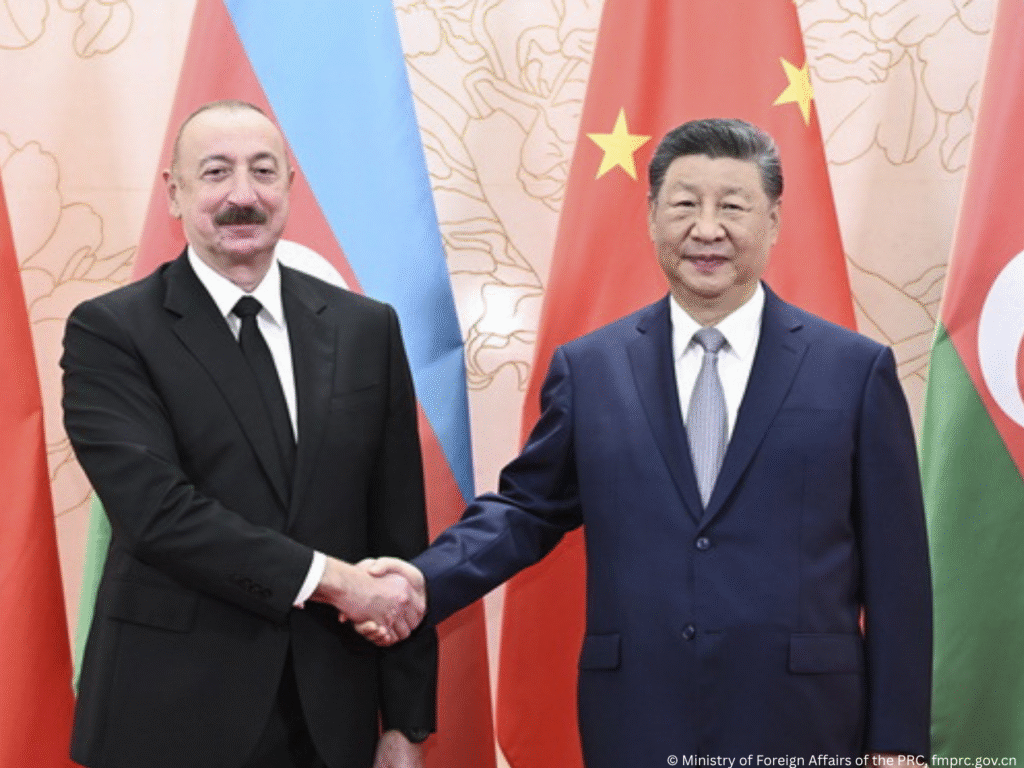
A meeting between Ilham Aliyev and Xi Jinping. Source: Ministry of Foreign Affairs of the People’s Republic of China
On August 31, Xi Jinping met with Azerbaijani President Ilham Aliyev in Tianjin.
Xi emphasised the need for the two sides to strengthen development strategy alignment and pursue “high-quality Belt and Road cooperation”. He also emphasised accelerating trade and investment liberalisation and facilitation, and enhancing the efficiency of the Trans-Caspian International Transport Route.
Xi also called for expanding cooperation in traditional areas such as infrastructure, agriculture and energy, “while fostering new growth drivers in emerging areas including the digital economy, green development and artificial intelligence.”
He noted that both China and Azerbaijan should also step up exchanges in education, science and technology, culture, tourism, youth and local-level interactions to pool resources and cement public support for bilateral relations.
Azerbaijan expressed firm adherence to the one-China principle and readiness to deepen cooperation with China in various fields.
The two sides signed multiple bilateral cooperation documents covering areas including artificial intelligence, scientific and technological innovation, finance, and media.
SCO
On August 31, during the meeting between Xi and Aliyev, China gave its support to Azerbaijan in joining the SCO, and expressed readiness to “enhance multilateral coordination with Azerbaijan in a joint effort to safeguard the common interests of the Global South and advance the building of a community with a shared future for humanity”.
Azerbaijan expressed willingness to deepen cooperation with China within the SCO and jointly contribute to peace and development in the region and the world.
On September 5, Apa reported that, according to diplomatic sources, Azerbaijan’s blocked SCO membership was discussed during political consultations between Russia and India, and an agreement was reached. “Russia reportedly allowed India to take the lead in the process while it remained in the background,” Apa reported.
On September 4, a Memorandum of Understanding was signed between the Central Bank of the Republic of Azerbaijan and the People’s Bank of China.
They plan to work together on organising meetings, seminars and business visits to address issues related to monetary policy, the financial sector, payment systems and financial technologies.
Aliyev’s meetings with Chinese companies
- On August 31, Aliyev met with the CEO of China Electronics Technology Group Corporation (CETC) Zhu Peng in Tianjin, China.
The meeting involved an exchange of views on cooperation in areas such as “modernising the national governance system and management capabilities through digital technologies, developing the digital economy, ensuring national network security, cybersecurity and data applications”.
- On August 31, Ilham Aliyev also met with the Chairman of the China Communications Construction Company Song Hailiang in Tianjin, Azernews reports.
The two sides also exchanged views on the development of the Trans-Caspian transport corridor and the participation of CCCC in the second phase of the Baku International Sea Port project.
Song Hailiang noted that the company would present conceptual proposals regarding the cleaning and rehabilitation of lakes on the Absheron Peninsula.
- On August 25, the Export and Investment Promotion Agency of the Republic of Azerbaijan (AZPROMO) hosted a meeting with a Chinese delegation led by the Deputy Director General of the Liaoning Provincial Foreign Affairs Office Zhao Hongbin.
They discussed possible regional cooperation opportunities in the fields of industry and agriculture with Liaoning Province.
- On August 22, the Prime Minister of Azerbaijan Ali Asadov held a meeting with the President of the China Road and Bridge Corporation (CRBC) Wang Lijun where they explored opportunities for cooperation with the CRBC.
- On September 2, Aliyev met with the Chairman of the China National Chemical Engineering Corporation Limited (CNCEC) Mo Dingge, in Tianjin.
They exchanged views on cooperation between Azerbaijan and the company across the petrochemical industry, oil refining activities and the manufacturing of petrochemical products.
The Framework Agreement signed between the State Oil Company of the Republic of Azerbaijan (SOCAR) and the China National Chemical Engineering and Construction Corporation “Seven LTD” was exchanged. The document envisages the implementation of joint projects in Azerbaijan and third countries.
Anaklia and the Middle Corridor
On August 18, the Chinese Ambassador to Georgia Zhou Qian said that without the joint participation of China and Europe, the success of the Middle Corridor initiative would be difficult to achieve.
Regarding the Anaklia Port project, the Chinese Ambassador said that a consortium of Chinese companies was engaged in active negotiations with the Georgian side.
“We welcome and support more Chinese companies entering Georgia in the future to invest and cooperate in new energy resources, tourism and other fields, through which China will contribute to Georgia’s economic and social development,” Zhou said.
According to BPN, the Ambassador of China to Georgia also stated that some Chinese companies were interested in Georgian e-commerce platforms for used cars and were considering acquiring them.
Georgia not invited to China’s Victory Day
No one from Georgia was invited to China’s Victory Day parade.
Georgian Dream Prime Minister Irakli Kobakhidze tried to explain why Georgia had not been invited to the parade in China. “The Shanghai Cooperation Organisation Summit is being held in China and it is within the framework of this summit that leaders of certain countries are currently in China; they are also attending the parade,” Kobakhidze said.
However, this statement is not accurate. The invitation criteria were not based on SCO participation. India, a member of the SCO, was not invited to the parade, while, for example, Slovakia was.
26 leaders were invited, mostly from Asia, but from all five continents, including those of Armenia and Azerbaijan. From the European leaders, only the Prime Minister of Slovakia Robert Fico was invited. Orbán was not present, but a representative of the Hungarian Government and Minister of Foreign Affairs and Trade Péter Szijjártó was.
Georgian Dream representative criticises the US Helsinki Commission while defending ties with China
- On September 10, Georgian Dream Mayor of Tbilisi Kakha Kaladze, while responding to the statement issued by the Helsinki Commission, which states that “Georgia is deepening relations with China and other rivals of the United States”, said the following: “For Georgia, strategic partnership and economic cooperation with China is very important”, while the “agents” and “enemies of the country, ruled from the outside carry out all the instructions they are told and instructed, considering the interests of external forces”.
- On September 3, Kaladze also criticised the US Helsinki Commission ahead of the planned hearing regarding Georgia: “…As for relations with China, strategic ties with this country are very important. Other countries around the world strive to have friendly relations with China. Utilising the opportunities that China offers is significant. Georgia will do everything to deepen our relations further and bring our economies closer together. The statements of certain congressmen are based on lies and contain slander”.
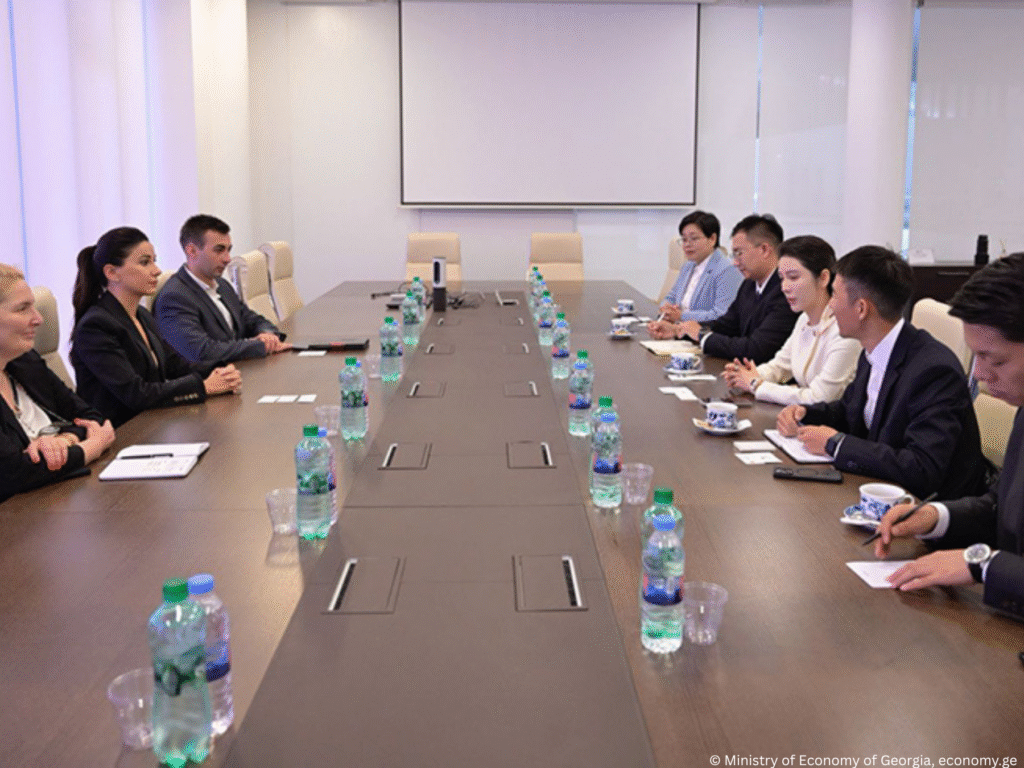
A meeting between the Chinese company Zhongbo Group representatives and Mariam Kvrivishvili. Source: Ministry of Economy and Sustainable Development of Georgia
On August 14, Georgian Dream Minister of Economy Mariam Kvrivishvili met with the representatives of the Chinese company Zhongbo Group. The Chinese side noted they had a great interest in studying in depth and making significant investments in different sectors of renewable energy in Georgia.